

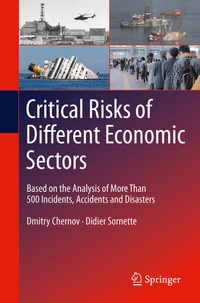
Critical Risks of Different Economic Sectors
Description

This book explores the major differences between the kinds of risk encountered in different sectors of industry - production (including agriculture) and services - and identifies the main features of accidents within different industries.
Because of these differences, unique risk-mitigation measures will need to be implemented in one industry that cannot be implemented in another, leading to large managerial differences between these broad economic sectors.
Based on the analysis of more than 500 disasters, accidents and incidents - around 230 cases from the production sector and around 280 cases from the service sector - the authors compare the risk response actions appropriate within different sectors, and establish when and how it is possible to generalize the experience of dealing with risks in any given industry to a wider field of economic activity.This book is mainly intended for executives, strategists, senior risk managers of enterprise-wide organizations and risk management experts engaged in academic or consulting work. By setting out clearly the sector differences in risk management, the authors aim to improve the practice of general risk assessment with regard to identifying and prioritizing risks, and of risk control with regard to planning appropriate mitigation measures.
More details
Other editions
Additional editions
Persons
Didier Sornette is Professor on the Chair of Entrepreneurial Risks at ETH Zurich, also a professor of the Swiss Finance Institute, and is associated with both the departments of Physics and of Earth Sciences at ETH Zurich. He is also a fellow of the AAAS among many other titles and memberships. Prof. Sornette is a passionate researcher in complex system and extreme risks. He uses rigorous data-driven mathematical statistical analyses combined with nonlinear multi-variable dynamical models including positive and negative feedbacks to study the predictability and control of crises and extreme events in complex systems, with applications to all domains of science and practice, including earthquake predictions, financial bubbles and crashes, nuclear risk, cyber risk, social networks, medical sciences.
