

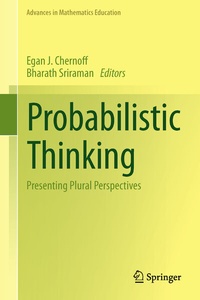
Probabilistic Thinking
Description

This volume provides a necessary, current and extensive analysis of probabilistic thinking from a number of mathematicians, mathematics educators, and psychologists. The work of 58 contributing authors, investigating probabilistic thinking across the globe, is encapsulated in 6 prefaces, 29 chapters and 6 commentaries. Ultimately, the four main perspectives presented in this volume (Mathematics and Philosophy, Psychology, Stochastics and Mathematics Education) are designed to represent probabilistic thinking in a greater context.
More details
Other editions
Additional editions
Content
SERIES PREFACE: Gabriele Kaiser and Bharath Sriraman.- ACKNOWLEDGEMENTS.- FOREWORD: Keith Devlin.- INTRODUCTION: Egan Chernoff and Bharath Sriraman.- PERSPECTIVE I: MATHEMATICS AND PHILOSOPHY.- Preface to Perspective I: Mathematics and Philosophy: Egan Chernoff and Gale Russell.- I.I. A historical and philosophical perspective on probability: Manfred Borovcnik and Ramesh Kapadia.- I.II. From puzzles and paradoxes to concepts in probability: Manfred Borovcnik and Ramesh Kapadia.- I.III. Three approaches for modeling situation with randomness: Andreas Eichler and Markus Vogel.- I.IV. A modeling perspective on probability: Maxine Pfannkuch and Ilze Ziedins.- Commentary on Perspective I: Mathematics and Philosophy: Bharath Sriraman and Kyeong-Hwa Lee.- PERSPECTIVE II: PSYCHOLOGY.- Preface to Perspective II: Psychology : Wim van Dooren.- II.I. Statistical thinking: no child left behind: Björn Meder and Gerd Gigerenzer.- II.II. The A-B-C of probabilistic literacy: Laura Martignon.- II.III. Intuitive conceptions of probability and the development of basic math skills: Gary Brase, Sherri Martinie and Carlos Castillo-Garsow.- II.IV. Testing a model on probabilistic reasoning: Francesca Chiesi and Caterina Primi.- II.V. Revisiting the medical diagnosis problem: reconciling intuitive and analytical thinking: Lisser Rye Ejersbo and Uri Leron.- II.VI. Rethinking probability education: perceptual judgment as epistemic resource: Dor Abrahamson.- II.VII. Sticking to your guns: a flawed heuristic for probabilistic decision-making: Deborah Bennett.- II.VIII. Developing probabilistic thinking: what about peoples' conceptions: Annie Savard.- Commentary I on Perspective II: Psychology : Brian Greer.- Commentary II on Perspective II: Psychology: Richard Lesh and Bharath Sriraman.- PERSPECTIVE III: STOCHASTICS.- Preface to Perspective III: Stochastics: Bharath Sriraman and Egan Chernoff.- III.I. Prospective primary school teachers' perception of randomness: CarmenBatanero, Pedro Arteaga, Luis Serrano and Blanca Ruiz.- III.II. Challenges of developing coherent probabilistic reasoning: rethinking randomness and probability from a stochastic perspective: Luis Saldanha and Yan Liu.- III.III. "It is very, very random because it doesn't happen very often": examining learners' discourse on randomness: Simin Jolafee, Rina Zazkis and Nathalie Sinclair.- III.IV. Developing a modelling approach to probability using computer-based simulations: Theodosia Prodromou.- III.V. Promoting statistical literacy through data modelling in the early school years: Lyn D. English.- III.VI. Learning Bayesian statistics in adulthood: Wolff-Michael Roth.- Commentary on Perspective III: Stochastics: Mike Shaughnessy.- PERSPECTIVE IV: MATHEMATICS EDUCATION.- Preface to Perspective IV: Mathematics Education: Bharath Sriraman and Egan Chernoff.- IV.I. A practitional perspective on probabilistic thinking models and frameworks: Edward S. Mooney, Cynthia Langrall and Joshua T. Hertel.- IV.II. Experimentation in probability teaching and learning: Per Nilsson.- IV.III. Investigating the dynamics of stochastic learning processes: Susanne Prediger and Susanne Schnell.- IV.IV. Counting as a foundation for learning to reason about probability: Carolyn A. Maher and Anoop Ahluwalia.- IV.V. Levels of probabilistic reasoning of high school students about binomial problems: Ernesto Sánchez and Pedro Rubén Landín.- IV.VI. Children's construction of sample space with respect to the law of large numbers: Efi Paparistodemou.- IV.VII. Researching conditional probability problem solving: Pedro Huerta.- IV.VIII. Real life experiences as hindrance in probabilistic situations: Ami Mamolo and Rina Zazkis.- IV.IX. Influence of culture on high school students' probabilistic thinking: Sashi Sharma.- IV.X. Primary school students' attitudes to and beliefs about probability: Steven Nisbet and Anne Williams.- Commentary on Perspective IV: Mathematics Education: JaneWatson.- COMMENTARY on Probabilistic Thinking: Presenting Plural Perspectives: Egan Chernoff and Bharath Sriraman.- AUTHOR INDEX.- SUBJECT INDEX.
