

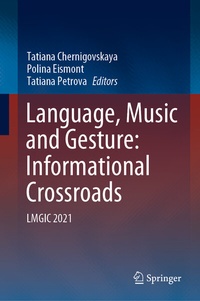
Language, Music and Gesture: Informational Crossroads
Description

This book brings together selected revised papers representing a multidisciplinary approach to language, music, and gesture, as well as their interaction. Among the number of multidisciplinary and comparative studies of the structure and organization of language and music, the presented book broadens the scope with the inclusion of gesture problems in the analyzed spectrum. A unique feature of the presented collection is that the papers, compiled in one volume, allow readers to see similarities and differences in gesture as an element of non-verbal communication and gesture as the main element of dance. In addition to enhancing the analysis, the data on the perception and comprehension of speech, music, and dance in regard to both their functioning in a natural situation and their reflection in various forms of performing arts makes this collection extremely useful for those who are interested in human cognitive abilities and performing skills.
The book begins with a philosophical overview of recent neurophysiological studies reflecting the complexity of higher cognitive functions, which references the idea of the baroque style in art being neither linear nor stable. The following papers are allocated into 5 sections. The papers of the section "Language-Music-Gesture As Semiotic Systems" discuss the issues of symbolic and semiotic aspects of language, music, and gesture, including from the perspective of their notation. This is followed by the issues of "Language-Music-Gesture Onstage" and interaction within the idea of the "World as a Text." The papers of "Teaching Language and Music" present new teaching methods that take into account the interaction of all the cognitive systems examined. The papers of the last two sections focus on issues related primarily to language: The section "Verbalization Of Music And Gesture" considers the problem of describing musical text and non-verbal behavior with language, and papers in the final section "Emotions In Linguistics And Ai-Communication Systems" analyze the ways of expressing emotions in speech and the problems of organizing emotional communication with computer agents.
More details
Other editions
Additional editions
Persons
Polina Eismont is an Associate Professor at the Department of General Linguistics, St. Petersburg State University. Her research interests include Language Acquisition and Psycholinguistics, Text Linguistics, Cognitive Linguistics, Event Structure, Music Semantics, Syntax of Nulls. She obtained her Ph.D. from St. Petersburg State University in 2008. She isthe author of more than 40 papers in domestic and international journals and the co-editor of two CCIS volumes "Language, Music, and Computing" (Springer Verlag, 2015, 2019).
Tatiana Petrova is an Associate Professor at the Department of Theory and Methodology for Teaching Arts and Humanities, and the leading researcher of the Institute for Cognitive Studies, St. Petersburg State University. Her research interests include Psycholinguistics and Neurolinguistics, Text Processing, Second Language Acquisition, Context Predictability, Reading and Visual Recognition. She obtained her Ph.D.from St. Petersburg State University in 2000. She is the author of more than 80 papers in domestic and international journals and the co-author of two online courses on Coursera. In the past 10 years, she has been coordinating the work of the St. Petersburg Seminar on cognitive Research. She also organizes St. Petersburg Winter Workshops on Experimental Studies of Speech and Language (2011, 2014, 2015, 2018, 2019), serving as a member of Program Committee.
