

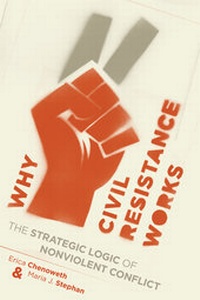
Why Civil Resistance Works
The Strategic Logic of Nonviolent Conflict
1st Edition
Published on 9. August 2011
320 pages
978-0-231-52748-4 (ISBN)
Description

For more than a century, from 1900 to 2006, campaigns of nonviolent resistance were more than twice as effective as their violent counterparts in achieving their stated goals. By attracting impressive support from citizens, whose activism takes the form of protests, boycotts, civil disobedience, and other forms of nonviolent noncooperation, these efforts help separate regimes from their main sources of power and produce remarkable results, even in Iran, Burma, the Philippines, and the Palestinian Territories.
Combining statistical analysis with case studies of specific countries and territories, Erica Chenoweth and Maria J. Stephan detail the factors enabling such campaigns to succeed and, sometimes, causing them to fail. They find that nonviolent resistance presents fewer obstacles to moral and physical involvement and commitment, and that higher levels of participation contribute to enhanced resilience, greater opportunities for tactical innovation and civic disruption (and therefore less incentive for a regime to maintain its status quo), and shifts in loyalty among opponents' erstwhile supporters, including members of the military establishment.
Chenoweth and Stephan conclude that successful nonviolent resistance ushers in more durable and internally peaceful democracies, which are less likely to regress into civil war. Presenting a rich, evidentiary argument, they originally and systematically compare violent and nonviolent outcomes in different historical periods and geographical contexts, debunking the myth that violence occurs because of structural and environmental factors and that it is necessary to achieve certain political goals. Instead, the authors discover, violent insurgency is rarely justifiable on strategic grounds.
Combining statistical analysis with case studies of specific countries and territories, Erica Chenoweth and Maria J. Stephan detail the factors enabling such campaigns to succeed and, sometimes, causing them to fail. They find that nonviolent resistance presents fewer obstacles to moral and physical involvement and commitment, and that higher levels of participation contribute to enhanced resilience, greater opportunities for tactical innovation and civic disruption (and therefore less incentive for a regime to maintain its status quo), and shifts in loyalty among opponents' erstwhile supporters, including members of the military establishment.
Chenoweth and Stephan conclude that successful nonviolent resistance ushers in more durable and internally peaceful democracies, which are less likely to regress into civil war. Presenting a rich, evidentiary argument, they originally and systematically compare violent and nonviolent outcomes in different historical periods and geographical contexts, debunking the myth that violence occurs because of structural and environmental factors and that it is necessary to achieve certain political goals. Instead, the authors discover, violent insurgency is rarely justifiable on strategic grounds.
All prices
More details
Other editions
Additional editions
Erica Chenoweth | Maria Stephan
Why Civil Resistance Works
The Strategic Logic of Nonviolent Conflict
Book
12/2012
Columbia University Press
€27.50
Shipment within 10-20 days
Erica Chenoweth | Maria Stephan
Why Civil Resistance Works
The Strategic Logic of Nonviolent Conflict
Book
08/2011
Columbia University Press
€76.75
Shipment within 10-20 days
Persons
Erica Chenoweth is an assistant professor at the Josef Korbel School of International Studies at the University of Denver and an Associate Senior Researcher at the Peace Research Institute of Oslo. Previously she taught at Wesleyan University and held fellowships at Harvard, Stanford, and the University of California at Berkeley.
Maria J. Stephan is a strategic planner with the U.S. Department of State. Formerly she served as director of policy and research at the International Center on Nonviolent Conflict (ICNC) and as an adjunct professor at Georgetown University and American University. She has also been a fellow at the Kennedy School of Government's Belfer Center for Science and International Affairs.
Maria J. Stephan is a strategic planner with the U.S. Department of State. Formerly she served as director of policy and research at the International Center on Nonviolent Conflict (ICNC) and as an adjunct professor at Georgetown University and American University. She has also been a fellow at the Kennedy School of Government's Belfer Center for Science and International Affairs.
Content
List of Illustrations
List of Tables
Acknowledgments
Part I. Why Civil Resistance Works
1. The Success of Nonviolent Resistance Campaigns
2. The Primacy of Particpation in Nonviolent Resistance
3. Exploring Alternative Explanations for the Success of Civil Resistance
Part II. Case Studies
Introduction to the Case Studies
4. The Iranian Revolution, 1977--1979
5. The First Palestinian Intifada, 1987--1992
6. The Philippine People Power Movement, 1983--1986
7. Why Civil Resistance Sometimes Fails: The Burmese Uprising, 1988--1990
Case Study Summary
Part III. The Implications of Civil Resistance
8. After the Campaign: The Consequences of Violent and Nonviolent Resistance
9. Conclusion
Epilogue
Appendix
Notes
References
Index
List of Tables
Acknowledgments
Part I. Why Civil Resistance Works
1. The Success of Nonviolent Resistance Campaigns
2. The Primacy of Particpation in Nonviolent Resistance
3. Exploring Alternative Explanations for the Success of Civil Resistance
Part II. Case Studies
Introduction to the Case Studies
4. The Iranian Revolution, 1977--1979
5. The First Palestinian Intifada, 1987--1992
6. The Philippine People Power Movement, 1983--1986
7. Why Civil Resistance Sometimes Fails: The Burmese Uprising, 1988--1990
Case Study Summary
Part III. The Implications of Civil Resistance
8. After the Campaign: The Consequences of Violent and Nonviolent Resistance
9. Conclusion
Epilogue
Appendix
Notes
References
Index
Read an excerpt from the chapter, >The Success of Nonviolent Resistance Campaigns.
