

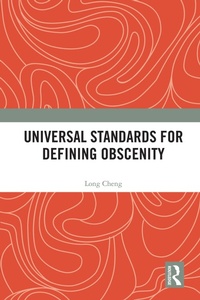
Universal Standards for Defining Obscenity
1st Edition
Published on 31. March 2025
182 pages
978-1-040-34353-1 (ISBN)
Description

In the existing literature, there is no universal standard for defining obscenity. The book aims to demonstrate that there indeed exist underlying universal standards for defining obscenity (USDOs). However, their application to different contexts of time, place, and culture, may legitimately result in varied manifestations.
The author examines a definition of obscenity proposed by the political and legal theorist Harry M. Clor, within John Finnis' natural law theoretical framework. He also explores how positive law, including legislation, case law, and customary law, should respond to the proposed USDOs. The book addresses the theoretical foundation of the determination and regulation of obscenity, and it is supplemented with examples of legal practices from several jurisdictions, such as the United States, the United Kingdom, Canada, and Germany.
The book will appeal to scholars of legal philosophy, natural law theories, obscenity law, and free speech.
The author examines a definition of obscenity proposed by the political and legal theorist Harry M. Clor, within John Finnis' natural law theoretical framework. He also explores how positive law, including legislation, case law, and customary law, should respond to the proposed USDOs. The book addresses the theoretical foundation of the determination and regulation of obscenity, and it is supplemented with examples of legal practices from several jurisdictions, such as the United States, the United Kingdom, Canada, and Germany.
The book will appeal to scholars of legal philosophy, natural law theories, obscenity law, and free speech.
Reviews / Votes
"CHENG Long's insightful work applies New Natural Law theory and Harry Clor's scholarship to develop a universal definition of obscenity. A groundbreaking contribution, it offers valuable guidance for jurists and scholars navigating the complexities of legal and philosophical inquiry. Highly recommended."Professor Stephen Hall, The Chinese University of Hong Kong
"At last a book that treats obscenity and pornography as harms and wrongs appropriate for a fully theorised analysis. Long Cheng's deep-going treatment can be completed by identifying the relevant basic human (and social!) good (inadequately identified in my Natural Law and Natural Rights until its Postscript): marriage, the commitment of a man and a woman to a friendship of a kind suitable for procreation and upbringing of children-a commitment which marital sexual intercourse enables them to express, experience and actualise, provided they exclude from their imaginations any willingness to engage in non-marital sex-an exclusion undermined by the obscene and pornographic."
Prof. John Finnis, University of Oxford and University of Notre Dame
More details
Edition
1. Auflage
Language
English
Place of publication
London
United Kingdom
Publishing group
Taylor & Francis Ltd
Target group
College/higher education
Professional and scholarly
File size
0,40 MB
ISBN-13
978-1-040-34353-1 (9781040343531)
Copyright in bibliographic data and cover images is held by Nielsen Book Services Limited or by the publishers or by their respective licensors: all rights reserved.
Schweitzer Classification
Other editions
Additional editions
Long Cheng
Universal Standards for Defining Obscenity
Book
approx. 07/2026
1st Edition
Routledge
€57.50
Not yet published

Long Cheng
Universal Standards for Defining Obscenity
Book
05/2025
Routledge
Unfortunately, price unknown
Available (delivery time upon request)
Long Cheng
Universal Standards for Defining Obscenity
Book
03/2025
1st Edition
Routledge
€207.20
Shipment within 15-20 days
Person
Long Cheng is an assistant professor at the School of Law, Shandong University. His research interests include constitutional law, jurisprudence, natural law theories, and international law.
Content
1 Introduction 2 Defining Obscenity 3 Universal Standards for Defining Obscenity (USDOs) 4 Derivation of Positive Law from Natural Law 5 The Determinatio Framework of the SRPRO
