

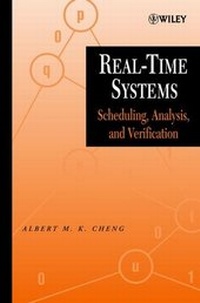
Real-Time Systems
Scheduling, Analysis, and Verification
Published on 13. March 2003
552 pages
978-0-471-46084-8 (ISBN)
Description

The first book to provide a comprehensive overview of the subject rather than a collection of papers.
* The author is a recognized authority in the field as well as an outstanding teacher lauded for his ability to convey these concepts clearly to many different audiences.
* A handy reference for practitioners in the field.
Reviews / Votes
"The author provides a substantial, up-to-date overview of theverification and validation process..." (ComputerMagazine, November 2004) "The unifying discussion on the formal analysis and verificationmethods are especially valuable and enlightening, both for graduatestudents and researchers." (International Journal of GeneralSystems, December 2003)More details
Other editions
Additional editions

Software
03/2003
Wiley
€191.32
Shipment within 10-20 days
Book
08/2002
Wiley
€187.50
Shipment within 10-20 days
Person
ALBERT M. K. CHENG, PhD, received his doctorate in computer science from the University of Texas at Austin, where he held a GTE Foundation Doctoral Fellowship. He is currently an associate professor in the department of computer science at the University of Houston, where he is the founding director of the Real-Time Systems Laboratory. He is the author and coauthor of over sixty refereed publications, and has received numerous awards, including the NSF Career award. He has served as a technical consultant for several organizations, including IBM, and has served on the program committees of many conferences.
Content
PREFACE.
LIST OF FIGURES.
1 INTRODUCTION.
1.1 What Is Time?
1.2 Simulation.
1.3 Testing.
1.4 Verification.
1.5 Run-Time Monitoring.
1.6 Useful Resources.
2 ANALYSIS AND VERIFICATION OF NON-REAL-TIME SYSTEMS.
2.1 Symbolic Logic.
2.2 Automata and Languages.
2.3 Historical Perspective and Related Work.
2.4 Summary.
Exercises.
3 REAL-TIME SCHEDULING AND SCHEDULABILITY ANALYSIS.
3.1 Determining Computation Time.
3.2 Uniprocessor Scheduling.
3.3 Multiprocessor Scheduling.
3.4 Available Scheduling Tools.
3.5 Available Real-Time Operating Systems.
3.6 Historical Perspective and Related Work.
3.7 Summary.
Exercises.
4 MODEL CHECKING OF FINITE-STATE SYSTEMS.
4.1 System Specification.
4.2 Clarke-Emerson-Sistla Model Checker.
4.3 Extensions to CTL.
4.4 Applications.
4.5 Complete CTL Model Checker in C.
4.6 Symbolic Model Checking.
4.7 Real-Time CTL.
4.8 Available Tools.
4.9 Historical Perspective and Related Work.
4.10 Summary.
Exercises.
5 VISUAL FORMALISM, STATECHARTS, AND STATEMATE.
5.1 Statecharts.
5.2 Activity-Charts.
5.3 Module-Charts.
5.4 STATEMATE.
5.5 Available Tools.
5.6 Historical Perspective and Related Work.
5.7 Summary.
Exercises.
6 REAL-TIME LOGIC, GRAPH-THEORETIC ANALYSIS, AND MODECHART.
6.1 Specification and Safety Assertions.
6.2 Event-Action Model.
6.3 Real-Time Logic.
6.4 Restricted RTL Formulas.
6.5 Checking for Unsatisfiability.
6.6 Efficient Unsatisfiability Check.
6.7 Industrial Example: NASA X-38 Crew Return Vehicle.
6.8 Modechart Specification Language.
6.9 Verifying Timing Properties of Modechart Specifications.
6.10 Available Tools.
6.11 Historical Perspective and Related Work.
6.12 Summary.
Exercises.
7 VERIFICATION USING TIMED AUTOMATA.
7.1 Lynch-Vaandrager Automata-Theoretic Approach.
7.2 Alur-Dill Automata-Theoretic Approach.
7.3 Alur-Dill Region Automaton and Verification.
7.4 Available Tools.
7.5 Historical Perspective and Related Work.
7.6 Summary.
Exercises.
8 TIMED PETRI NETS.
8.1 Untimed Petri Nets.
8.2 Petri Nets with Time Extensions.
8.3 Time ER Nets.
8.4 Properties of High-Level Petri Nets.
8.5 Berthomieu-Diaz Analysis Algorithm for TPNs.
8.6 Milano Group's Approach to HLTPN Analysis.
8.7 Practicality: Available Tools.
8.8 Historical Perspective and Related Work.
8.9 Summary.
Exercises.
9 PROCESS ALGEBRA.
9.1 Untimed Process Algebras.
9.2 Milner's Calculus of Communicating Systems.
9.3 Timed Process Algebras.
9.4 Algebra of Communicating Shared Resources.
9.5 Analysis and Verification.
9.6 Relationships to Other Approaches.
9.7 Available Tools.
9.8 Historical Perspective and Related Work.
9.9 Summary.
Exercises.
10 DESIGN AND ANALYSIS OF PROPOSITIONAL-LOGIC RULE-BASED SYSTEMS.
10.1 Real-Time Decision Systems.
10.2 Real-Time Expert Systems.
10.3 Propositional-Logic Rule-Based Programs: the EQL Language.
10.4 State-Space Representation.
10.5 Computer-Aided Design Tools.
10.6 The Analysis Problem.
10.7 Industrial Example: Analysis of the Cryogenic Hydrogen Pressure Malfunction Procedure of the Space Shuttle Vehicle Pressure Control System.
10.8 The Synthesis Problem.
10.9 Specifying Termination Conditions in Estella.
10.10 Two Industrial Examples.
10.11 The Estella-General Analysis Tool.
10.12 Quantitative Timing Analysis Algorithms.
10.13 Historical Perspective and Related Work.
10.14 Summary.
Exercises.
11 TIMING ANALYSIS OF PREDICATE-LOGIC RULE-BASED SYSTEMS.
11.1 The OPS5 Language.
11.2 Cheng-Tsai Timing Analysis Methodology.
11.3 Cheng-Chen Timing Analysis Methodology.
11.4 Historical Perspective and Related Work.
11.5 Summary.
Exercises.
12 OPTIMIZATION OF RULE-BASED SYSTEMS.
12.1 Introduction.
12.2 Background.
12.3 Basic Definitions.
12.4 Optimization Algorithm.
12.5 Experimental Evaluation.
12.6 Comments on Optimization Methods.
12.7 Historical Perspective and Related Work.
12.8 Summary.
Exercises.
BIBLIOGRAPHY.
INDEX.
LIST OF FIGURES.
1 INTRODUCTION.
1.1 What Is Time?
1.2 Simulation.
1.3 Testing.
1.4 Verification.
1.5 Run-Time Monitoring.
1.6 Useful Resources.
2 ANALYSIS AND VERIFICATION OF NON-REAL-TIME SYSTEMS.
2.1 Symbolic Logic.
2.2 Automata and Languages.
2.3 Historical Perspective and Related Work.
2.4 Summary.
Exercises.
3 REAL-TIME SCHEDULING AND SCHEDULABILITY ANALYSIS.
3.1 Determining Computation Time.
3.2 Uniprocessor Scheduling.
3.3 Multiprocessor Scheduling.
3.4 Available Scheduling Tools.
3.5 Available Real-Time Operating Systems.
3.6 Historical Perspective and Related Work.
3.7 Summary.
Exercises.
4 MODEL CHECKING OF FINITE-STATE SYSTEMS.
4.1 System Specification.
4.2 Clarke-Emerson-Sistla Model Checker.
4.3 Extensions to CTL.
4.4 Applications.
4.5 Complete CTL Model Checker in C.
4.6 Symbolic Model Checking.
4.7 Real-Time CTL.
4.8 Available Tools.
4.9 Historical Perspective and Related Work.
4.10 Summary.
Exercises.
5 VISUAL FORMALISM, STATECHARTS, AND STATEMATE.
5.1 Statecharts.
5.2 Activity-Charts.
5.3 Module-Charts.
5.4 STATEMATE.
5.5 Available Tools.
5.6 Historical Perspective and Related Work.
5.7 Summary.
Exercises.
6 REAL-TIME LOGIC, GRAPH-THEORETIC ANALYSIS, AND MODECHART.
6.1 Specification and Safety Assertions.
6.2 Event-Action Model.
6.3 Real-Time Logic.
6.4 Restricted RTL Formulas.
6.5 Checking for Unsatisfiability.
6.6 Efficient Unsatisfiability Check.
6.7 Industrial Example: NASA X-38 Crew Return Vehicle.
6.8 Modechart Specification Language.
6.9 Verifying Timing Properties of Modechart Specifications.
6.10 Available Tools.
6.11 Historical Perspective and Related Work.
6.12 Summary.
Exercises.
7 VERIFICATION USING TIMED AUTOMATA.
7.1 Lynch-Vaandrager Automata-Theoretic Approach.
7.2 Alur-Dill Automata-Theoretic Approach.
7.3 Alur-Dill Region Automaton and Verification.
7.4 Available Tools.
7.5 Historical Perspective and Related Work.
7.6 Summary.
Exercises.
8 TIMED PETRI NETS.
8.1 Untimed Petri Nets.
8.2 Petri Nets with Time Extensions.
8.3 Time ER Nets.
8.4 Properties of High-Level Petri Nets.
8.5 Berthomieu-Diaz Analysis Algorithm for TPNs.
8.6 Milano Group's Approach to HLTPN Analysis.
8.7 Practicality: Available Tools.
8.8 Historical Perspective and Related Work.
8.9 Summary.
Exercises.
9 PROCESS ALGEBRA.
9.1 Untimed Process Algebras.
9.2 Milner's Calculus of Communicating Systems.
9.3 Timed Process Algebras.
9.4 Algebra of Communicating Shared Resources.
9.5 Analysis and Verification.
9.6 Relationships to Other Approaches.
9.7 Available Tools.
9.8 Historical Perspective and Related Work.
9.9 Summary.
Exercises.
10 DESIGN AND ANALYSIS OF PROPOSITIONAL-LOGIC RULE-BASED SYSTEMS.
10.1 Real-Time Decision Systems.
10.2 Real-Time Expert Systems.
10.3 Propositional-Logic Rule-Based Programs: the EQL Language.
10.4 State-Space Representation.
10.5 Computer-Aided Design Tools.
10.6 The Analysis Problem.
10.7 Industrial Example: Analysis of the Cryogenic Hydrogen Pressure Malfunction Procedure of the Space Shuttle Vehicle Pressure Control System.
10.8 The Synthesis Problem.
10.9 Specifying Termination Conditions in Estella.
10.10 Two Industrial Examples.
10.11 The Estella-General Analysis Tool.
10.12 Quantitative Timing Analysis Algorithms.
10.13 Historical Perspective and Related Work.
10.14 Summary.
Exercises.
11 TIMING ANALYSIS OF PREDICATE-LOGIC RULE-BASED SYSTEMS.
11.1 The OPS5 Language.
11.2 Cheng-Tsai Timing Analysis Methodology.
11.3 Cheng-Chen Timing Analysis Methodology.
11.4 Historical Perspective and Related Work.
11.5 Summary.
Exercises.
12 OPTIMIZATION OF RULE-BASED SYSTEMS.
12.1 Introduction.
12.2 Background.
12.3 Basic Definitions.
12.4 Optimization Algorithm.
12.5 Experimental Evaluation.
12.6 Comments on Optimization Methods.
12.7 Historical Perspective and Related Work.
12.8 Summary.
Exercises.
BIBLIOGRAPHY.
INDEX.
