

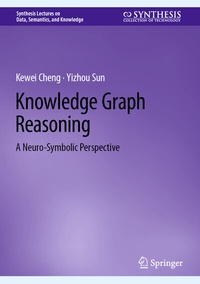
Knowledge Graph Reasoning
Description

This book provides a coherent and unifying view for logic and representation learning to contribute to knowledge graph (KG) reasoning and produce better computational tools for integrating both worlds. To this end, logic and deep neural network models are studied together as integrated models of computation. This book is written for readers who are interested in KG reasoning and the new perspective of neuro-symbolic integration and have prior knowledge to neural networks and deep learning. The authors first provide a preliminary introduction to logic and background knowledge closely related to the surveyed techniques such as the introduction of knowledge graph and ontological schema and the technical foundations of first-order logic learning. Reasoning techniques for knowledge graph completion are presented from three perspectives, including: representation learning-based, logical, and neuro-symbolic integration. The book then explores question answering on KGs with specific focus on multi-hop and complex-logic query answering before outlining work that addresses the rule learning problem. The final chapters highlight foundations on ontological schema and introduce its usage in KG before closing with open research questions and a discussion on the potential directions in the future of the field.
More details
Other editions
Additional editions
Persons
Kewei Cheng, Ph.D., is an applied scientist at Amazon. She earned her Ph.D. in Computer Science from UCLA in 2024. Her main research areas include graph and network mining as well as broader interests in data mining and machine learning. Dr. Cheng's work has been featured in various prestigious conferences across multiple domains such as KDD, VLDB, WSDM, CIKM, AAAI, ICLR, EMNLP, and ACL.
Yizhou Sun, Ph.D., is a Professor in the Department of Computer Science at UCLA. Her principal research interest is on mining graphs/networks and more generally in data mining and machine learning with a recent focus on deep learning on graphs and neuro-symbolic reasoning. Dr. Sun is a recipient of multiple Best Paper Awards, two Test of Time Awards, among many other awards. She has also served as organizers of top conferences in the field, such as KDD'23, ICLR'24, and KDD'25.
Content
Introduction.- Preliminaries on Knowledge Graph and Symbolic Logic.- Knowledge Graph Completion.- Complex Query Answering.-Logical Rule Learning.- Incorporating Ontology to Knowledge Graph Reasoning.- Conclusion and Research Frontiers.
