

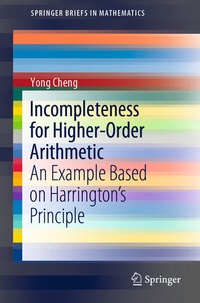
Incompleteness for Higher-Order Arithmetic
An Example Based on Harrington's Principle
1st Edition
Published on 30. August 2019
XIV, 122 pages
978-981-13-9949-7 (ISBN)
Description

Gödel's true-but-unprovable sentence from the first incompleteness theorem is purely logical in nature, i.e. not mathematically natural or interesting. An interesting problem is to find mathematically natural and interesting statements that are similarly unprovable. A lot of research has since been done in this direction, most notably by Harvey Friedman. A lot of examples of concrete incompleteness with real mathematical content have been found to date. This brief contributes to Harvey Friedman's research program on concrete incompleteness for higher-order arithmetic and gives a specific example of concrete mathematical theorems which is expressible in second-order arithmetic but the minimal system in higher-order arithmetic to prove it is fourth-order arithmetic.
This book first examines the following foundational question: are all theorems in classic mathematics expressible in second-order arithmetic provable in second-order arithmetic? The author gives a counterexample for this question and isolates this counterexample from the Martin-Harrington Theorem in set theory. It shows that the statement "Harrington's principle implies zero sharp" is not provable in second-order arithmetic. This book further examines what is the minimal system in higher-order arithmetic to prove the theorem "Harrington's principle implies zero sharp" and shows that it is neither provable in second-order arithmetic or third-order arithmetic, but provable in fourth-order arithmetic. The book also examines the large cardinal strength of Harrington's principle and its strengthening over second-order arithmetic and third-order arithmetic.
This book first examines the following foundational question: are all theorems in classic mathematics expressible in second-order arithmetic provable in second-order arithmetic? The author gives a counterexample for this question and isolates this counterexample from the Martin-Harrington Theorem in set theory. It shows that the statement "Harrington's principle implies zero sharp" is not provable in second-order arithmetic. This book further examines what is the minimal system in higher-order arithmetic to prove the theorem "Harrington's principle implies zero sharp" and shows that it is neither provable in second-order arithmetic or third-order arithmetic, but provable in fourth-order arithmetic. The book also examines the large cardinal strength of Harrington's principle and its strengthening over second-order arithmetic and third-order arithmetic.
More details
Series
Language
English
Place of publication
Singapore
Singapore
Publishing group
Springer Singapore
Target group
Professional and scholarly
Product notice
Reflowable
Illustrations
XIV, 122 p. 1 illus.
File size
2,44 MB
ISBN-13
978-981-13-9949-7 (9789811399497)
DOI
10.1007/978-981-13-9949-7
Schweitzer Classification
Other editions
Additional editions
Book
09/2019
1st Edition
Springer
€64.19
Shipment within 15-20 days
Content
Introduction and Preliminary.- A minimal system.- The Boldface Martin-Harrington Theorem in Z2.- Strengthenings of Harrington's Principle.- Forcing a model of Harrington's Principle without reshaping.- The strong reflecting property for L-cardinals.
