


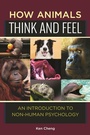
How Animals Think and Feel
An Introduction to Non-Human Psychology
1st Edition
Published on 3. October 2016
312 pages
978-1-4408-3715-9 (ISBN)
Available for download
Description

This highly accessible book explains key scientific findings in the areas of animal cognition, emotion, and behavior in easy-to-understand language.
Why do dogs get separation anxiety? Can a chimpanzee recognize itself in a mirror? Do animals in a zoo get neurotic? Do animals actually have emotions, or are humans simply anthropomorphizing them? How Animals Think and Feel: An Introduction to Non-Human Psychology answers these interesting questions and many more in its examination of animal psychology-particularly non-human primates (our closest relatives) and companion animals (the animals with which we spend the most time).
Readers will learn about the history of the study of animals as well as the methodologies and applications of animal research, examples of higher-level thought and problem solving in animals, learning and memory, emotion, and basic behaviors such as feeding and mating. Chapters examine specific animal species or groups in greater depth to address particular behaviors and discuss characteristic traits. The book also includes sidebars that offer additional high-interest, ready-reference content; a bibliography of print and electronic sources for further study; and a glossary of unfamiliar terms.
Why do dogs get separation anxiety? Can a chimpanzee recognize itself in a mirror? Do animals in a zoo get neurotic? Do animals actually have emotions, or are humans simply anthropomorphizing them? How Animals Think and Feel: An Introduction to Non-Human Psychology answers these interesting questions and many more in its examination of animal psychology-particularly non-human primates (our closest relatives) and companion animals (the animals with which we spend the most time).
Readers will learn about the history of the study of animals as well as the methodologies and applications of animal research, examples of higher-level thought and problem solving in animals, learning and memory, emotion, and basic behaviors such as feeding and mating. Chapters examine specific animal species or groups in greater depth to address particular behaviors and discuss characteristic traits. The book also includes sidebars that offer additional high-interest, ready-reference content; a bibliography of print and electronic sources for further study; and a glossary of unfamiliar terms.
More details
Language
English
Place of publication
United States
Publishing group
Bloomsbury Publishing Plc
Target group
Interest Age: From 7 to 17 years
Illustrations
10 bw illus
ISBN-13
978-1-4408-3715-9 (9781440837159)
Copyright in bibliographic data and cover images is held by Nielsen Book Services Limited or by the publishers or by their respective licensors: all rights reserved.
Schweitzer Classification
Other editions
Additional editions
Book
10/2016
Greenwood Press
€73.70
Shipment within 10-20 days
Content
Preface
Chapter 1-Introduction
Evolution
Scientific Study of Animal Behavior
Tinbergen's Four Whys
PART I: ANIMAL COGNITION
Chapter 2-Sensory and Perceptual Processes
Transduction
Range of Sensory Worlds
Perceptual Organization
Perceptual Processes
Conclusion
Chapter 3-Basic Learning
Why Learn?
Nonassociative Learning
Associative Learning: Classical Conditioning
Associative Learning: Operant Conditioning
Latent Learning
The Misbehavior of Animals: Constraints on Learning
Conclusion
Chapter 4-Spatial Cognition and Behavior
Path Integration
Terrestrial Landmarks
Geometry
Some Neurobiology of Spatial Cognition
Cognitive Map
Debate: Do Insects Use Cognitive Maps?
Global Navigation
Conclusion
Chapter 5-Timing
Circadian Clocks
Arranging Behaviors in Circadian Time
Interval Timing
Multiple Oscillators for Timing
Conclusion
Chapter 6-Numerical Cognition
Analog Magnitude System: Approximate Counts
Object-Tracking System: One, Two, Three, Too Many
Training Animals to Count
Conclusion
Chapter 7-Emotions
Emotions and Motivation
Emotions in Comparative Perspective
What about Emotions in Invertebrate Animals?
Emotions, Consciousness, and Ethics
Conclusion
Chapter 8-Animal Communication
Signals and Cues
Wide Range of Signals
Functions of Signals
Attention Signals
Camouflage Signals
Identity Signals
Mimicry
Aggressive Mimicry
Signals of Quality: Sexual Selection at Work
Alarm Calls: Warning Signals
Debate: How Important Is the Actual Information Conveyed through Animal Communication?
Cognitive Processes in Communication
Conclusion
Chapter 9-Complex Cognition
Physical Cognition
Episodic-Like Memory
Prospective Cognition
Metacognition
Debate: Do Animals Have Metacognition?
Self-Recognition: The Mirror Test
Social Learning
Theory of Mind
Conclusion
PART II: CASE STUDIES OF SELECTED ANIMALS
Chapter 10-Honeybees
Eusocial Lifestyle
Honeybee Cognition
Colony Collapse: A Multifaceted Syndrome
Conclusion
Chapter 11-Jumping Spiders
Best Arthropod Eyes
Myrmarachne: Ant-Mimicking Jumping Spiders
Portia: Stalker Playing Mind Games
Conclusion
Chapter 12-Cephalopods
Coleoid Nervous Systems: Embodied Intelligence
Learning in Cephalopods
Play in Octopuses
Skin Coloration: Masters of Disguise
Conclusion
Chapter 13-Corvids
Clark's Nutcrackers
New Caledonian Crows
Western Scrub Jays
Conclusion
Chapter 14-Parrots
Kea
Alex the African Grey Parrot
Conclusion
Chapter 15-Dolphins
Numerical Sense
Tool Use
Culture
Planning and Prospective Cognition
Cooperation and Altruism
Imitation
Artificial "Language"
Conclusion
Chapter 16-Dogs
WEIRD Human and WHOC Dogs
Domestication of the Dog: Coevolution of Uncertain Origin
Canid Play and Wild Justice
Sensitivity to Humans
Word Learning in Two Dogs: A Record for Nonprimates
Conclusion
Chapter 17-Great Apes
Primates and Great Apes: Some Basic Biology
Manual Skills and Clever Foraging
Brain and Intelligence in Primates
Nim, Kanzi, and Ape Language
Nim
Kanzi
Conclusion
Chapter 18-What about Humans?
Brief Summary
What about Humans?
Debate: What Is Special about Humans?
Glossary
References and Other Interesting Materials
About the Author and Contributors
Index
Chapter 1-Introduction
Evolution
Scientific Study of Animal Behavior
Tinbergen's Four Whys
PART I: ANIMAL COGNITION
Chapter 2-Sensory and Perceptual Processes
Transduction
Range of Sensory Worlds
Perceptual Organization
Perceptual Processes
Conclusion
Chapter 3-Basic Learning
Why Learn?
Nonassociative Learning
Associative Learning: Classical Conditioning
Associative Learning: Operant Conditioning
Latent Learning
The Misbehavior of Animals: Constraints on Learning
Conclusion
Chapter 4-Spatial Cognition and Behavior
Path Integration
Terrestrial Landmarks
Geometry
Some Neurobiology of Spatial Cognition
Cognitive Map
Debate: Do Insects Use Cognitive Maps?
Global Navigation
Conclusion
Chapter 5-Timing
Circadian Clocks
Arranging Behaviors in Circadian Time
Interval Timing
Multiple Oscillators for Timing
Conclusion
Chapter 6-Numerical Cognition
Analog Magnitude System: Approximate Counts
Object-Tracking System: One, Two, Three, Too Many
Training Animals to Count
Conclusion
Chapter 7-Emotions
Emotions and Motivation
Emotions in Comparative Perspective
What about Emotions in Invertebrate Animals?
Emotions, Consciousness, and Ethics
Conclusion
Chapter 8-Animal Communication
Signals and Cues
Wide Range of Signals
Functions of Signals
Attention Signals
Camouflage Signals
Identity Signals
Mimicry
Aggressive Mimicry
Signals of Quality: Sexual Selection at Work
Alarm Calls: Warning Signals
Debate: How Important Is the Actual Information Conveyed through Animal Communication?
Cognitive Processes in Communication
Conclusion
Chapter 9-Complex Cognition
Physical Cognition
Episodic-Like Memory
Prospective Cognition
Metacognition
Debate: Do Animals Have Metacognition?
Self-Recognition: The Mirror Test
Social Learning
Theory of Mind
Conclusion
PART II: CASE STUDIES OF SELECTED ANIMALS
Chapter 10-Honeybees
Eusocial Lifestyle
Honeybee Cognition
Colony Collapse: A Multifaceted Syndrome
Conclusion
Chapter 11-Jumping Spiders
Best Arthropod Eyes
Myrmarachne: Ant-Mimicking Jumping Spiders
Portia: Stalker Playing Mind Games
Conclusion
Chapter 12-Cephalopods
Coleoid Nervous Systems: Embodied Intelligence
Learning in Cephalopods
Play in Octopuses
Skin Coloration: Masters of Disguise
Conclusion
Chapter 13-Corvids
Clark's Nutcrackers
New Caledonian Crows
Western Scrub Jays
Conclusion
Chapter 14-Parrots
Kea
Alex the African Grey Parrot
Conclusion
Chapter 15-Dolphins
Numerical Sense
Tool Use
Culture
Planning and Prospective Cognition
Cooperation and Altruism
Imitation
Artificial "Language"
Conclusion
Chapter 16-Dogs
WEIRD Human and WHOC Dogs
Domestication of the Dog: Coevolution of Uncertain Origin
Canid Play and Wild Justice
Sensitivity to Humans
Word Learning in Two Dogs: A Record for Nonprimates
Conclusion
Chapter 17-Great Apes
Primates and Great Apes: Some Basic Biology
Manual Skills and Clever Foraging
Brain and Intelligence in Primates
Nim, Kanzi, and Ape Language
Nim
Kanzi
Conclusion
Chapter 18-What about Humans?
Brief Summary
What about Humans?
Debate: What Is Special about Humans?
Glossary
References and Other Interesting Materials
About the Author and Contributors
Index

