

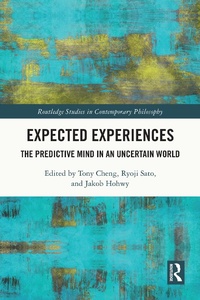
Expected Experiences
The Predictive Mind in an Uncertain World
1st Edition
Published on 29. December 2023
314 pages
978-1-003-82783-2 (ISBN)
Description

This book brings together perspectives on predictive processing and expected experience. It features contributions from an interdisciplinary group of authors specializing in philosophy, psychology, cognitive science, and neuroscience.
Predictive processing, or predictive coding, is the theory that the brain constantly minimizes the error of its predictions based on the sensory input it receives from the world. This process of prediction error minimization has numerous implications for different forms of conscious and perceptual experience. The chapters in this volume explore these implications and various phenomena related to them. The contributors tackle issues related to precision estimation, sensory prediction, probabilistic perception, and attention, as well as the role predictive processing plays in emotion, action, psychotic experience, anosognosia, and gut complex.
Expected Experiences will be of interest to scholars and advanced students in philosophy, psychology, and cognitive science working on issues related to predictive processing and coding.
Predictive processing, or predictive coding, is the theory that the brain constantly minimizes the error of its predictions based on the sensory input it receives from the world. This process of prediction error minimization has numerous implications for different forms of conscious and perceptual experience. The chapters in this volume explore these implications and various phenomena related to them. The contributors tackle issues related to precision estimation, sensory prediction, probabilistic perception, and attention, as well as the role predictive processing plays in emotion, action, psychotic experience, anosognosia, and gut complex.
Expected Experiences will be of interest to scholars and advanced students in philosophy, psychology, and cognitive science working on issues related to predictive processing and coding.
More details
Series
Edition
1. Auflage
Language
English
Place of publication
London
United Kingdom
Publishing group
Taylor & Francis Ebooks
Target group
College/higher education
Illustrations
23 Line drawings, black and white; 9 Halftones, black and white; 32 Illustrations, black and white
ISBN-13
978-1-003-82783-2 (9781003827832)
Copyright in bibliographic data and cover images is held by Nielsen Book Services Limited or by the publishers or by their respective licensors: all rights reserved.
Schweitzer Classification
Other editions
Additional editions
Book
05/2025
1st Edition
Routledge
€67.80
Shipment within 15-20 days
Book
12/2023
1st Edition
Routledge
€208.20
Shipment within 15-20 days
Persons
Tony Cheng is the Director of Center for Phenomenology at NCCU, Taiwan, and is also affiliated to Department of Philosophy/Research Center for Mind, Brain and Learning at the same university. He obtained Ph.D. in Philosophy from University College London with the dissertation Sense, Space, and Self. His research topics include perception, the senses, attention, self-awareness, spatio-temporal representations, metacognition, cognitive development, and animal minds. He has published several theoretical papers, mostly single-authored, and several empirical papers, primarily with Patrick Haggard's Action and Body Lab at UCL and Brown Hsieh's Brain and Consciousness Lab at NTU. He just published a book entitled John McDowell on Worldly Subjectivity: Oxford Kantianism Meets Phenomenology and Cognitive Sciences and is working on another book Transcendental Epistemology.
Ryoji Sato is currently an Associate Professor at University Education Center, Tokyo Metropolitan University. Before that, he taught at Nagoya University of Foreign Studies and the University of Tokyo. He earned his Ph.D. in Philosophy from Monash University. He works broadly in philosophy of mind and specifically in the predictive processing framework.
Jakob Hohwy is the Director of the Monash Centre for Consciousness and Contemplative Studies, M3CS, which conducts philosophical, neuroscientific, and psychological research in consciousness and contemplative science. He conducts interdisciplinary research in the areas of philosophy, psychology, and neuroscience. In M3CS and in his Cognition and Philosophy Lab, they study the science of consciousness, theoretical neurobiology, decision-making and rationality, and psychiatry and neurobiology. He collaborates with neuroscientists and psychologists from Monash University and around the world.
Ryoji Sato is currently an Associate Professor at University Education Center, Tokyo Metropolitan University. Before that, he taught at Nagoya University of Foreign Studies and the University of Tokyo. He earned his Ph.D. in Philosophy from Monash University. He works broadly in philosophy of mind and specifically in the predictive processing framework.
Jakob Hohwy is the Director of the Monash Centre for Consciousness and Contemplative Studies, M3CS, which conducts philosophical, neuroscientific, and psychological research in consciousness and contemplative science. He conducts interdisciplinary research in the areas of philosophy, psychology, and neuroscience. In M3CS and in his Cognition and Philosophy Lab, they study the science of consciousness, theoretical neurobiology, decision-making and rationality, and psychiatry and neurobiology. He collaborates with neuroscientists and psychologists from Monash University and around the world.
Content
Introduction: Mind and World, Predictive Style Tony Cheng, Ryoji Sato, and Jakob Hohwy Part 1: Varieties of Experiences 1. Deep Neurophenomenology: An Active Inference Account of Some Features of Conscious Experience and of Their Disturbance in Major Depressive Disorder Maxwell J. D. Ramstead, Wanja Wiese, Mark Miller, and Karl J. Friston 2. Expectancies and the Generation of Perceptual Experience: Predictive Processing and Phenomenological Control Peter Lush, Zoltan Dienes, and Anil Seth 3. The Synergistic Relationship between Perception and Action Clare Press, Emily Thomas, and Daniel Yon 4. Perceptual Uncertainty, Clarity, and Attention Jonna Vance 5. Predictive Processing and Object Recognition Berit Brogaard and Thomas Alrik Sorensen 6. Predicting First Person and Counterfactual Experiences of Selfhood: Insights from Anosognosia Aikaterini Fotopoulou and Sahba Besharati 7. Predictive Processing in the Second Brain: From Gut Complex to Meta-Awareness Tony Cheng, Lynn Chiu, Linus Huang, Ying-Tung Lin, Hsing-Hao Lee, Yi-Chuan Chen, and Su-Ling Yeh Part 2: Related Theoretical Issues Concerning Bayesian Probability 8. Neural Implementation of (Approximate) Bayesian Inference Michael Rescorla 9. Realism and Instrumentalism in Bayesian Cognitive Science Danielle Jeanenne Williams and Zoe Drayson 10. Bayesian Psychiatry and the Social Focus of Delusions Daniel Williams and Marcella Montagnese 11. Higher-Order Bayesian Statistical Decision Theory of Consciousness, Probabilistic Justification, and Predictive Processing Tony Cheng
