

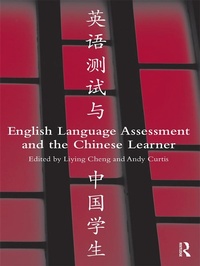
English Language Assessment and the Chinese Learner
Published on 17. March 2010
304 pages
978-1-135-21386-2 (ISBN)
Description

'This volume addresses a very timely and important topic, and provides both broad and in-depth coverage of a number of large-scale English tests in China, including Hong Kong and Taiwan, and about the Chinese learner.' - Lyle F. Bachman, From the Foreword
Building on current theoretical and practical frameworks for English language assessment and testing, this book presents a comprehensive, up-to-date, relevant picture of English language assessment for students in China (Mainland China, Hong Kong and Taiwan) and for Chinese learners of English around the world. Written by well-recognized international scholars in language testing, it covers:
the history of tests and testing systems, issues and challenges, and current research in China
both test-designers' and test-users' points of view on test development and test validation within a range of political, economical, social, and financial contexts in China
theoretical/conceptual perspectives on the use of the English language assessment at different levels, including societal, university, and schools
empirical research related specifically to test development, curricular innovation, and test validation
Given the long history of objective testing and its extensive use in Chinese society, and considering the sheer number of students taking various tests in English in China and elsewhere, an understanding of the impact of English language testing is essential for anyone involved in testing and assessment issues in China and elsewhere in the world. This is a must-read volume for testing and assessment policy makers, curriculum designers, researchers, ESL/EFL materials writers, graduate students, and English language teachers/researchers at all levels.
Building on current theoretical and practical frameworks for English language assessment and testing, this book presents a comprehensive, up-to-date, relevant picture of English language assessment for students in China (Mainland China, Hong Kong and Taiwan) and for Chinese learners of English around the world. Written by well-recognized international scholars in language testing, it covers:
the history of tests and testing systems, issues and challenges, and current research in China
both test-designers' and test-users' points of view on test development and test validation within a range of political, economical, social, and financial contexts in China
theoretical/conceptual perspectives on the use of the English language assessment at different levels, including societal, university, and schools
empirical research related specifically to test development, curricular innovation, and test validation
Given the long history of objective testing and its extensive use in Chinese society, and considering the sheer number of students taking various tests in English in China and elsewhere, an understanding of the impact of English language testing is essential for anyone involved in testing and assessment issues in China and elsewhere in the world. This is a must-read volume for testing and assessment policy makers, curriculum designers, researchers, ESL/EFL materials writers, graduate students, and English language teachers/researchers at all levels.
Reviews / Votes
"The book's broad coverage and state-of-the-art description of language testing in China will definitely help interested researchers and stakeholders alike better understand Chinese test-takers and shed light on a variety of validation studies, whether Chinese test-takers are involved or not." - Zhi Li, System , System, Volume 40 (2), June 2012More details
Language
English
Place of publication
London
United Kingdom
Publishing group
Taylor & Francis Ltd
Target group
College/higher education
Product notice
Reflowable
Illustrations
31 s/w Tabellen
31 Tables, black and white
File size
0,98 MB
ISBN-13
978-1-135-21386-2 (9781135213862)
Copyright in bibliographic data and cover images is held by Nielsen Book Services Limited or by the publishers or by their respective licensors: all rights reserved.
Schweitzer Classification
Other editions
Additional editions
Liying Cheng | Andy Curtis
English Language Assessment and the Chinese Learner
Book
10/2011
1st Edition
Routledge
€58.10
Shipment within 15-20 days
Liying Cheng | Andy Curtis
English Language Assessment and the Chinese Learner
Book
09/2009
1st Edition
Routledge
€156.20
Shipment within 15-20 days
Persons
Liying Cheng is Associate Professor, and a Director of the Assessment and Evaluation Group, at the Faculty of Education, Queen's University.
Andy Curtis is Director of the English Language Teaching Unit at the Chinese University of Hong Kong, China, where he is also an Associate Professor in the Department of Curriculum and Instruction within the Faculty of Education.
Andy Curtis is Director of the English Language Teaching Unit at the Chinese University of Hong Kong, China, where he is also an Associate Professor in the Department of Curriculum and Instruction within the Faculty of Education.
Content
Foreword, Lyle F. Bachman
Preface
Acknowledgments
The Editors
Part I: Setting the Scene
1. The Realities of English Language Assessment and the Chinese Learner in China and Beyond, Liying Cheng, Queen's University, Andy Curtis, The Chinese University of Hong Kong
2. The History of Examinations: Why, How, What, and Whom to Select? Liying Cheng, Queen's University
Part II: Validity and Test Validation: Views from Test Designers
3. The National Education Examinations Authority and its English Language Tests, Qingsi Liu, The National Education Examinations Authority
4. The National College English Testing Committee, Yan Jin, Shanghai Jiaotong University
5. Developments of English Language Assessment in Public Examinations in Hong Kong, Chee-cheong Choi, Christina Lee, both at The Hong Kong Examinations and Assessment Authority
6. The Language Training and Testing Center, Taiwan: Past, Present and Future, Antony John Kunnan, California State University, Los Angeles, Jessica R. W. Wu, The Language Training and Testing Center
Part III: Test Use and Consequences: Views from Test Users-Test Quality: Theoretical/Conceptual Points of View
Test Quality: Theoretical/Conceptual Points of Views
7. From TOEFL pBT to TOEFL iBT: Recent Trends, Research Landscape, and Chinese Learners, David D. Qian, The Hong Kong Polytechnic University
8. IELTS: International English Language Testing System, Janna Fox, Carleton University, Andy Curtis, The Chinese University of Hong Kong
9. Chinese Test-takers' Performance and Characteristics on the Michigan English Language Assessment Battery, Xiaomei Song, Queen's University
10. The Public English Testing System, Jianda Liu, Guangdong University of Foreign Studies
11. The Graduate School Entrance English Examination, Lianzhen He, Zhejiang University
12. The General English Proficiency Test, Viphavee Vongpumitch, National Tsing Hua University
Part IV: Test Use and Consequences: Views from Test Users-Test Quality: Empirical Studies
13. Chinese EFL Learners' Discoursal Performance in the Cambridge ESOL FCE Speaking Test: Culture-Specific or Test-Driven? Yang Lu, University of Nottingham
14. Exploring the Relationship between Chinese University Students' Attitudes towards the College English Test and their Test Performance, Jing Zhao, The Ohio State University, Liying Cheng, Queen's University
15. Chinese EFL Students' Perceptions of the Classroom Assessment Environment and their Goal Orientations, Xiaoying Wang, Beijing Foreign Studies University, Liying Cheng, Queen's University
16. Should Proofreading Go? Examining the Selection Function and Washback of the Proofreading Sub-test in the National Matriculation English Test, Luxia Qi, Guangdong University of Foreign Studies
17. The Computerized Oral English Test of the National Matriculation English Test, Yongqiang Zeng, Guangdong University of Foreign Studies
18. The Hong Kong Certificate of Education: School-Based Assessment Reform in Hong Kong English Language Education, Chris Davison, The University of New South Wales, Liz Hamp-Lyons, The University of Hong Kong
Part V: The Link between Test Validity and Validation, and Test Use and the Consequences: Conclusion and Beyond
19. The Impact of English Language Assessment and the Chinese Learner in China and Beyond, Liying Cheng, Queen's University, Andy Curtis, The Chinese University of Hong Kong
List of Contributors
Index
Preface
Acknowledgments
The Editors
Part I: Setting the Scene
1. The Realities of English Language Assessment and the Chinese Learner in China and Beyond, Liying Cheng, Queen's University, Andy Curtis, The Chinese University of Hong Kong
2. The History of Examinations: Why, How, What, and Whom to Select? Liying Cheng, Queen's University
Part II: Validity and Test Validation: Views from Test Designers
3. The National Education Examinations Authority and its English Language Tests, Qingsi Liu, The National Education Examinations Authority
4. The National College English Testing Committee, Yan Jin, Shanghai Jiaotong University
5. Developments of English Language Assessment in Public Examinations in Hong Kong, Chee-cheong Choi, Christina Lee, both at The Hong Kong Examinations and Assessment Authority
6. The Language Training and Testing Center, Taiwan: Past, Present and Future, Antony John Kunnan, California State University, Los Angeles, Jessica R. W. Wu, The Language Training and Testing Center
Part III: Test Use and Consequences: Views from Test Users-Test Quality: Theoretical/Conceptual Points of View
Test Quality: Theoretical/Conceptual Points of Views
7. From TOEFL pBT to TOEFL iBT: Recent Trends, Research Landscape, and Chinese Learners, David D. Qian, The Hong Kong Polytechnic University
8. IELTS: International English Language Testing System, Janna Fox, Carleton University, Andy Curtis, The Chinese University of Hong Kong
9. Chinese Test-takers' Performance and Characteristics on the Michigan English Language Assessment Battery, Xiaomei Song, Queen's University
10. The Public English Testing System, Jianda Liu, Guangdong University of Foreign Studies
11. The Graduate School Entrance English Examination, Lianzhen He, Zhejiang University
12. The General English Proficiency Test, Viphavee Vongpumitch, National Tsing Hua University
Part IV: Test Use and Consequences: Views from Test Users-Test Quality: Empirical Studies
13. Chinese EFL Learners' Discoursal Performance in the Cambridge ESOL FCE Speaking Test: Culture-Specific or Test-Driven? Yang Lu, University of Nottingham
14. Exploring the Relationship between Chinese University Students' Attitudes towards the College English Test and their Test Performance, Jing Zhao, The Ohio State University, Liying Cheng, Queen's University
15. Chinese EFL Students' Perceptions of the Classroom Assessment Environment and their Goal Orientations, Xiaoying Wang, Beijing Foreign Studies University, Liying Cheng, Queen's University
16. Should Proofreading Go? Examining the Selection Function and Washback of the Proofreading Sub-test in the National Matriculation English Test, Luxia Qi, Guangdong University of Foreign Studies
17. The Computerized Oral English Test of the National Matriculation English Test, Yongqiang Zeng, Guangdong University of Foreign Studies
18. The Hong Kong Certificate of Education: School-Based Assessment Reform in Hong Kong English Language Education, Chris Davison, The University of New South Wales, Liz Hamp-Lyons, The University of Hong Kong
Part V: The Link between Test Validity and Validation, and Test Use and the Consequences: Conclusion and Beyond
19. The Impact of English Language Assessment and the Chinese Learner in China and Beyond, Liying Cheng, Queen's University, Andy Curtis, The Chinese University of Hong Kong
List of Contributors
Index
