

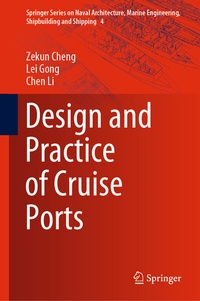
Design and Practice of Cruise Ports
Description

This book focuses on design technologies and practical engineering applications in connection with cruise ports and terminals. After a brief introduction to cruise ships and global cruise ports, it addresses the location, structure and layout of cruise terminals, the technologies involved, cruise terminal buildings and supporting facilities. The book also explores practical engineering cases, including projects that the authors have worked on, such as the Shenzhen Prince Bay and Shanghai Wusongkou International Cruise Terminal projects. Systematically discussing the design and engineering aspects of domestic and international cruise terminals, the book offers a practical reference guide for engineers, researchers, practitioners and policymakers in relevant fields.
More details
Other editions
Additional editions
Persons
Dr. Zekun Cheng received his Ph.D. degree in Structural Engineering from Dalian University of Technology, China, in 1997. At present, he is the Chief Engineer of the Third Harbor Engineering Survey and Design Institute Co., Ltd., part of China Communications Construction Group Co., Ltd. (CCCC), Shanghai, China. Dr. Cheng was recognized as a "Model Worker in Central Government Owned Enterprises" in China in 2019.
Dr. Lei Gong received his Ph.D. degree in Structural Engineering from the Federal University of Rio de Janeiro, Brazil, in 1998. Having previously worked as an Associate Professor at the Institute of Research, Federal University of Rio de Janeiro, he is currently a Professorate Senior Engineer, and former Deputy General Manager and Chief Engineer of China Merchants Shekou Industrial Zone Co., Ltd., Shenzhen, China. Chen Li is the Director of the Cruise Port Technology Research Center, CCCC Third Harbor Consultants Co., Ltd., Shanghai, China. He completedhis Master's degree in Transportation Planning and Management at Hohai University, China, in March 2004 and has worked at CCCC Third Harbor Engineering Survey and Design Institute Co., Ltd. ever since. He is also currently a Ph.D. candidate at the School of Transportation, Shanghai Maritime University. Having been engaged in port engineering planning and design for more than ten years, his qualifications include Professorate Senior Engineer and Registered Civil Engineer specialized in ports and waterways.Chen Li has presided over a number of domestic and foreign cruise port design and consulting projects (including Shanghai, Shenzhen, Guangzhou, Xiamen, Wenzhou, Sanya, Qinhuangdao, etc.). He has extensive expertise concerning the technical standards and specifications of domestic and foreign cruise ships and all-weather ports, has solved a number of major technical problems in cruise port engineering, and is broadly recognized as a leading expert in the cruise industry and the preparation of design specifications for wharfs.
