

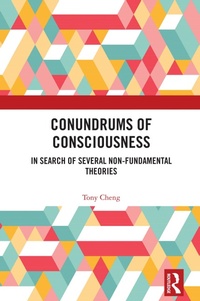
Conundrums of Consciousness
In Search of Several Non-fundamental Theories
Will be published approx. on 16. July 2026
202 pages
978-1-040-96753-9 (ISBN)
Description

Consciousness is widely regarded as one of the final frontiers of the human intellectual journey. Despite efforts in psychology, neuroscience, and cognitive science, many issues remain elusive and intractable. This book identifies ten problems, five "easy" and five "hard," and navigates the challenging terrain of these issues.
The so-called easy problems are by no means straightforward; they are only relatively easy in the sense that current scientific methods can make steady progress on them. Topics covered in the first half of this book include attention, cognition, neural correlates, neural mechanisms, and perceptual perspectives. The so-called hard problems are those that cannot be readily tackled by current standard scientific methods. Those in the second half of the book include subjectivity, objectivity, reasons, persons, and freedom of the will. Each chapter deals with one topic and is coupled with one specific research question. In answering these questions, the author proposes several non-fundamental theories which are not intended to be definitive.
This book provides an intellectual roadmap for novices and experts alike and will stimulate further interdisciplinary research programmes in consciousness studies.
The so-called easy problems are by no means straightforward; they are only relatively easy in the sense that current scientific methods can make steady progress on them. Topics covered in the first half of this book include attention, cognition, neural correlates, neural mechanisms, and perceptual perspectives. The so-called hard problems are those that cannot be readily tackled by current standard scientific methods. Those in the second half of the book include subjectivity, objectivity, reasons, persons, and freedom of the will. Each chapter deals with one topic and is coupled with one specific research question. In answering these questions, the author proposes several non-fundamental theories which are not intended to be definitive.
This book provides an intellectual roadmap for novices and experts alike and will stimulate further interdisciplinary research programmes in consciousness studies.
More details
Language
English
Place of publication
London
United Kingdom
Publishing group
Taylor & Francis Ltd
Target group
College/higher education
Professional and scholarly
Product notice
Reflowable
File size
0,55 MB
ISBN-13
978-1-040-96753-9 (9781040967539)
Copyright in bibliographic data and cover images is held by Nielsen Book Services Limited or by the publishers or by their respective licensors: all rights reserved.
Schweitzer Classification
Other editions
Additional editions
Book
approx. 07/2026
1st Edition
Routledge
€191.50
Not yet published
Person
Tony Cheng is an Associate Professor at the Waseda Institute for Advanced Study (WIAS), an associate research fellow at Research Center for Mind, Brain, and Learning (RCMBL), and an associate editor of Cognitive Science: A Multidisciplinary Journal. He primarily works on attention, memory, spatial senses, Molyneux's question, and transcendental argument.
Content
Introduction: Concepts and Conundrums PART I Easy Problems 1 Attention: Is Consciousness Richer and/or Finer-Grained than Attention? 2 Cognition: Is There a Joint in Nature Between Consciousness and Cognition? 3 Correlates: Is the Prefrontal Cortex Part of the Overall Sensory Neural Correlates of Consciousness? 4 Mechanisms: What Brain Mechanisms Are Responsible for Consciousness? 5 Perspectives: Do We Consciously Represent Perspectival Properties? PART II Hard Problems 6 Subjectivity: How Can Subjectivity Be Placed into the Objective World? 7 Objectivity: How Can Consciousness Reach out to the Objective World? 8 Reasons: How Do Consciousness and Reasons Relate to Each Other? 9 Persons: Is Personhood at Least Partially Constituted by Consciousness? 10 Freedom: Does Free Will Require Strong Emergence About Consciousness? Conclusion: The Hard Enough Problem, the Meta-Problem, and the Truly Hard Problem
