

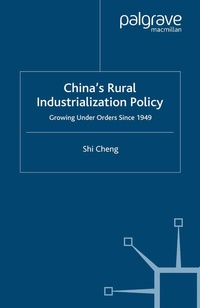
China's Rural Industrialization Policy
Growing Under Orders Since 1949
Published on 3. August 2006
XVIII, 340 pages
978-0-230-50171-3 (ISBN)
Description

This book is a comprehensive and positive study of the special pattern of China's industrialization and economic development, covering all of the relevant, main policies (more than one hundred) from 1949 to the twenty-first century.
Reviews / Votes
'Shi Cheng presents a comprehensive study of China's industrialization process over the decades, covering the main policies from 1949 till today.' - Development
'...the book provides a valuable, careful and thorough study, which might be of high value for students interestd in rural economic development and its prospects.' - Thomas Heberer, Asian-Pacific Economic Literature
More details
Other editions
Additional editions

Book
08/2006
Palgrave Macmillan
€106.99
Shipment within 10-20 days
Book
Palgrave Macmillan
€106.99
The article will not be published
Person
SHI CHENG is Research Fellow in Economics at the Japan Society for the
Promotion of Science (JSPS), Japan, and at the Jiangsu Provincial Academy
of Social Sciences, China. He is also Visiting Research Fellow at the
Graduate School of Economics, Nagoya University, Japan, where he leads
the JSPS project on the impact of the WTO on government policies and
the productivity of township and village enterprises in China.
Promotion of Science (JSPS), Japan, and at the Jiangsu Provincial Academy
of Social Sciences, China. He is also Visiting Research Fellow at the
Graduate School of Economics, Nagoya University, Japan, where he leads
the JSPS project on the impact of the WTO on government policies and
the productivity of township and village enterprises in China.
Content
List of Tables List of Figures List of Abbreviations Preface Introduction: China's Rural Industrialization, Characteristics and Miracle PART I: RURAL INDUSTRIALIZATION UNDER STATE MONOPOLY CONTROL Shifting in the Land Reform Campaign Sprouting in the Cooperative Campaign Great Leap Forward in the People's Communization Campaign Great Leap Backward in the Panic Famine Recovery in the Campaign to Accelerate the Mechanization of Agriculture PART II: RURAL INDUSTRIALIZATION IN THE TRANSITION TO ECONOMIC LIBERALIZATION Rise Under the Household Responsibility System Great Expansion in the Disintegration of the People's Commune System Setbacks in the Emergency Braking for a Crisis New Great Leap Forward after the Collapse of the Soviet Union Slowing Down in the Privatization Wave New Century Shifting in the Campaign to Increase Farmer Income Concluding Remarks Notes Bibliography Index
