

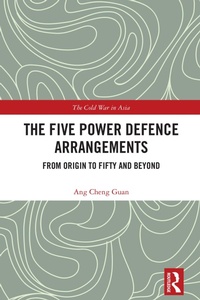
The Five Power Defence Arrangements
From Origin to Fifty and Beyond
1st Edition
Published on 4. March 2025
150 pages
978-1-040-33004-3 (ISBN)
Description

Ang describes the development of the Five Power Defence Arrangements (FPDA), an important security regional arrangement, from its inception to the present from the perspectives of the five FPDA allies.
The book recounts the establishment of the FPDA in 1971 from the Anglo-Malaysian Defence Agreement and its development in the first 20 years to the end of the Cold War in 1990. Based on declassified archival documents and secondary literature, it explores how the FDPA has evolved and adapted to provide different benefits to each of its partners after the Cold War. Ang contextualises the FPDA within existing scholarship and offers a glimpse into possible future trajectories.
A valuable resource for scholars, students, researchers, and professionals interested in international history, defence, and security.
The book recounts the establishment of the FPDA in 1971 from the Anglo-Malaysian Defence Agreement and its development in the first 20 years to the end of the Cold War in 1990. Based on declassified archival documents and secondary literature, it explores how the FDPA has evolved and adapted to provide different benefits to each of its partners after the Cold War. Ang contextualises the FPDA within existing scholarship and offers a glimpse into possible future trajectories.
A valuable resource for scholars, students, researchers, and professionals interested in international history, defence, and security.
Reviews / Votes
"With great powers now declining and rising, there is an urgent need to better understand how multilateral security organisations can form, function and persist in Asia. This detailed and authoritative examination of the Five Power Defence Arrangements uses archival research to provide a fresh perspective on an under-studied institution. It will be of great use to policymakers, diplomatic historians, and scholars of alliance politics."Iain Henry, Senior Lecturer, Strategic and Defence Studies Centre, Australian National University
"The durability of consultative arrangements conceived in the context of the British withdrawal East of Suez remains a great puzzle. Ang Cheng Guan addresses it heads on in his remarkable historical study of the FPDA. This book is a must read for anyone interested in understanding the FPDA's ability to adjust to evolving circumstances and its ongoing relevance in the Southeast Asian security architecture."
Ralf Emmers, Professor in International Politics of East Asia, SOAS University of London
"Professor Ang Cheng Guan's detailed and excellent study of the Five Power Defence Arrangement (FPDA) is an important statement about the significance of enduring defence instrumentalities for regional security. Ang shows us persuasively that the FPDA, despite its weaknesses, is still highly relevant as a minilateral confidience-building measure in managing conflict in our turbulent geopolitical times."
Johan Saravanamuttu, Professor Emeritus, Science University of Malaysia
"This welcome study by Ang Cheng Guan provides a comprehensive analysis of the evolution of FPDA, an important but relatively understudied defence arrangement in Asia. Ang's study makes a valuable contribution to the literature on multilateral defence alliances in Asia. The book offers a thorough exploration of the FPDA's development, particularly during significant periods such as the Cold War and its aftermath, highlighting the alliance's distinctive features, contributions, and adaptability while presenting new perspectives on its sustained relevance...This is an important book that is highly recommended for historians, defence analysts and scholars of international relations."
Tan Tai Yong, Professor, Singapore University of Social Sciences
More details
Series
Edition
1. Auflage
Language
English
Place of publication
London
United Kingdom
Publishing group
Taylor & Francis Ltd
Target group
College/higher education
Professional and scholarly
File size
0,48 MB
ISBN-13
978-1-040-33004-3 (9781040330043)
Copyright in bibliographic data and cover images is held by Nielsen Book Services Limited or by the publishers or by their respective licensors: all rights reserved.
Schweitzer Classification
Other editions
Additional editions
Book
approx. 07/2026
1st Edition
Routledge
€57.50
Not yet published

Book
04/2025
Routledge
Unfortunately, price unknown
Available (delivery time upon request)
Book
03/2025
1st Edition
Routledge
€207.00
Shipment within 10-20 days
Person
Ang Cheng Guan is Professor of the International History of Southeast Asia and Associate Dean of S. Rajaratnam School of International Studies at Nanyang Technological University, Singapore.
Content
Introduction
1. Replacing AMDA
2. Negotiating the FPDA
3. The First 20 Years
4. After the Cold War
5. Towards 50 and Beyond
Conclusion
1. Replacing AMDA
2. Negotiating the FPDA
3. The First 20 Years
4. After the Cold War
5. Towards 50 and Beyond
Conclusion
