

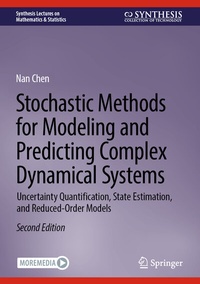
Stochastic Methods for Modeling and Predicting Complex Dynamical Systems
Description

This Second Edition is an essential guide to understanding, modeling, and predicting complex dynamical systems using new methods with stochastic tools. Expanding upon the original book, the author covers a unique combination of qualitative and quantitative modeling skills, novel efficient computational methods, rigorous mathematical theory, as well as physical intuitions and thinking. The author presents mathematical tools for understanding, modeling, and predicting complex dynamical systems using various suitable stochastic tools. The book provides practical examples and motivations when introducing these tools, merging mathematics, statistics, information theory, computational science, and data science. The author emphasizes the balance between computational efficiency and modeling accuracy while equipping readers with the skills to choose and apply stochastic tools to a wide range of disciplines. This second edition includes updated discussion of combining stochastic models with machine learning and addresses several additional topics, including importance sampling, regression, and maximum likelihood estimate. The author also introduces a new chapter on optimal control.
More details
Other editions
Additional editions
Person
Nan Chen, Ph.D., is an Associate Professor at the Department of Mathematics, University of Wisconsin-Madison. He is also a faculty affiliate of the Institute for Foundations of Data Science. Dr. Chen received his Ph.D. from the Courant Institute of Mathematical Sciences and the Center of Atmosphere and Ocean Science, New York University (NYU), in 2016. He worked as a postdoc research associate at NYU for two years before joining UW-Madison. Dr. Chen's research interests lie in applied mathematics, geophysics, complex dynamical systems, stochastic methods, numerical algorithms, and general data science. He is also active in developing dynamical and stochastic models and using these models to analyze and predict real-world phenomena related to atmosphere-ocean science, climate, and other complex systems with the help of real observational data. He has received several awards, including the Kurt O. Friedrichs Prize for an outstanding dissertation in mathematics and the Young Investigator Award from the Office of Naval Research.
Content
Stochastic Toolkits.- Introduction to Information Theory.- Basic Stochastic Computational Methods.- Simple Gaussian and Non-Gaussian SDEs.- Data Assimilation.- Optimal Control.- Prediction.- Data-Driven Low-Order Stochastic Models.- Conditional Gaussian Nonlinear Systems.- Parameter Estimation with Uncertainty Quantification.- Combining Stochastic Models with Machine Learning.- Instruction Manual for the MATLAB Codes.
