

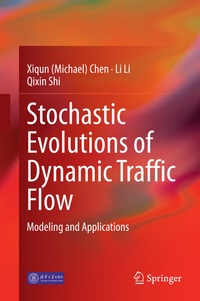
Stochastic Evolutions of Dynamic Traffic Flow
Description

This book reveals the underlying mechanisms of complexity and stochastic evolutions of traffic flows. Using Eulerian and Lagrangian measurements, the authors propose lognormal headway/spacing/velocity distributions and subsequently develop a Markov car-following model to describe drivers' random choices concerning headways/spacings, putting forward a stochastic fundamental diagram model for wide scattering flow-density points. In the context of highway onramp bottlenecks, the authors present a traffic flow breakdown probability model and spatial-temporal queuing model to improve the stability and reliability of road traffic flows. This book is intended for researchers and graduate students in the fields of transportation engineering and civil engineering.
More details
Other editions
Additional editions
Persons
Xiqun (Michael) Chen received the B.E. degree and the Ph.D. degree from the Department of Civil Engineering, Tsinghua University, China, in 2008 and 2012. His thesis entitled "Stochastic Evolutions of Dynamic Traffic Flow: Modeling and Application" received the 2013 IEEE ITSS Best Ph.D. Dissertation Award. He is now a post-doctoral researcher at Department of Civil and Environmental Engineering, University of Maryland at College Park, working on intelligent transportation systems, simulation based optimization, and traffic flow theory.
For details please refer to attached CV.
Li Li is currently an Associate Professor at Department of Automation, Tsinghua University, Beijing, China, working in the fields of complex and networked systems, intelligent control and sensing, intelligent transportation systems, and intelligent vehicles. He had published more than 30 peer-reviewed journal papers and over 40 peer-reviewed conference papers as a first/corresponding author. He currently serves as an Associate Editor for IEEE Transactions on Intelligent Transportation Systems.
Qixin Shi is currently an Emeritus Professor in Department of Civil Engineering, Tsinghua University, Beijing, China. He received the B.E. degree from Department of Civil Engineering, Tsinghua University in 1970. He worked at Tsinghua University since 1970 and retired in 2009. His major research fields include intelligent transportation systems, transportation planning, traffic management and control, sustainable transportation systems, road and bridge Engineering. Professor Shi founded the traffic engineering discipline in accordance with national needs at Tsinghua University in 1985. He was the founder of the Institute of Transportation Engineering at Tsinghua University, and served as the first director. Professor Shi has published more than 200 papers and devotes himself to promoting the development and implementation of intelligent transportation systems in China.
>Content
Introduction. - Literature Review.- Empirical Observations of Stochastic and Dynamic Evolutions of Trac Flow.- A Markov Model Based on Headway/Spacing Distributions.- Stochastic Fundamental Diagram Based on Headway/Spacing Distributions.- Trac Flow Breakdown Model Based on Headway/Spacing Distributions.- Conclusions and Future Work.
