

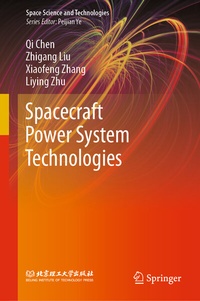
Spacecraft Power System Technologies
Description

This book provides an introduction to the main design principles, methods, procedures, and development trends in spacecraft power systems. It is divided into nine chapters, the first of which covers the classification and main components of primary power system design and power distribution system design. In turn, Chapters 2 to 4 focus on the spacecraft power system design experience and review the latest typical design cases concerning spacecraft power systems in China. More specifically, these chapters also introduce readers to the topological structure and key technologies used in spacecraft power systems. Chapters 5 to 7 address power system reliability and safety design, risk analysis and control, and in-orbit management in China's spacecraft engineering projects. The book's closing chapters provide essential information on new power systems and technologies, such as space nuclear power, micro- and nano-satellite power systems, and space energy interconnection systems. An outlook on future development trends rounds out the coverage.
More details
Other editions
Additional editions
Persons
Dr. Zhigang Liu is a Senior Engineer at Institute of Spacecraft System Engineering,CAST. His work mainly focuses on spacecraft power supply and distribution system design, high-power spacecraft energy management, and near-field wireless energy transfer technologies. He has participated in the research and development of the "Chang'E-5" flight tester and the power supply and distribution subsystems for the Mars probe. He has presided over a number of special projects in national defense science and technology innovation zones, equipment prefabrication sharing technology, and special technologies for pre-research projects in the field of aerospace. He has published more than 20 papers in academic journals and holds more than 10 national invention patents and 5 software copyrights.
Xiaofeng Zhang is a Senior Engineer at Institute of Spacecraft System Engineering,CAST. His work mainly focuses on the overall design of spacecraft power systems, space distributed energy control, and the Internet. He has actively participated in the research and development of power supply subsystems such as "BD-2" and "BD-3" space infrastructures, has presided over a key national defense basic scientific research project, and participated in a number of civil aerospace and equipment pre-research projects. He won the second prizefor military science and technology progress in 2013, has published more than 20 papers in academic journals, and holds 5 national invention patents and 3 software copyrights.
Dr. Liying Zhu is currently working at Institute of Spacecraft System Engineering,CAST. Her chief areas of expertise are spacecraft power supply and distribution system design, high-power spacecraft energy management, and near-field wireless energy transfer technologies. She has participated in "ZY3000," "Beidou-3," and various R&D projects in the aerospace field. She has published more than 30 papers in academic journals and holds 5 national patents.
