

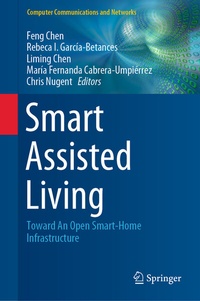
Smart Assisted Living
Description

Smart Homes (SH) offer a promising approach to assisted living for the ageing population. Yet the main obstacle to the rapid development and deployment of Smart Home (SH) solutions essentially arises from the nature of the SH field, which is multidisciplinary and involves diverse applications and various stakeholders. Accordingly, an alternative to a one-size-fits-all approach is needed in order to advance the state of the art towards an open SH infrastructure.
This book makes a valuable and critical contribution to smart assisted living research through the development of new effective, integrated, and interoperable SH solutions. It focuses on four underlying aspects: (1) Sensing and Monitoring Technologies; (2) Context Interference and Behaviour Analysis; (3) Personalisation and Adaptive Interaction, and (4) Open Smart Home and Service Infrastructures, demonstrating how fundamental theories, models and algorithms can be exploited to solve real-world problems.
This comprehensive and timely book offers a unique and essential reference guide for policymakers, funding bodies, researchers, technology developers and managers, end users, carers, clinicians, healthcare service providers, educators and students, helping them adopt and implement smart assisted living systems.More details
Other editions
Additional editions
Persons
Dr Feng Chen is a Senior Lecturer at the School of Computer Science and Informatics, De Montfort University.
Dr Rebeca I García-Betances is a Senior Researcher in the Life Supporting Technologies Group at the Technical University of Madrid.
Prof María Fernanda Cabrera-Umpiérrez is an Associate Professor at the Telecommunication School, Technical University of Madrid.
Prof Liming Chen is a Chair Professor of Computer Science at De Montfort University, where he leads the Context, Intelligence and Interaction Research Group (CIIRG).
Prof Chris Nugent is a Professor of Biomedical Engineering and Head of the School of Computing at Ulster University, where he also leads the Pervasive Computing Research Group and is Co-Principal Investigator at the Connected Health Innovation Centre.
Content
Multi-Resident Activity Monitoring in Smart Homes Through Non-Wearable Non-Intrusive Sensors
Son N. Tran and Qing Zhang and Vanessa Smallbon and Mohan Karunanithi
Where Am I? Comparing CNN and LSTM for Location Classification in Egocentric Videos
Georgios Kapidis, Ronald W. Poppe, Elsbeth A. van Dam, Remco C. Veltkamp, and Lucas P. J. J. Noldus
A Privacy-Preserving Wearable Camera Setup for Dietary Event Spotting in Free-Living
Giovanni Schiboni, Fabio Wasner, and Oliver Amft
Saving Energy on EMG-Monitoring Eyeglasses for Free-Living Eating Event Spotting Using Adaptive Duty-Cycling
Giovanni Schiboni and Oliver Amft
Zumin Wang
Unobtrusive Sensing to Assist with Post-Stroke Rehabilitation
Chris Nugent
