

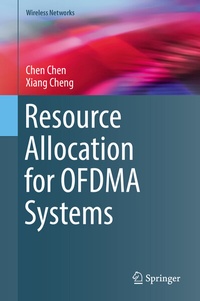
Resource Allocation for OFDMA Systems
1st Edition
Published on 29. June 2019
XI, 132 pages
978-3-030-19392-8 (ISBN)
Description

This book introduces the sources and historic collection campaigns of resource allocation in wireless communication systems. The unique characteristics of MIMO-OFDMA systems are thoroughly studied and summarized. Remarks on resource allocation and spectrum sharing are also presented, which demonstrate the great value of resource allocation techniques, but also introduce distinct challenges of resource allocation in MIMO-OFDMA systems. Novel resource allocation techniques for OFDMA Systems are surveyed from various applications (e.g., for unicast, or multicast with Guaranteed BER and Rate, subcarrier and power allocation with various detectors, low-complexity energyefficient resource allocation, etc.) in this book.
Due to the high mobility and low latency requirements of 5G wireless communications, this book discusses how to deal with the imperfect CSI. It also discusses how to deal with e.g., throughput maximization, outage probabilities maximizationand guarantee, energy efficiency, physical-layer security issues with feedback channel capacity constraints, in order to characterize and understand the applications of practical scenes.
This book will target professionals & researchers working in the fields of Wireless Communications and Networking, Resource Allocation and Transmissions. Advanced-level students in electrical engineering and computer science will also find this book useful as a secondary textbook.
Due to the high mobility and low latency requirements of 5G wireless communications, this book discusses how to deal with the imperfect CSI. It also discusses how to deal with e.g., throughput maximization, outage probabilities maximizationand guarantee, energy efficiency, physical-layer security issues with feedback channel capacity constraints, in order to characterize and understand the applications of practical scenes.
This book will target professionals & researchers working in the fields of Wireless Communications and Networking, Resource Allocation and Transmissions. Advanced-level students in electrical engineering and computer science will also find this book useful as a secondary textbook.
More details
Series
Language
English
Place of publication
Cham
Switzerland
Publishing group
Springer International Publishing
Target group
Professional and scholarly
Product notice
Reflowable
Illustrations
XI, 132 p. 36 illus., 15 illus. in color.
File size
3,84 MB
ISBN-13
978-3-030-19392-8 (9783030193928)
DOI
10.1007/978-3-030-19392-8
Schweitzer Classification
Other editions
Additional editions
Chen Chen | Xiang Cheng
Resource Allocation for OFDMA Systems
Book
07/2019
Springer
€106.99
Shipment within 7-9 days
Persons
Chen Chen
received the Ph.D. degree from Peking University, China, in 2009. He is currently an Associate Professor with Peking University. Since 2010, he has been the principal investigator of over ten funded research projects. He has authored or co-authored over 100 journal and conference papers, and 3 books. His current research interests include signal processing, wireless communications and networking. He was a recipient of two Outstanding Paper Awards from the Chinese Government of Beijing in 2013 and 2018, respectively, and the Best Paper Awards of IEEE ICNC'17, ICCS'18, and Globecom'18. He has served as the symposium Co-Chair, Session Chair, and a member of the Technical Program Committee for several international conferences. He is currently an Associate Editor of the IET Communications.
Xiang Cheng received the Ph.D. degree from Heriot-Watt University, Edinburgh, U.K., and the University of Edinburgh, Edinburgh, in 2009. Heis currently a Professor with Peking University, Beijing, China. He has authored or co-authored over 200 journal and conference papers, 5 books, and 7 patents. His publications have received nearly 5652 Google Scholar citations with an h-index of 36, and i10-index of 95. His current research interests include channel modeling and mobile communications. He was a recipient of the IEEE Asia-Pacific Outstanding Young Researcher Award in 2015 and the Postgraduate Research Thesis Prize from the University of Edinburgh and a co-recipient of the 2016 IEEE JSAC Best Paper Award: Leonard G. Abraham Prize, the NSFC Outstanding Young Investigator Award, the First-Rank and Second-Rank Awards in Natural Science, Ministry of Education in China, and the Best Paper Award of IEEE ITST'12, ICCC'13, ITSC'14, ICC'16, ICNC'17, ICCS'18, and Globecom'18. He has served as the symposium Leading-Chair, the Co-Chair, and a member of the Technical Program Committee for several international conferences. He is currently an Associate Editor of the IEEE Transactions on Intelligent Transportation Systems, and the Journal of Communications and Information Networks. He is an IEEE Distinguished Lecturer.
Xiang Cheng received the Ph.D. degree from Heriot-Watt University, Edinburgh, U.K., and the University of Edinburgh, Edinburgh, in 2009. Heis currently a Professor with Peking University, Beijing, China. He has authored or co-authored over 200 journal and conference papers, 5 books, and 7 patents. His publications have received nearly 5652 Google Scholar citations with an h-index of 36, and i10-index of 95. His current research interests include channel modeling and mobile communications. He was a recipient of the IEEE Asia-Pacific Outstanding Young Researcher Award in 2015 and the Postgraduate Research Thesis Prize from the University of Edinburgh and a co-recipient of the 2016 IEEE JSAC Best Paper Award: Leonard G. Abraham Prize, the NSFC Outstanding Young Investigator Award, the First-Rank and Second-Rank Awards in Natural Science, Ministry of Education in China, and the Best Paper Award of IEEE ITST'12, ICCC'13, ITSC'14, ICC'16, ICNC'17, ICCS'18, and Globecom'18. He has served as the symposium Leading-Chair, the Co-Chair, and a member of the Technical Program Committee for several international conferences. He is currently an Associate Editor of the IEEE Transactions on Intelligent Transportation Systems, and the Journal of Communications and Information Networks. He is an IEEE Distinguished Lecturer.
Content
1. Introduction.- 2. Overview of OFDMA and MIMO Systems.- 3. Remarks on Resource Allocation.- 4. Resource Allocation for OFDMA Systems.- 5. Dealing with Imperfect CSI.- 6. Summary and Outlook.
