

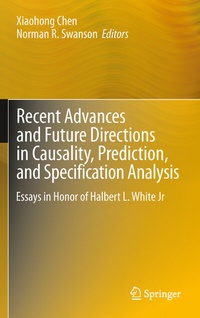
Recent Advances and Future Directions in Causality, Prediction, and Specification Analysis
Description

This book is a collection of articles that present the most recent cutting edge results on specification and estimation of economic models written by a number of the world's foremost leaders in the fields of theoretical and methodological econometrics. Recent advances in asymptotic approximation theory, including the use of higher order asymptotics for things like estimator bias correction, and the use of various expansion and other theoretical tools for the development of bootstrap techniques designed for implementation when carrying out inference are at the forefront of theoretical development in the field of econometrics. One important feature of these advances in the theory of econometrics is that they are being seamlessly and almost immediately incorporated into the "empirical toolbox" that applied practitioners use when actually constructing models using data, for the purposes of both prediction and policy analysis and the more theoretically targeted chapters in the book will discuss these developments. Turning now to empirical methodology, chapters on prediction methodology will focus on macroeconomic and financial applications, such as the construction of diffusion index models for forecasting with very large numbers of variables, and the construction of data samples that result in optimal predictive accuracy tests when comparing alternative prediction models. Chapters carefully outline how applied practitioners can correctly implement the latest theoretical refinements in model specification in order to "build" the best models using large-scale and traditional datasets, making the book of interest to a broad readership of economists from theoretical econometricians to applied economic practitioners.
More details
Other editions
Additional editions
Content
- Intro
- Recent Advances and Future Directions in Causality,Prediction, and Specification Analysis
- Editor's Introduction
- Contents
- 1 Improving U.S. GDP Measurement: A Forecast Combination Perspective
- 1 Introduction
- 2 Combination Under Quadratic Loss
- 2.1 Basic Results and Calibration
- 2.2 On the Rationale for our Calibration
- 3 Combination Under Minimax Loss
- 4 Empirics
- 4.1 A Combined U.S. GDP Series
- 4.2 U.S. Recession and Volatility Regime Probabilities
- 5 Extensions
- 5.1 Vintage Data, Time-Varying Combining Weights, and Real-Time Analysis
- 5.2 A Model of Measurement Error
- 6 Conclusions
- References
- 2 Identification Without Exogeneity Under Equiconfounding in Linear Recursive Structural Systems
- 1 Introduction
- 2 Notation
- 3 Equiconfounded Predictive Proxy and Response
- 4 Equiconfounded Joint Causes and Response
- 5 Equiconfounded Cause and Joint Responses
- 6 Equiconfounding in Triangular Structures
- 7 Discussion
- 8 Conclusion
- References
- 3 Optimizing Robust Conditional Moment Tests: An Estimating Function Approach
- 1 Introduction
- 2 A Generalized RCM Test
- 3 Examples: RCM Tests
- 3.1 Conditional-Mean Context
- 3.2 Conditional Mean-and-Variance Context
- 3.3 Conditional Quantile Context
- 4 Optimization
- 4.1 Parametric Optimality
- 4.2 Semi-Parametric Optimality
- 4.3 Computational Aspect
- 5 Examples: Optimized Tests
- 5.1 Conditional-Mean Context
- 5.2 Conditional Mean-and-Variance Context
- 5.3 Conditional Quantile Context
- 6 Simulation
- 7 Conclusions
- References
- 4 Asymptotic Properties of Penalized M Estimators with Time Series Observations
- 1 Introduction
- 2 Definitions and Examples
- 3 Convergence Rate of the Penalized M Estimate
- 4 Asymptotic Normality of Plug-In Penalized M Estimates
- 5 Consistent Estimation of the Long-Run Variance
- 6 Conclusion
- References
- 5 A Survey of Recent Advances in Forecast Accuracy Comparison Testing, with an Extension to Stochastic Dominance
- 1 Introduction
- 2 DM and Reality Check Tests
- 2.1 The Case of Vanishing Estimation Error
- 2.2 Bootstrap Critical Values for Recursive Estimation Schemes
- 3 Extending the DM and Reality Check Tests to Forecast Interval Evaluation
- 3.1 The Case of Known Distribution Function
- 3.2 The Case of Unknown Distribution Function
- 4 Stochastic Dominance: Predictive Evaluation Based on Distribution of Loss
- 4.1 Motivation
- 4.2 Setup
- 4.3 Statistic
- 5 Concluding Remarks
- References
- 6 New Directions in Information Matrix Testing: Eigenspectrum Tests
- 1 Introduction
- 1.1 Model Misspecification
- 1.2 Specification Analysis for Logistic Regression
- 1.3 Information Matrix Test
- 1.4 Empirical Performance of the Information Matrix Test
- 1.5 Nondirectional and Directional Tests
- 1.6 Logistic Regression Modeling IMTs
- 1.7 Generalized Information Matrix Test Theory
- 2 Theory
- 2.1 Information Matrix Equality
- 2.2 The Null Hypothesis for a Generalized IMT
- 2.3 Asymptotic Behavior of the Generalized IMT Statistic
- 2.4 Classical IMT Family
- 2.5 Eigenspectrum GIMT Family
- 3 Simulation Studies
- 3.1 Epidemiological Data Sample
- 3.2 Logistic Regression Models
- 3.3 Simulation Study
- 4 Summary and Conclusions
- References
- 7 Bayesian Analysis and Model Selection of GARCH Models with Additive Jumps
- 1 Introduction
- 2 A GARCH Setting with Additive Jumps
- 3 Parameter Estimation
- 4 Model Selection
- 5 Performance in Simulated and Empirical Data
- 5.1 Simulated Data
- 5.2 Empirical Data
- 6 Conclusions
- References
- 8 Hal White: Time at MIT and Early Days of Research
- 1 My Approach Before White Standard Errors
- 2 Finite Sample Approach
- References
- 9 Open-Model Forecast-Error Taxonomies
- 1 Introduction
- 2 Forecasting in an Open I(0) System
- 2.1 Omitting the Exogenous Variables
- 2.2 1-Step Forecasts One Period Later
- 2.3 Avoiding Systematic Forecast Failure
- 3 1-Step Taxonomies
- 3.1 Forecasting the Unmodeled Variables
- 4 Artificial Data Illustration
- 5 h-Step Ahead Forecasts
- 5.1 Omitting the Unmodeled Variables in h-Step Ahead Forecasts
- 5.2 Forecasting the Unmodeled Variables in h-Step Ahead Forecasts
- 5.3 Parameter Estimation in h-Step Ahead Forecasts
- 6 Transforming an I(1) System to I(0)
- 7 Conclusion
- References
- 10 Heavy-Tail and Plug-In Robust Consistent Conditional Moment Tests of Functional Form
- 1 Introduction
- 2 Tail-Weighted Conditional Moment Test
- 2.1 Tail-Trimmed Equations
- 2.2 Plug-In Properties
- 2.3 Main Results
- 3 Fractile Choice
- 4 Plug-In Choice and Verification of the Assumptions
- 4.1 Linear AR
- 4.2 Linear ARCH
- 5 Simulation Study
- 5.1 Tail-Trimmed CM Test
- 5.2 Tests of Functional Form
- 5.3 Simulation Results
- 6 Conclusion
- References
- 11 Nonparametric Identification in Dynamic Nonseparable Panel Data Models
- 1 Introduction
- 2 The Data Generating Process and Effects of Interest
- 3 Identification of Average Marginal Effects
- 3.1 The Static Case
- 3.2 The Dynamic Case
- 3.3 Binary Choice Structures
- 4 Estimation
- 4.1 Estimating Covariate-Conditioned Effects
- 4.2 Estimating Partial Means
- 5 Summary and Concluding Remarks
- References
- 12 Consistent Model Selection: Over Rolling Windows
- 1 Introduction
- 2 Asymptotic Theory
- 2.1 Consistency of the Rolling-Window PMSE Criterion When Parameters are Constant
- 2.2 Consistency of the Rolling-Window PMSE Criterion When Parameters are Time Varying
- 3 Monte Carlo Evidence
- 3.1 Simulation 1: DGP2 in Clark and McCracken (2005)
- 3.2 Simulation 2:Autoregressive DGP With/Without a Time-Varying Parameter
- 4 Empirical Application
- 5 Concluding Remarks
- References
- 13 Estimating Misspecified Moment Inequality Models
- 1 Introduction
- 2 The Data Generating Process and the Model
- 2.1 Examples
- 2.2 Projection
- 3 Estimation
- 3.1 Set Estimator
- 3.2 The Rate of Convergence
- 3.3 The First-Stage Estimator
- 4 Concluding Remarks
- A Mathematical Proofs
- A.1 Notation
- A.2 Projection
- A.3 Consistency of the Parametric Part
- A.4 Convergence Rate
- A.5 First Stage Estimation
- References
- 14 Model Adequacy Checks for Discrete Choice Dynamic Models
- 1 Introduction
- 2 Test Statistics
- 3 Asymptotic Properties of Specification Tests
- 4 Monte Carlo Simulation
- 5 Conclusion
- References
- 15 On Long-Run Covariance Matrix Estimation with the Truncated Flat Kernel
- 1 Introduction
- 2 Estimators Adjusted for Positive Semidefiniteness
- 3 Algorithm of Adjustment for Positive Definiteness
- 4 Properties of Adjustment for Positive Definiteness
- 5 Truncated Flat Kernel Estimator Adjusted for Positive Semidefiniteness
- 6 Extended Truncated Flat Kernel Estimator
- 7 Finite-Sample Performance of the ATF and AETF Estimators
- 8 TF Estimation with Data-Based Bandwidth
- 9 Finite-Sample Performance of the ATF and AETF Estimators with Data-Based Bandwidths
- 10 Conclusion
- Appendix A Mathematical Proofs
- References
- 16 Predictability and Specification in Models of Exchange Rate Determination
- 1 Introduction
- 1.1 Entropy Measure of Dependence for Forecast Performance
- 2 Out-of-Sample Exchange Rate Forecasting
- 2.1 Data and the ``Structural'' Models
- 2.2 Evaluating Point Forecasts
- 3 Constructing and Evaluating Density Forecasts
- 3.1 Density of Forecasts
- 4 Conclusion
- References
- 17 Thirty Years of Heteroskedasticity-Robust Inference
- 1 Introduction
- 2 Better HCCMEs
- 3 Bootstrap Methods
- 4 Cluster-Robust Covariance Matrices
- 5 Simulation Evidence
- 6 Conclusion
- References
- 18 Smooth Constrained Frontier Analysis
- 1 Overview
- 2 Constrained Nonparametric Regression
- 3 Smooth Constrained Nonparametric Frontier Estimation
- 3.1 Constrained Nonparametric Deterministic Frontiers
- 3.2 Constrained Semiparametric Stochastic Frontiers
- 3.3 Theoretical Properties
- 4 Finite-Sample Behavior
- 4.1 Deterministic Frontiers
- 4.2 Stochastic Frontiers
- 4.3 Discussion
- 5 Application
- 6 Concluding Remarks
- References
- 19 NoVaS Transformations: Flexible Inference for Volatility Forecasting
- 1 Introduction
- 2 Review of the NoVaS Methodology
- 2.1 NoVaS Transformation and Implied Distribution
- 2.2 NoVaS Distributional Matching
- 2.3 NoVaS Forecasting
- 2.4 Departures from the Assumption of Stationarity: Local Stationarity and Structural Breaks
- 3 NoVaS Forecasting Performance: A Simulation Analysis
- 3.1 Simulation Design
- 3.2 Discussion of Simulation Results
- 4 Empirical Application
- 4.1 Data and Summary Statistics
- 4.2 NoVaS Optimization and Forecasting Specifications
- 4.3 Discussion of Results
- 5 Concluding Remarks
- References
- 20 Regression Efficacy and the Curse of Dimensionality
- 1 Introduction
- 1.1 Different Answers
- 1.2 The Source of the Difference
- 1.3 Outline
- 2 Norms, Density, and Rates
- 2.1 Notation
- 2.2 A Tale of Two Norms
- 2.3 Estimation and Approximation Errors
- 3 Intuitions About Efficacy
- 3.1 The Information Contained in a Set of Regressors
- 3.2 Affine Conditional Expectations and Iid Regressors
- 3.3 Receding Targets
- 3.4 Number of Regressors Intuitions
- 4 The Geometry of Dimension Independent Rates
- 4.1 Spaces of Targets
- 4.2 Compactly Generated Two-Way Cones
- 4.3 Examples
- 4.4 Rates and Consistency
- 4.5 Results
- 5 Conclusions and Complements
- 5.1 Comparison and Estimation of Dense Sets
- 5.2 Comparisons Across Rates
- 5.3 Smoothness
- 5.4 More on Negligible Sets
- 5.5 Possible Extensions and Generalizations
- 5.6 Studying the Difficulty of Nonparametric Problems
- References
- Index
