

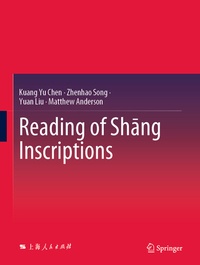
Reading of Shang Inscriptions
1st Edition
Published on 9. November 2020
XIII, 558 pages
978-981-15-6214-3 (ISBN)
Description

This book introduces readers to oracle bone inscriptions (OBI), the oldest known form of Chinese writing. It presents 120 rubbings made from unearthed animal bones and turtle shells that the Shang royal court employed to record royal divinations 3500 years ago, covering topics ranging from ancestor worship, rituals, and astronomy to agriculture, war, and hunting. Each rubbing is accompanied by a graph-to-graph transcription, a translation and a detailed annotation. The book is intended for both general readers and scholars who are interested in ancient civilizations and Early China in particular, acquainting them not only with OBI graphs and the development of the Chinese writing system, but also the history of the Shang Dynasty. The didactic and tutorial format makes this book ideal for teaching and for self-learning.
Sumerian, Egyptian, Chinese OBI and Mayan constitute the four pristine writing systems. Of these, only Chinese writing has remained logographic and survived to the present day. The study of OBI not only plays a pivotal role in connecting archaeology to history, but is also of great importance to the comparative study of the origin of writing and civilization. Though there are numerous books on Mayan and Egyptian hieroglyphs, there are very few on OBI; this book fills that gap.
Sumerian, Egyptian, Chinese OBI and Mayan constitute the four pristine writing systems. Of these, only Chinese writing has remained logographic and survived to the present day. The study of OBI not only plays a pivotal role in connecting archaeology to history, but is also of great importance to the comparative study of the origin of writing and civilization. Though there are numerous books on Mayan and Egyptian hieroglyphs, there are very few on OBI; this book fills that gap.
More details
Series
Language
English
Place of publication
Singapore
Singapore
Publishing group
Springer Singapore
Target group
Professional and scholarly
Illustrations
XIII, 558 p. 25 illus., 17 illus. in color.
File size
187,98 MB
ISBN-13
978-981-15-6214-3 (9789811562143)
DOI
10.1007/978-981-15-6214-3
Schweitzer Classification
Other editions
Additional editions
Kuang Yu Chen | Zhenhao Song | Yuan Liu
Reading of Shang Inscriptions
Book
11/2020
Springer
€117.69
Shipment within 3-4 weeks
Persons
Kuang Yu Chen
is a Distinguished Professor at Rutgers University where he serves at the Department of Chemistry and Chemical Biology, as well as at the Department of Asian Languages and Cultures. He is a board member of the Confucius Institute at Rutgers and an elected Fellow of the American Association for the Advancement of Science. He was a speaker at the 2018 Colloquium Series of the Institute of Archaeology, Chinese Academy of Social Sciences, Beijing, and in 2019, he was the keynote speaker at the International Conference on Paleography and Unearthed Texts at Henan University, Kaifeng.
He studied oracle bone inscriptions (OBI) and Archaeology at National Taiwan University, Taipei and at the Graduate School at Yale University, working under several highly respected scholars, including Jin Xiangheng( ??? NTU), Li Xiaoding (???NTU), Chang Kwang-chi (??? Yale), and JaoTsung-I (??? Yale). He has taught OBI at Rutgers University for over 10 years. He also taught a seminar course at Rutgers entitled "Origin of Writing and Civilization."
Zhenhao Song is an Academic Committee Member and Research Fellow at the Institute of History, Chinese Academy of Social Sciences, Beijing. He is also the Director of the Center of Research on Oracle Bone and Shang History at the Chinese Academy of Social Sciences. He is the chief editor of the Journal of Oracle Bone Inscriptions and Shang History («???????»). He has edited two highly acclaimed book series: Society and Life of Xia and Shang ( «???????») and History of Shang Dynasty («???»), and has published numerous articles in the field of paleography and pre-Qin China. He has received numerous awards for his contributions to oracle bone research, including cataloging and publishing the source materials for OBI research. He has recently compiled seven volumes of OBI collected from private and public sources, adding thousands of hitherto unpublishedpieces to the corpus of OBI.
Yuan Liu is a Research Fellow at the Institute of History, Chinese Academy of Social Sciences, Beijing. He is also a Professor of History at the University of the Chinese Academy of Social Sciences. His research focuses on the evolution of social structure, political and administrative machinery, and cultural institutions in the Shang and Zhou Dynasties. He is also interested in didactics of OBI and bronze inscriptions (BI). He has authored the Study of Ancestral Worship Ceremony in Shang and Zhou («???????») and published numerous journal articles and conference papers on OBI, BI, and Shang Zhou history.
Matthew Anderson is an independent scholar on Early China. He studied under Professor Victor Mair and holds a Ph.D. in East Asian Languages and Civilizations from the University of Pennsylvania, Philadelphia. His thesis Change and Standardization in Anyang: Writing and Culture in Bronze Age China is available through University of Pennsylvania Scholarly Commons. He is interested in the origins and evolution of the Chinese writing system, the linguistic development of Chinese, early Chinese rituals and religious practice, and interactions between the Early Chinese states and peoples on their peripheries. He is currently translating the corpus Yinxu Xiaotun cun zhong cun nan jiagu (Oracle bones from the center and south of Xiaotun village in the Yin Ruins).
He studied oracle bone inscriptions (OBI) and Archaeology at National Taiwan University, Taipei and at the Graduate School at Yale University, working under several highly respected scholars, including Jin Xiangheng( ??? NTU), Li Xiaoding (???NTU), Chang Kwang-chi (??? Yale), and JaoTsung-I (??? Yale). He has taught OBI at Rutgers University for over 10 years. He also taught a seminar course at Rutgers entitled "Origin of Writing and Civilization."
Zhenhao Song is an Academic Committee Member and Research Fellow at the Institute of History, Chinese Academy of Social Sciences, Beijing. He is also the Director of the Center of Research on Oracle Bone and Shang History at the Chinese Academy of Social Sciences. He is the chief editor of the Journal of Oracle Bone Inscriptions and Shang History («???????»). He has edited two highly acclaimed book series: Society and Life of Xia and Shang ( «???????») and History of Shang Dynasty («???»), and has published numerous articles in the field of paleography and pre-Qin China. He has received numerous awards for his contributions to oracle bone research, including cataloging and publishing the source materials for OBI research. He has recently compiled seven volumes of OBI collected from private and public sources, adding thousands of hitherto unpublishedpieces to the corpus of OBI.
Yuan Liu is a Research Fellow at the Institute of History, Chinese Academy of Social Sciences, Beijing. He is also a Professor of History at the University of the Chinese Academy of Social Sciences. His research focuses on the evolution of social structure, political and administrative machinery, and cultural institutions in the Shang and Zhou Dynasties. He is also interested in didactics of OBI and bronze inscriptions (BI). He has authored the Study of Ancestral Worship Ceremony in Shang and Zhou («???????») and published numerous journal articles and conference papers on OBI, BI, and Shang Zhou history.
Matthew Anderson is an independent scholar on Early China. He studied under Professor Victor Mair and holds a Ph.D. in East Asian Languages and Civilizations from the University of Pennsylvania, Philadelphia. His thesis Change and Standardization in Anyang: Writing and Culture in Bronze Age China is available through University of Pennsylvania Scholarly Commons. He is interested in the origins and evolution of the Chinese writing system, the linguistic development of Chinese, early Chinese rituals and religious practice, and interactions between the Early Chinese states and peoples on their peripheries. He is currently translating the corpus Yinxu Xiaotun cun zhong cun nan jiagu (Oracle bones from the center and south of Xiaotun village in the Yin Ruins).
Content
1 Ganzhi Cycle.- 2 The Millet Harvest.- 3 Fifteen Dogs.- 4 Rain in the First Month.- 5 Rain from the East.- 6 From Daybreak to Morning.- 7 Tricolored Clouds.- 8 Heavy Rain.- 9 Encounter Gusty Wind.- 10 Strong Gale.
