

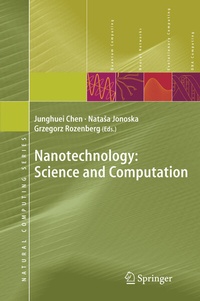
Nanotechnology: Science and Computation
Description

Nanoscale science and computing is becoming a major research area as today's scientists try to understand the processes of natural and biomolecular computing. The field is concerned with the architectures and design of molecular self-assembly, nanostructures and molecular devices, and with understanding and exploiting the computational processes of biomolecules in nature.
This book offers a unique and authoritative perspective on current research in nanoscale science, engineering and computing. Leading researchers cover the topics of DNA self-assembly in two-dimensional arrays and three-dimensional structures, molecular motors, DNA word design, molecular electronics, gene assembly, surface layer protein assembly, and membrane computing.
The book is suitable for academic and industrial scientists and engineers working in nanoscale science, in particular researchers engaged with the idea of computing at a molecular level.
More details
Other editions
Additional editions
Persons
Junghei Chen received his Ph.D. in Chemistry from NYU, under the supervision of Ned Seeman. He has since worked at Berkeley and is now Associate Professor in the Department of Chemistry and Biochemistry at the University of Delaware. He has edited a Springer book: LNCS 2943, Int. Workshop on DNA Based Computers, DNA 9 (2003). He has authored dozens of papers in key journals areas of chemistry, biochemistry, physics, computing and nanoscience
Natascha Jonoska received her Ph.D. in Mathematical Science from SUNY Binghamton and is currently Associate Professor in the Mathematics Dept. at the University of South Florida. She has coedited a number of Springer books: LNCS 2723, Genetic and Evolutionary Computation Conf., GECCO 2003; LNCS 2950, Aspects of Molecular Computing, Essays Dedicated to Tom Head on the Occasion of His 70th Birthday (2004). Natasha has also contributed chapters in various Natural Computing books, and many journal and LNCS articles. Her journal publications cover her interests in both theoretical computer science and natural computing.
Grzegorz Rozenberg is the editor of the Springer Natural Computing series; is one of the series editors of the Springer EATCS Texts in Theoretical Computer Science series; was until this year the editor of the Springer journal Natural Computing; is the editor of the Elsevier Theoretical Computer Science journal Track C (Natural Computing). He has also edited or authored dozens of Springer books over the last 30 years. He has authored hundreds of publications in theoretical computer science and natural computing, and has been involved in the organization of dozens of conferences in both communities. He has authored and edited dozens of LNCS volumes and monographs, across a range of theoretical computer science fields and also in the area of natural computing. He has also recently edited some relevant Natural Computing series and EATCS series books, such as: Modelling in Molecular Biology (2004); Computation in Living Cells (2004); DNA Computing -- New Computing Paradigms (Reprint 2005). He also coedited LNCS 2950, Aspects of Molecular Computing, Essays Dedicated to Tom Head on the Occasion of His 70th Birthday (2004).
