

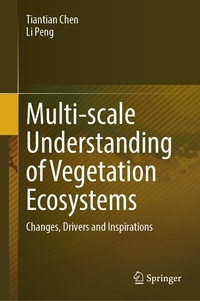
Multi-scale Understanding of Vegetation Ecosystems
Description

This book highlights the vital role of vegetation in terrestrial surface systems, emphasizing its importance in regulating climate change, acting as a carbon sink, and maintaining the surface energy balance by absorbing CO2 from human activities. However, urbanization, extreme droughts, floods, fires, and other events negatively impact biodiversity, increase tree mortality, trigger wildfires, and exacerbate food insecurity and poverty. Understanding the influence of global climate change and human activity on vegetation patterns is essential. The structure and function of vegetation ecosystems result from interactions between natural ecological processes and socio-cultural factors, leading to variability across different spatial and temporal scales. While local-scale studies provide detailed insights, they are often difficult to generalize. Conversely, large-scale studies can inform comprehensive planning but may overlook nuances between subsystems. Therefore, enhancing research on the evolution of vegetation ecosystems and their responses to climate change across multiple scales is crucial to mitigate risks and maintain ecosystem balance.
Extensive studies have explored the spatiotemporal dynamics and driving forces on large-scale vegetation structure, productivity, and resilience, especially on a global scale. However, there is limited research on vegetation characteristics in specific geological conditions and geomorphic regions, particularly in karst regions. Karst landforms account for 15% of the global vegetated land and are vital for global carbon and water cycles, as well as biodiversity conservation. Southwest China, the largest contiguous karst region, represents 0.36% of the vegetated land but contributes 5% of global aboveground biomass, making it a key carbon sink. However, its fragile ecological conditions, frequent extreme climate events, and unsustainable human activities have led to significant vegetation degradation and desertification, resulting in severe environmental damage in recent decades. To address these issues, ecological restoration measures have been launched since the early 2000s to boost vegetation.
More details
Other editions
Additional editions
Persons
Dr. Tiantian Chen is an associate professor in the College of Geography and Tourism, Chongqing Normal University, China. Her research focuses on land use structure and ecological process, ecosystem services and human well-being, and sustainability.
Dr. Li Peng is a distinguished professor in the Faculty Geography Resource Sciences, Sichuan Normal University, China. His research focuses on land use structure and ecological process, disaster risk adaptation and management, spatial planning and geographic big data, and rural sustainable development.
Content
Part ? - Vegetation ecosystem changes and ecological zoning in Southwest China.- 1. Spatiotemporal pattern and driving forces of vegetation dynamics in Southwest China.- 2. Nonlinear characteristics and driving forces for karst vegetation resilience variation.- 3. Characteristics and the constraint relationship between vegetation coverage and ecosystem services in Southwest China.- 4. Application of threshold effect between ecosystem services and driving factors in ecological security zoning.- Part ? - Variation and driving forces identification of vegetation ecosystems in China.- 5. Nonlinear processes and driving mechanisms of China's vegetation ecosystem based on the reconstructed NDVI.- 6. Direct and indirect effects of climate and human activities on China's vegetation greening.- 7. Time-lagged and cumulative responses of vegetation growth to drought and human activities.- Part ? - Evolution of vegetation carbon-water process and its response to climate changes.- 8. Global GPP changes and its sensitivity to temperature.- 9. Time-lagged response of global GPP to drought and its socio-economic risks.- 10. Global GPP variations and its intricate response to VPD and SM.- 11. Changes in carbon use efficiency of vegetation ecosystem and its driving forces.- 12. Vegetation water use efficiency prediction and its dynamic response to the coupling of VPD and SM.- Appendix A.- Appendix B.
