

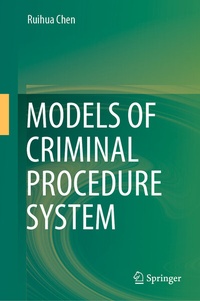
Models of Criminal Procedure System
Description

This book is an in-depth study on the criminal procedure in China. Using the social science research method, the author studies some systems and reforms, such as the criminal reconciliation, the sentencing procedure, the criminal incidental civil action, the trial hearing, the exclusionary rule and the defense system. The author puts forward some new theories and opinions. He points out that there are two modes of criminal procedure in China: the adversarial mode and the cooperative mode. He has advanced a new theory based on the practice of the procedure where the defendant pleads guilty or the parties reach a reconciliation. Also, the author has summarized three forms of criminal trial and three modes of criminal incidental civil action. He analyzes "conviction trial", "sentencing trial" and "procedural trial" and points out their defects. He holds that the coexistence of the three models of incidental civil action reflects some problems in the criminal procedure.
The criminal procedure has the problem of malfunction which refers to the fact that the procedure prescribed by the law is not effectively implemented. The author points out five sources of the process's malfunction through factual and empirical analysis. He describes them as the "5 rules of malfunction of the criminal procedure". As for the criminal defense system, the author thinks that it not only has made great progress, but also has a great deal of problems. Also, the author puts forward a theory of coordinating defense which aims at rebuilding the relationship between the defense lawyer and the accused. China has established the exclusionary rule with its own characteristics. The author points out that the reformers should not only enact the rule,but also pay attention to its implementation. A series of judicial reforms will arrive, for which the exclusionary rule is the activator and the start.
More details
Other editions
Additional editions
Person
Translator: Gao Yong, associate professor, Beijing International Studies University. Her main research interests are Criminal Procedural Law, Evidence law and judicial system.
