

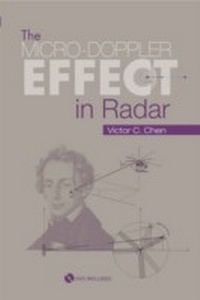
Micro-Doppler Effect in Radar
1st Edition
Published on 1. January 2011
340 pages
978-1-60807-058-9 (ISBN)
Description

This highly practical resource provides you with thorough working knowledge of the micro-Doppler effect in radar, including its principles, applications and implementation with MATLAB codes. The book presents code for simulating radar backscattering from targets with various motions, generating micro-Doppler signatures, and analyzing the characteristics of targets. You find detailed descriptions of the physics and mathematics of the Doppler and micro-Doppler effect. Moreover, you learn how to derive rigid and non-rigid body motion induced micro-Doppler effect in radar scattering. The book provides a wide range of clear examples, including an oscillating pendulum, a spinning and precession heavy top, rotating rotor blades of a helicopter, rotating wind-turbine blades, a person walking with swinging arms and legs, a flying bird, and movements of quadruped animals. DVD Included! Contains time-saving MATLAB(R) source codes for simulation, radar data processing, and micro-Doppler signature analysis to help you with your challenging projects in the field.
More details
Other editions
Additional editions
Victor Chen
The Micro-Doppler Effect in Radar
Book
02/2011
Artech House Publishers
€136.67
Shipment within 10-20 days
Content
- The Micro-Doppler Effect in Radar
- Contents
- Preface
- 1 Introduction
- 1.1 Doppler Effect
- 1.2 Relativistic Doppler Effect and Time Dilation
- 1.3 Doppler Effect Observed in Radar
- 1.4 Estimation and Analysis of Doppler Frequency Shifts
- 1.5 Cramer-Rao Bound of the Doppler Frequency Estimation
- 1.6 The Micro-Doppler Effect
- 1.7 Micro-Doppler Effect Observed in Radar
- 1.8 Estimation and Analysis of Micro-Doppler Frequency Shifts
- 1.8.1 Instantaneous Frequency Analysis
- 1.8.2 Joint Time-Frequency Analysis
- 1.9 The Micro-Doppler Signature of Objects
- References
- Appendix 1A MATLAB Source Codes
- 2 Basics of the Micro-Doppler Effect in Radar
- 2.1 Rigid Body Motion
- 2.1.1 Euler Angles
- 2.1.2 Quaternion
- 2.1.3 Equations of Motion
- 2.2 Nonrigid Body Motion
- 2.3 Electromagnetic Scattering from a Body with Motion
- 2.3.1 Radar Cross Section of a Target
- 2.3.2 RCS Prediction Methods
- 2.3.3 EM Scattering from a Body with Motion
- 2.4 Basic Mathematics for Calculating the Micro-Doppler Effect
- 2.4.1 Micro-Doppler Induced by a Target with Micro Motion
- 2.4.2 Vibration-Induced Micro-Doppler Shift
- 2.4.3 Rotation-Induced Micro-Doppler Shift
- 2.4.4 Coning Motion-Induced Micro-Doppler Shift
- 2.5 Bistatic Micro-Doppler Effect
- 2.6 Multistatic Micro-Doppler Effect
- 2.7 Cramer-Rao Bound of the Micro-Doppler Estimation
- References
- Appendix 2A
- Appendix 2B MATLAB Source Codes
- 3 The Micro-Doppler Effect of the Rigid Body Motion
- 3.1 Pendulum Oscillation
- 3.1.1 Modeling Nonlinear Motion Dynamic of a Pendulum
- 3.1.2 Modeling RCS of a Pendulum
- 3.1.3 Radar Backscattering from an Oscillating Pendulum
- 3.1.4 Micro-Doppler Signatures Generated by an Oscillating Pendulum
- 3.2 Helicopter Rotor Blades
- 3.2.1 Mathematic Model of Rotating Rotor Blades
- 3.2.2 RCS Model of Rotating Rotor Blades
- 3.2.3 PO Facet Prediction Model
- 3.2.4 Radar Backscattering from Rotor Blades
- 3.2.5 Micro-Doppler Signatures of Rotor Blades
- 3.2.6 Required Minimum PRF
- 3.2.7 Analysis and Interpretation of the Micro-Doppler Signature of Rotor Blades
- 3.3 Spinning Symmetric Top
- 3.3.1 Force-Free Rotation of a Symmetric Top
- 3.3.2 Torque-Induced Rotation of a Symmetric Top
- 3.3.3 RCS Model of a Symmetric Top
- 3.3.4 Radar Backscattering from a Symmetric Top
- 3.3.5 Micro-Doppler Signatures Generated by a Precession Top
- 3.3.6 Analysis and Interpretation of the Micro-Doppler Signature of a PrecessionTop
- 3.4 Wind Turbines
- 3.4.1 Micro-Doppler Signatures of Wind Turbines
- 3.4.2 Analysis and Interpretation of the Micro-Doppler Signature of Wind Turbines
- References
- Appendix 3A MATLAB Source Codes
- 4 The Micro-Doppler Effect of the Nonrigid Body Motion
- 4.1 Human Body Articulated Motion
- 4.1.1 Human Walking
- 4.1.2 Description of the Periodic Motion of Human Walking
- 4.1.3 Simulation of Human Movements
- 4.1.4 Human Body Segment Parameters
- 4.1.5 Human Walking Model Derived from Empirical Mathematical Parameterizations
- 4.1.6 Capturing Human Motion Kinematic Parameters
- 4.1.7 Three-Dimensional Kinematic Data Collection
- 4.1.8 Characteristics of Angular Kinematics Using the Angle-Cyclogram Pattern
- 4.1.9 Radar Backscattering from a Walking Human
- 4.1.10 Human Movement Data Processing
- 4.1.11 Human Movement-Induced Radar Micro-Doppler Signatures
- 4.2 Bird Wing Flapping
- 4.2.1 Bird Wing Flapping Kinematics
- 4.2.2 Doppler Observations of the Bird Wing Flapping
- 4.2.3 Simulation of the Bird Wing Flapping
- 4.3 Quadrupedal Animal Motion
- 4.3.1 Modeling of Quadrupedal Locomotion
- 4.3.2 Micro-Doppler Signatures of Quadrupedal Locomotion
- 4.3.3 Summary
- References
- Appendix 4A MATLAB Source Codes
- Appendix 4B MATLAB Source Codes
- 5 Analysis and Interpretation of Micro-Doppler Signatures
- 5.1 Biological Motion Perception
- 5.2 Decomposition of Biological Motion
- 5.2.1 Statistics-Based Decomposition
- 5.2.2 Decomposition of Micro-Doppler Signatures in the Joint Time-Frequency Domain
- 5.2.3 Physical Component-Based Decomposition
- 5.3 Extraction of Features from Micro-Doppler Signatures
- 5.4 Estimation of Kinematic Parameters from Micro-Doppler Signatures
- 5.5 Identifying Human Movements
- 5.5.1 Features Used for Identifying Human Movements
- 5.5.2 Anomalous Human Behavior
- 5.5.3 Summary
- References
- 6 Summary, Challenges, and Perspectives
- 6.1 Summary
- 6.2 Challenges
- 6.2.1 Decomposing Micro-Doppler Signatures
- 6.2.2 Feature Extraction and Target Identification Based on Micro-Doppler Signatures
- 6.3 Perspectives
- 6.3.1 Multistatic Micro-Doppler Analysis
- 6.3.2 Micro-Doppler Signature-Based Classification
- 6.3.3 Aural Methods for Micro-Doppler-Based Discrimination
- 6.3.4 Through-the-Wall Micro-Doppler Signatures
- References
- About the Author
- Index
