

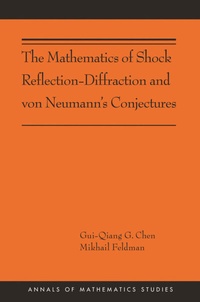
The Mathematics of Shock Reflection-Diffraction and von Neumann's Conjectures
(AMS-197)
Published on 10. September 2018
832 pages
978-1-4008-8543-5 (ISBN)
Description

This book offers a survey of recent developments in the analysis of shock reflection-diffraction, a detailed presentation of original mathematical proofs of von Neumann's conjectures for potential flow, and a collection of related results and new techniques in the analysis of partial differential equations (PDEs), as well as a set of fundamental open problems for further development.
Shock waves are fundamental in nature. They are governed by the Euler equations or their variants, generally in the form of nonlinear conservation laws-PDEs of divergence form. When a shock hits an obstacle, shock reflection-diffraction configurations take shape. To understand the fundamental issues involved, such as the structure and transition criteria of different configuration patterns, it is essential to establish the global existence, regularity, and structural stability of shock reflection-diffraction solutions. This involves dealing with several core difficulties in the analysis of nonlinear PDEs-mixed type, free boundaries, and corner singularities-that also arise in fundamental problems in diverse areas such as continuum mechanics, differential geometry, mathematical physics, and materials science. Presenting recently developed approaches and techniques, which will be useful for solving problems with similar difficulties, this book opens up new research opportunities.
Shock waves are fundamental in nature. They are governed by the Euler equations or their variants, generally in the form of nonlinear conservation laws-PDEs of divergence form. When a shock hits an obstacle, shock reflection-diffraction configurations take shape. To understand the fundamental issues involved, such as the structure and transition criteria of different configuration patterns, it is essential to establish the global existence, regularity, and structural stability of shock reflection-diffraction solutions. This involves dealing with several core difficulties in the analysis of nonlinear PDEs-mixed type, free boundaries, and corner singularities-that also arise in fundamental problems in diverse areas such as continuum mechanics, differential geometry, mathematical physics, and materials science. Presenting recently developed approaches and techniques, which will be useful for solving problems with similar difficulties, this book opens up new research opportunities.
More details
Other editions
Additional editions
Gui-Qiang Chen | Mikhail Feldman
The Mathematics of Shock Reflection-Diffraction and von Neumann's Conjectures
Book
02/2018
Princeton University Press
€94.50
Shipment within 10-20 days
Gui-Qiang Chen | Mikhail Feldman
The Mathematics of Shock Reflection-Diffraction and von Neumann's Conjectures
Book
02/2018
Princeton University Press
€207.50
Shipment within 10-20 days
Persons
Gui-Qiang G. Chen is the Statutory Professor in the Analysis of Partial Differential Equations at the Mathematical Institute of the University of Oxford, where he is also professorial fellow at Keble College. Mikhail Feldman is professor of mathematics at the University of Wisconsin-Madison.
Content
- Cover
- Title
- Copyright
- Contents
- Preface
- I Shock Reflection-Diffraction, Nonlinear Conservation Laws of Mixed Type, and von Neumann's Conjectures
- 1 Shock Reflection-Diffraction, Nonlinear Partial Differential Equations of Mixed Type, and Free Boundary Problems
- 2 Mathematical Formulations and Main Theorems
- 2.1 The potential flow equation
- 2.2 Mathematical problems for shock reflection-diffraction
- 2.3 Weak solutions of Problem 2.2.1 and Problem 2.2.3
- 2.4 Structure of solutions: Regular reflection-diffraction configurations
- 2.5 Existence of state (2) and continuous dependence on the parameters
- 2.6 Von Neumann's conjectures, Problem 2.6.1 (free boundary problem), and main theorems
- 3 Main Steps and Related Analysis in the Proofs of the Main Theorems
- 3.1 Normal reflection
- 3.2 Main steps and related analysis in the proof of the sonic conjecture
- 3.3 Main steps and related analysis in the proof of the detachment conjecture
- 3.4 Appendix: The method of continuity and fixed point theorems
- II Elliptic Theory and Related Analysis for Shock Reflection-Diffraction
- 4 Relevant Results for Nonlinear Elliptic Equations of Second Order
- 4.1 Notations: Hölder norms and ellipticity
- 4.2 Quasilinear uniformly elliptic equations
- 4.3 Estimates for Lipschitz solutions of elliptic boundary value problems
- 4.4 Comparison principle for a mixed boundary value problem in a domain with corners
- 4.5 Mixed boundary value problems in a domain with corners for uniformly elliptic equations
- 4.6 Hölder spaces with parabolic scaling
- 4.7 Degenerate elliptic equations
- 4.8 Uniformly elliptic equations in a curved triangle-shaped domain with one-point Dirichlet condition
- 5 Basic Properties of the Self-Similar Potential Flow Equation
- 5.1 Some basic facts and formulas for the potential flow equation
- 5.2 Interior ellipticity principle for self-similar potential flow
- 5.3 Ellipticity principle for self-similar potential flow with slip condition on the flat boundary
- III Proofs of the Main Theorems for the Sonic Conjecture and Related Analysis
- 6 Uniform States and Normal Reflection
- 6.1 Uniform states for self-similar potential flow
- 6.2 Normal reflection and its uniqueness
- 6.3 The self-similar potential flow equation in the coordinates flattening the sonic circle of a uniform state
- 7 Local Theory and von Neumann's Conjectures
- 7.1 Local regular reflection and state (2)
- 7.2 Local theory of shock reflection for large-angle wedges
- 7.3 The shock polar for steady potential flow and its properties
- 7.4 Local theory for shock reflection: Existence of the weak and strong state (2) up to the detachment angle
- 7.5 Basic properties of the weak state (2) and the definition of supersonic and subsonic wedge angles
- 7.6 Von Neumann's sonic and detachment conjectures
- 8 Admissible Solutions and Features of Problem 2.6.1
- 8.1 Definition of admissible solutions
- 8.2 Strict directional monotonicity for admissible solutions
- 8.3 Appendix: Properties of solutions of Problem 2.6.1 for large-angle wedges
- 9 Uniform Estimates for Admissible Solutions
- 9.1 Bounds of the elliptic domain O and admissible solution f in O
- 9.2 Regularity of admissible solutions away from ? shock ??sonic ?{P3}
- 9.3 Separation of ?shock from ?sym
- 9.4 Lower bound for the distance between ?shock and ?wedge
- 9.5 Uniform positive lower bound for the distance between ?shock and the sonic circle of state (1)
- 9.6 Uniform estimates of the ellipticity constant in O\Gsonic
- 10 Regularity of Admissible Solutions away from the Sonic Arc
- 10.1 Gshock as a graph in the radial directions with respect to state (1)
- 10.2 Boundary conditions on Gshock for admissible solutions
- 10.3 Local estimates near Gshock
- 10.4 The critical angle and the distance between Gshock and Gwedge
- 10.5 Regularity of admissible solutions away from Gsonic
- 10.6 Regularity of the limit of admissible solutions away from Gsonic
- 11 Regularity of Admissible Solutions near the Sonic Arc
- 11.1 The equation near the sonic arc and structure of elliptic degeneracy
- 11.2 Structure of the neighborhood of Gsonic in O and estimates of (?, D?)
- 11.3 Properties of the Rankine-Hugoniot condition on Gshock near Gsonic
- 11.4 C2,a -estimates in the scaled Hölder norms near Gsonic
- 11.5 The reflected-diffracted shock is C2,a near P1
- 11.6 Compactness of the set of admissible solutions
- 12 Iteration Set and Solvability of the Iteration Problem
- 12.1 Statement of the existence results
- 12.2 Mapping to the iteration region
- 12.3 Definition of the iteration set
- 12.4 The equation for the iteration
- 12.5 Assigning a boundary condition on the shock for the iteration
- 12.6 Normal reflection, iteration set, and admissible solutions
- 12.7 Solvability of the iteration problem and estimates of solutions
- 12.8 Openness of the iteration set
- 13 Iteration Map, Fixed Points, and Existence of Admissible Solutions up to the Sonic Angle
- 13.1 Iteration map
- 13.2 Continuity and compactness of the iteration map
- 13.3 Normal reflection and the iteration map for ?w = p/2
- 13.4 Fixed points of the iteration map for ?w & p/2 are admissible solutions
- 13.5 Fixed points cannot lie on the boundary of the iteration set
- 13.6 Proof of the existence of solutions up to the sonic angle or the critical angle
- 13.7 Proof of Theorem 2.6.2: Existence of global solutions up to the sonic angle when u1 = c1
- 13.8 Proof of Theorem 2.6.4: Existence of global solutions when u1 & c1
- 13.9 Appendix: Extension of the functions in weighted spaces
- 14 Optimal Regularity of Solutions near the Sonic Circle
- 14.1 Regularity of solutions near the degenerate boundary for nonlinear degenerate elliptic equations of second order
- 14.2 Optimal regularity of solutions across Gsonic
- IV Subsonic Regular Reflection-Diffraction and Global Existence of Solutions up to the Detachment Angle
- 15 Admissible Solutions and Uniform Estimates up to the Detachment Angle
- 15.1 Definition of admissible solutions for the supersonic and subsonic reflections
- 15.2 Basic estimates for admissible solutions up to the detachment angle
- 15.3 Separation of Gshock from Gsym
- 15.4 Lower bound for the distance between Gshock and Gwedge away from P0
- 15.5 Uniform positive lower bound for the distance between Gshock and the sonic circle of state (1)
- 15.6 Uniform estimates of the ellipticity constant
- 15.7 Regularity of admissible solutions away from Gsonic
- 16 Regularity of Admissible Solutions near the Sonic Arc and the Reflection Point
- 16.1 Pointwise and gradient estimates near Gsonic and the reflection point
- 16.2 The Rankine-Hugoniot condition on Gshock near Gsonic and the reflection point
- 16.3 A priori estimates near Gsonic in the supersonic-away-from-sonic case
- 16.4 A priori estimates near Gsonic in the supersonic-near-sonic case
- 16.5 A priori estimates near the reflection point in the subsonic-near-sonic case
- 16.6 A priori estimates near the reflection point in the subsonic-away-from-sonic case
- 17 Existence of Global Regular Reflection-Diffraction Solutions up to the Detachment Angle
- 17.1 Statement of the existence results
- 17.2 Mapping to the iteration region
- 17.3 Iteration set
- 17.4 Existence and estimates of solutions of the iteration problem
- 17.5 Openness of the iteration set
- 17.6 Iteration map and its properties
- 17.7 Compactness of the iteration map
- 17.8 Normal reflection and the iteration map for ?w = p/2
- 17.9 Fixed points of the iteration map for w & 2 are admissible solutions
- 17.10 Fixed points cannot lie on the boundary of the iteration set
- 17.11 Proof of the existence of solutions up to the critical angle
- 17.12 Proof of Theorem 2.6.6: Existence of global solutions up to the detachment angle when u1 = c1
- 17.13 Proof of Theorem 2.6.8: Existence of global solutions when u1 & c1
- V Connections and Open Problems
- 18 The Full Euler Equations and the Potential Flow Equation
- 18.1 The full Euler equations
- 18.2 Mathematical formulation I: Initial-boundary value problem
- 18.3 Mathematical formulation II: Boundary value problem
- 18.4 Normal reflection
- 18.5 Local theory for regular reflection near the reflection point
- 18.6 Von Neumann's conjectures
- 18.7 Connections with the potential flow equation
- 19 Shock Reflection-Diffraction and New Mathematical Challenges
- 19.1 Mathematical theory for multidimensional conservation laws
- 19.2 Nonlinear partial differential equations of mixed elliptic-hyperbolic type
- 19.3 Free boundary problems and techniques
- 19.4 Numerical methods for multidimensional conservation laws
- Bibliography
- Index
