

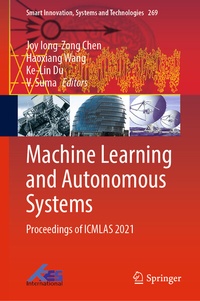
Machine Learning and Autonomous Systems
Description

More details
Other editions
Additional editions
Persons
Dr. Joy Iong-Zong Chen is currently a full professor of Department of Electrical Engineering Dayeh University at Changhua, Taiwan. Prior to joining the Dayeh University, he worked at the Control Data Company (Taiwan) as a technical manager since September 1985 to September 1996. His research interests include wireless communications, spread spectrum technical, OFDM systems, and wireless sensor networks. He has published a large number of SCI Journal papers in the issues addressed physical layer for wireless communication systems. Moreover, he also majors in developing some applications of the Internet of Thing (IoT) techniques, and Dr. Joy I.-Z. Chen owned some patents authorized by the Taiwan Intellectual Property Office (TIPO).
Haoxiang Wang is currently the director and lead executive faculty member of GoPerception Laboratory, NY, USA. His research interests include multimedia information processing, pattern recognition and machine learning, remote sensing image processingand data-driven business intelligence. He has co-authored over 60 journal and conference papers in these fields on journals such as Springer MTAP, Cluster Computing, SIVP; IEEE TII, Communications Magazine; ElsevierComputers & Electrical Engineering, Computers, Environment and Urban Systems, Optik, Sustainable Computing: Informatics and Systems, Journal of Computational Science, Pattern Recognition Letters, Information Sciences, Computers in Industry, Future Generation Computer Systems; Taylor&Francis International Journal of Computers and Applications and conference such as IEEE SMC, ICPR, ICTAI, ICICI, CCIS and ICACI. He is the guest editor for IEEE Transactions on Industrial Informatics, IEEE Consumer Electronics Magazine, Multimedia Tools and Applications, MDPI Sustainability, International Journal of Information and Computer Security, Journal of Medical Imaging and Health Informatics and Concurrency and Computation: Practice and Experience.
Dr. Ke-Lin Du is a research scientist at Center for Signal Processing and Communications, Department of Electrical and Computer Engineering, Concordia University, since 2001, where he became an affiliate associate professor in 2011. I investigated on signal processing, wireless communications and soft computing.
Dr. Suma. V has obtained her B.E. in Information Science and Technology, M.S. in Software Systems and her Ph.D. in Computer Science and Engineering. She has a vast experience of more than 17 years of teaching. She has published more than 183 international publications which include her research articles published in world class international journals such as ACM, ASQ, Crosstalk, IET Software and international journals from Inderscience publishers, from journals released in MIT, Darmout, USA. Her research results are published in NASA, UNI trier, Microsoft, CERN, IEEE, ACM portals, Springer and so on.
