

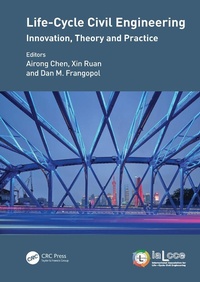
Life-Cycle Civil Engineering: Innovation, Theory and Practice
Proceedings of the 7th International Symposium on Life-Cycle Civil Engineering (IALCCE 2020), October 27-30, 2020, Shanghai, China
1st Edition
Published on 26. February 2021
384 pages
978-1-000-34204-8 (ISBN)
Description

Life-Cycle Civil Engineering: Innovation, Theory and Practice contains the lectures and papers presented at IALCCE2020, the Seventh International Symposium on Life-Cycle Civil Engineering, held in Shanghai, China, October 27-30, 2020. It consists of a book of extended abstracts and a multimedia device containing the full papers of 230 contributions, including the Fazlur R. Khan lecture, eight keynote lectures, and 221 technical papers from all over the world. All major aspects of life-cycle engineering are addressed, with special emphasis on life-cycle design, assessment, maintenance and management of structures and infrastructure systems under various deterioration mechanisms due to various environmental hazards.
It is expected that the proceedings of IALCCE2020 will serve as a valuable reference to anyone interested in life-cycle of civil infrastructure systems, including students, researchers, engineers and practitioners from all areas of engineering and industry.
It is expected that the proceedings of IALCCE2020 will serve as a valuable reference to anyone interested in life-cycle of civil infrastructure systems, including students, researchers, engineers and practitioners from all areas of engineering and industry.
More details
Series
Edition
1. Auflage
Language
English
Place of publication
London
United Kingdom
Publishing group
Taylor & Francis Ltd
Target group
College/higher education
Professional and scholarly
Adult education
ISBN-13
978-1-000-34204-8 (9781000342048)
Copyright in bibliographic data and cover images is held by Nielsen Book Services Limited or by the publishers or by their respective licensors: all rights reserved.
Schweitzer Classification
Other editions
Additional editions
Airong Chen | Xin Ruan | Dan M. Frangopol
Life-Cycle Civil Engineering: Innovation, Theory and Practice
Proceedings of the 7th International Symposium on Life-Cycle Civil Engineering (IALCCE 2020), October 27-30, 2020, Shanghai, China
Book
01/2021
1st Edition
CRC Press
€284.74
Shipment within 15-20 days
Persons
Content
Preface. Sponsors. Symposium organization. Acknowledgements. Fazlur R. Khan Lecture
Keynote Lectures. Mini-Symposia. MS1: Life-cycle performance assessment of civil engineering systems. MS2: Vibration-based structural health monitoring, damage identification and residual lifetime estimation. MS3: Time-dependent reliability of reinforced concrete structures. MS4: Risk and resilience-informed structural design and management under multiple hazards in a life-cycle context. MS5: Life-cycle engineering for water infrastructures. MS6: Study and advancement on life-cycle performance of steel-concrete composite structures. MS7: Value protection of built environment. MS8: Modelling and assessment of existing concrete structures. MS9: Structural health monitoring for performance assessment: Theory and applications. MS10: Advances in understanding transport-related phenomena in cement-based materials. MS11: Innovations and applications of composite member/material on life-cycle bridge maintenance and rehabilitation. MS12: Life-cycle performance of timber and timber-hybrid structures. MS13: Innovative inspection (monitoring), evaluation and strengthening technique for existing bridges. Special Sessions. SS1: Design, disaster prevention and repair for the life-cycle of rapid construction bridges. SS2: Distributed fiber optic sensing for geoengineering monitoring. S3: Life-cycle performance of structural interfaces in repair and strengthening applications. SS4: Incorporating natural hazards in the life-cycle analysis of civil infrastructure. SS5: Time-dependent reliability assessment of deteriorating infrastructure systems. SS6: Planning risk reducing interventions on infrastructure networks. SS7: Rehabilitation and renovation of steel bridges. SS8: Innovative multilevel strategies for improving structural assessment and lifetime prediction of concrete structures. SS9: Strengthening infrastructure risk management. SS10: High performance materials in bridge engineering. SS11: Life-cycle redundancy, robustness and resilience indicators for aging structural systems under multiple hazards. SS12: Real-world applications of novel structural health monitoring technologies. SS13: Condition assessment indices in the life cycle of structures. SS14: Life cycle performance of hydraulic engineering. SS15: Life cycle civil engineering: Decarbonization and digitalization. SS16: Advances in state of the art, of the practice and code implementations, in assessment, simulation, and retrofit of aged infrastructures. SS17: Tunnel life-cycle management and application. SS18: Vulnerability of infrastructural under extreme and multi-hazard. General Session.
Keynote Lectures. Mini-Symposia. MS1: Life-cycle performance assessment of civil engineering systems. MS2: Vibration-based structural health monitoring, damage identification and residual lifetime estimation. MS3: Time-dependent reliability of reinforced concrete structures. MS4: Risk and resilience-informed structural design and management under multiple hazards in a life-cycle context. MS5: Life-cycle engineering for water infrastructures. MS6: Study and advancement on life-cycle performance of steel-concrete composite structures. MS7: Value protection of built environment. MS8: Modelling and assessment of existing concrete structures. MS9: Structural health monitoring for performance assessment: Theory and applications. MS10: Advances in understanding transport-related phenomena in cement-based materials. MS11: Innovations and applications of composite member/material on life-cycle bridge maintenance and rehabilitation. MS12: Life-cycle performance of timber and timber-hybrid structures. MS13: Innovative inspection (monitoring), evaluation and strengthening technique for existing bridges. Special Sessions. SS1: Design, disaster prevention and repair for the life-cycle of rapid construction bridges. SS2: Distributed fiber optic sensing for geoengineering monitoring. S3: Life-cycle performance of structural interfaces in repair and strengthening applications. SS4: Incorporating natural hazards in the life-cycle analysis of civil infrastructure. SS5: Time-dependent reliability assessment of deteriorating infrastructure systems. SS6: Planning risk reducing interventions on infrastructure networks. SS7: Rehabilitation and renovation of steel bridges. SS8: Innovative multilevel strategies for improving structural assessment and lifetime prediction of concrete structures. SS9: Strengthening infrastructure risk management. SS10: High performance materials in bridge engineering. SS11: Life-cycle redundancy, robustness and resilience indicators for aging structural systems under multiple hazards. SS12: Real-world applications of novel structural health monitoring technologies. SS13: Condition assessment indices in the life cycle of structures. SS14: Life cycle performance of hydraulic engineering. SS15: Life cycle civil engineering: Decarbonization and digitalization. SS16: Advances in state of the art, of the practice and code implementations, in assessment, simulation, and retrofit of aged infrastructures. SS17: Tunnel life-cycle management and application. SS18: Vulnerability of infrastructural under extreme and multi-hazard. General Session.
