

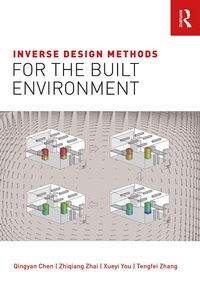
Inverse Design Methods for the Built Environment
Published on 14. July 2017
264 pages
978-1-315-46800-6 (ISBN)
Description

The inverse design approach is new to the built environment research and design community, though it has been used in other industries including automobile and airplane design. This book, from some of the pioneers of inverse design applications in the built environment, introduces the basic principles of inverse design and the specific techniques that can be applied to built environment systems. The authors' inverse design concept uses the desired enclosed environment as the design objective and inversely determines the systems required to achieve the objective.
The book discusses a number of backward and forward methods for inverse design. Backward methods, such as the quasi-reversibility method, the pseudo-reversibility method, and the regularized inverse matrix method, can be used to identify contaminant sources in an enclosed environment. However, these methods cannot be used to inversely design a desired indoor environment. Forward methods, such as the computational-fluid-dynamics (CFD)-based genetic algorithm (GA) method, the CFD-based adjoint method, the CFD-based artificial neural network (ANN) method, and the CFD-based proper orthogonal decomposition (POD) method, show the promise in the inverse design of airflow and heat transfer in an enclosed environment.
The book describes the fundamentals of the methods for beginners, provides exciting design examples for the reader to duplicate, discusses the pros and cons of each design method and points out the knowledge gaps for further development.
The book discusses a number of backward and forward methods for inverse design. Backward methods, such as the quasi-reversibility method, the pseudo-reversibility method, and the regularized inverse matrix method, can be used to identify contaminant sources in an enclosed environment. However, these methods cannot be used to inversely design a desired indoor environment. Forward methods, such as the computational-fluid-dynamics (CFD)-based genetic algorithm (GA) method, the CFD-based adjoint method, the CFD-based artificial neural network (ANN) method, and the CFD-based proper orthogonal decomposition (POD) method, show the promise in the inverse design of airflow and heat transfer in an enclosed environment.
The book describes the fundamentals of the methods for beginners, provides exciting design examples for the reader to duplicate, discusses the pros and cons of each design method and points out the knowledge gaps for further development.
More details
Language
English
Place of publication
London
United Kingdom
Publishing group
Taylor & Francis Ltd
Target group
College/higher education
Illustrations
210 s/w Zeichnungen, 25 s/w Tabellen
25 Tables, black and white; 210 Line drawings, black and white
File size
34,59 MB
ISBN-13
978-1-315-46800-6 (9781315468006)
Copyright in bibliographic data and cover images is held by Nielsen Book Services Limited or by the publishers or by their respective licensors: all rights reserved.
Schweitzer Classification
Other editions
Additional editions
Qingyan Chen | Zhiqiang Zhai | Xueyi You
Inverse Design Methods for the Built Environment
Book
10/2024
1st Edition
Routledge
€62.50
Shipment within 10-20 days
Qingyan Chen | Zhiqiang Zhai | Xueyi You
Inverse Design Methods for the Built Environment
Book
07/2017
1st Edition
Routledge
€217.50
Shipment within 10-20 days
Persons
Qingyan Chen is the Vincent P. Reilly Professor of Mechanical Engineering at Purdue University, USA. He also serves as the Editor-in-Chief of the international journal Building and Environment.
Zhiqiang Zhai is a Professor of Architectural Engineering at the University of Colorado at Boulder, USA.
Xueyi You is a Professor of Environmental Engineering at Tianjin University, China.
Tengfei Zhang is a Professor of HVAC at Dalian University of Technology, China.
Zhiqiang Zhai is a Professor of Architectural Engineering at the University of Colorado at Boulder, USA.
Xueyi You is a Professor of Environmental Engineering at Tianjin University, China.
Tengfei Zhang is a Professor of HVAC at Dalian University of Technology, China.
Content
1. Methods for Inverse/Optimal Design of an Enclosed Environment
2. CFD-Based Genetic Algorithm Method
3. CFD-based Adjoint Method
4. CFD-Based Artificial Neural Network Method
5. CFD-Based Proper Orthogonal Decomposition Method
6. Enhancement of the Inverse Design Methods
2. CFD-Based Genetic Algorithm Method
3. CFD-based Adjoint Method
4. CFD-Based Artificial Neural Network Method
5. CFD-Based Proper Orthogonal Decomposition Method
6. Enhancement of the Inverse Design Methods
