

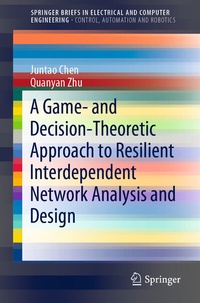
A Game- and Decision-Theoretic Approach to Resilient Interdependent Network Analysis and Design
Description

This brief introduces game- and decision-theoretical techniques for the analysis and design of resilient interdependent networks. It unites game and decision theory with network science to lay a system-theoretical foundation for understanding the resiliency of interdependent and heterogeneous network systems.
The authors pay particular attention to critical infrastructure systems, such as electric power, water, transportation, and communications. They discuss how infrastructure networks are becoming increasingly interconnected as the integration of Internet of Things devices, and how a single-point failure in one network can propagate to other infrastructures, creating an enormous social and economic impact. The specific topics in the book include:
· static and dynamic meta-network resilience game analysis and design;
· optimal control of interdependent epidemics spreading over complex networks; and· applications to secure and resilient design of critical infrastructures.
These topics are supported by up-to-date summaries of the authors' recent research findings. The authors then discuss the future challenges and directions in the analysis and design of interdependent networks and explain the role of multi-disciplinary research has in computer science, engineering, public policy, and social sciences fields of study.
The brief introduces new application areas in mathematics, economics, and system and control theory, and will be of interest to researchers and practitioners looking for new approaches to assess and mitigate risks in their systems and enhance their network resilience. A Game- and Decision-Theoretic Approach to Resilient Interdependent Network Analysis and Design also has self-contained chapters, which allows for multiple levels of reading by anyone with an interest in game and decision theory and network science.
More details
Other editions
Additional editions
Persons
Juntao Chen is currently a Ph.D. candidate at the Department of Electrical and Computer Engineering of Tandon School of Engineering, New York University. He is the first author of more than 20 peer-reviewed research papers. He is a recipient of the Ernst Weber Ph.D. Fellowship and Dante Youla Award for Graduate Research Excellence. He is currently the assistant director of the Laboratory for Agile and Resilient Complex Systems (LARX) and a member of Center for Cybersecurity (CCS) at NYU.
Quanyan Zhu is an assistant professor at the Department of Electrical and Computer Engineering of Tandon School of Engineering, New York University. He has published more than 200 peer-reviewed articles and a book. He is a recipient of many awards including NSF CAREER Award, NYU Goddard Junior Faculty Fellowship, NSERC Postdoctoral Fellowship (PDF), NSERC Canada Graduate Scholarship (CGS), and Mavis Future Faculty Fellowships. He spearheaded and chaired INFOCOM Workshop on Communications and Control on Smart Energy Systems (CCSES), and Midwest Workshop on Control and Game Theory (WCGT). He has served as the general chair of the 7th Conference on Decision and Game Theory for Security (GameSec) in 2016, the 9th International Conference on NETwork Games, COntrol and OPtimisation (NETGCOOP) in 2018, and the 5th International Conference on Artificial Intelligence and Security (ICAIS) in 2019. His current research on interdependent networks is supported by two NSF grants on resilient and interdependent critical infrastructures. He is a recipient of best paper awards at the 5th International Conference on Resilient Control Systems, the 18th International Conference on Information Fusion, and the 7th ACM CCS Workshop on Managing Insider Security Threat (MIST).
