

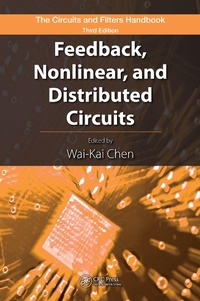
Feedback, Nonlinear, and Distributed Circuits
Published on 8. October 2018
466 pages
978-1-4200-5882-6 (ISBN)
Description

Upon its initial publication, the Handbook of Circuits and Filters broke new ground. It quickly became the resource for comprehensive coverage of issues and practical information that can be put to immediate use. Not content to rest on his laurels, editor Wai-kai Chen divided the second edition into volumes, making the information easily accessible and digestible. In the third edition, these volumes have been revised, updated, and expanded so that they continue to provide solid coverage of standard practices and enlightened perspectives on new and emerging techniques.
Feedback, Nonlinear, and Distributed Circuits draws together international contributors who discuss feedback amplifier theory and then move on to explore feedback amplifier configurations. They develop Bode's feedback theory as an example of general feedback theory. The coverage then moves on to the importance of complementing numerical analysis with qualitative analysis to get a global picture of a circuit's performance. After reviewing a wide range of approximation techniques and circuit design styles for discreet and monolithic circuits, the book presents a comprehensive description of the use of piecewise-linear methods in modeling, analysis, and structural properties of nonlinear circuits highlighting the advantages. It describes the circuit modeling in the frequency domain of uniform MTL based on the Telegrapher's equations and covers frequency and time domain experimental characterization techniques for uniform and nonuniform multiconductor structures.
This volume will undoubtedly take its place as the engineer's first choice in looking for solutions to problems encountered in the analysis and behavior predictions of circuits and filters.
Feedback, Nonlinear, and Distributed Circuits draws together international contributors who discuss feedback amplifier theory and then move on to explore feedback amplifier configurations. They develop Bode's feedback theory as an example of general feedback theory. The coverage then moves on to the importance of complementing numerical analysis with qualitative analysis to get a global picture of a circuit's performance. After reviewing a wide range of approximation techniques and circuit design styles for discreet and monolithic circuits, the book presents a comprehensive description of the use of piecewise-linear methods in modeling, analysis, and structural properties of nonlinear circuits highlighting the advantages. It describes the circuit modeling in the frequency domain of uniform MTL based on the Telegrapher's equations and covers frequency and time domain experimental characterization techniques for uniform and nonuniform multiconductor structures.
This volume will undoubtedly take its place as the engineer's first choice in looking for solutions to problems encountered in the analysis and behavior predictions of circuits and filters.
More details
Series
Language
English
Place of publication
Baton Rouge
United States
Publishing group
Taylor & Francis Inc
Target group
Professional and scholarly
Illustrations
229 s/w Abbildungen
229 Illustrations, black and white
File size
9,53 MB
ISBN-13
978-1-4200-5882-6 (9781420058826)
Copyright in bibliographic data and cover images is held by Nielsen Book Services Limited or by the publishers or by their respective licensors: all rights reserved.
Schweitzer Classification
Other editions
Additional editions
Wai-Kai Chen
Feedback, Nonlinear, and Distributed Circuits
Book
06/2017
1st Edition
CRC Press
€110.30
Shipment within 10-20 days
Wai-Kai Chen
Feedback, Nonlinear, and Distributed Circuits
Book
06/2009
1st Edition
CRC Press
€295.30
Article not available at the moment
Person
Content
Feedback Circuits. Feedback Amplifier Theory. Feedback Amplifier Configurations. General Feedback Theory. Network Functions and Feedback. Measurement of Return Difference. Multiple-Loop Feedback Amplifiers. Nonlinear Circuits. Qualitative Analysis. Synthesis and Design of Nonlinear Circuits. Representation, Approximation, and Identification. Transformation and Equivalence. Piecewise-Linear Circuits and Piecewise-Linear Analysis. Simulation. Cellular Neural Networks and Cellular Wave Computers. Bifurcation and Chaos. Distributed Circuits. Transmission Lines. Multiconductor Transmission Lines. Time and Frequency Domain Responses. Distributed RC Networks. Synthesis of Distributed Circuits. Index.
