

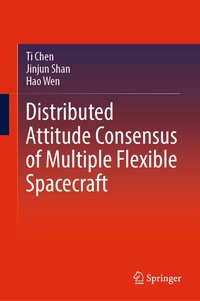
Distributed Attitude Consensus of Multiple Flexible Spacecraft
Description

This book mainly presents the authors' recent studies on the distributed attitude consensus of multiple flexible spacecraft. Modified Rodrigues parameters and rotation matrix are used to represent spacecraft attitude. Several distributed adaptive controllers are presented with theoretical analyses, numerical simulations and experimental verifications. The authors intend to provide a manual that allows researchers, engineers and students in the field of aerospace engineering and mechanics to learn a theoretical and practical approach to the design of attitude consensus algorithms.
Reviews / Votes
"Each chapter is endowed with its own reference list. The book strongly relies on the authors' own experience and can be recommended to researcher in the fields of applied mathematics and flight mechanics and control. With an additional effort it might be useful to graduate students." (Vladimir Rasvan, zbMATH 1506.70002, 2023)More details
Other editions
Additional editions
Persons
Ti Chen received the Ph.D. degree in dynamics and control from Nanjing University of Aeronautics and Astronautics, Nanjing, China, in 2017. From April 2017 to July 2017, he was a research assistant with Department of Electronic Engineering, City University of Hong Kong. From August 2017 to February 2020, he was a post-doctoral fellow with Department of Earth and Space Science and Engineering, York University. From March 2020 to December 2020, he held a joint postdoctoral fellowship offered by Department of Earth and Space Science and Engineering, York University and the University of Toronto Institute for Aerospace Studies. He is currently a professor at Nanjing University of Aeronautics and Astronautics. He is a Senior Member of AIAA, a Senior Member of CSVE and a Member of IEEE. His research interests include in-orbit autonomous assembly, dynamics and control of multiple flexible spacecraft, drone transportation, and complex structure dynamics and control.
Dr. Jinjun Shan is an internationally recognized expert in the areas of dynamics, control and navigation. He joined York University as an Assistant Professor of Space Engineering in 2006 and was promoted to Full Professor in 2016. Prior to his appointment in York, he was a Post-Doctoral Fellow at the University of Toronto Institute for Aerospace Studies (UTIAS) in 2003-2006 and a Research Assistant at the Department of Manufacturing Engineering and Engineering Management (MEEM), City University of Hong Kong, in 2002-2003. He received his B.Eng., M.Eng., and Ph.D. degrees all from Harbin Institute of Technology, China, in 1997, 1999, and 2002, respectively. Dr. Shan has made outstanding contributions to several national and international space missions including the NEOSSat.
He has attracted over $5 million in research funding from various governmental agencies and industry partners. His research progress is demonstrated through over 190 peer-reviewed journal and conference publications and 2 issued patents. Dr. Shan's accomplishments in research and engineering education have seen him recognized with prestigious recognitions such as the Fellow of Engineering Institute of Canada (EIC), the Fellow of American Astronautical Society (AAS), the Associate Fellow of AIAA, Alexander von Humboldt Fellowship, JSPS Fellowship, York Research Leader Awards, and Excellent in Teaching Award. He serves the profession as the Associate Editor for several field-leading journals including IEEE Transactions on Industrial Electronics, IEEE/ASME Transactions on Mechatronics, and the Journal of Franklin Institute, as well as numerous conference chairs. He is the founding director of Spacecraft Dynamics Control and Navigation Laboratory (SDCNLab) at York University. He has served as the Department Chair since January 2018.Hao Wen received the Ph.D. degree in dynamics and control from Nanjing University of Aeronautics and Astronautics, Nanjing, China, in 2009. He iscurrently a Professor at Nanjing University of Aeronautics and Astronautics, Nanjing, China. He is a Senior Member of AIAA and Member of IEEE. His main research interests include the dynamics modeling, motion/vibration control, and ground-based experiments of space structures.
Content
Introduction.- Attitude Dynamics.- Distributed Attitude Tracking Based on 3-Dimensional Attitude Representations.- Distributed Attitude Tracking on SO(3) Under Undirected Graphs.- Distributed Attitude Tracking on SO(3) Under Directed Graphs.- Leaderless Attitude Consensus on SO(3).
