

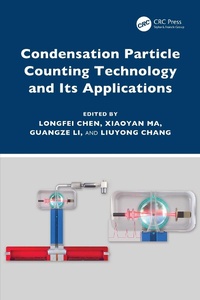
Condensation Particle Counting Technology and Its Applications
1st Edition
Published on 20. September 2024
170 pages
978-1-040-10597-9 (ISBN)
Description

Condensation Particle Counting Technology and Its Applications introduces the principles, key components, calibration methods, and applications of condensation particle counting systems.
This book delves into the adverse effects of fine particles on human health, along with the existing detection technologies for these particles. It discusses the theories and methods of optical measurement for fine particles and elaborates on the applicable conditions for each light scattering theory, providing a theoretical foundation for detecting particle-scattered light. This book concludes with an overview of the challenges posed by ongoing climate change and future research prospects in condensation particle counting (CPC).
This book is intended for industry professionals and environmental researchers specializing in particle and aerosol measurement, detection methods, and technology.
This book delves into the adverse effects of fine particles on human health, along with the existing detection technologies for these particles. It discusses the theories and methods of optical measurement for fine particles and elaborates on the applicable conditions for each light scattering theory, providing a theoretical foundation for detecting particle-scattered light. This book concludes with an overview of the challenges posed by ongoing climate change and future research prospects in condensation particle counting (CPC).
This book is intended for industry professionals and environmental researchers specializing in particle and aerosol measurement, detection methods, and technology.
Reviews / Votes
"The book offers a detailed exploration of the adverse effects of fine particles on human health and the environment, along with an extensive analysis of current detection technologies and methodologies. The breadth of topics ensures that readers gain a holistic understanding of the subject. It discusses theories and methods of optical measurement for fine particles, providing a robust theoretical foundation for understanding the complex underlying mechanisms. This book could be an excellent textbook for a graduate-level course focused on environmental science or engineering, particularly those specializing in air quality, pollution control, and environmental health. In addition, professionals in the field of environmental engineering who are involved in air quality monitoring and control would benefit from a training course based on this book." - Fatemeh Salehi, Macquarie UniversityMore details
Edition
1. Auflage
Language
English
Place of publication
London
United Kingdom
Publishing group
Taylor & Francis Ltd
Target group
College/higher education
Professional and scholarly
Illustrations
47 Line drawings, black and white; 21 Halftones, black and white; 68 Illustrations, black and white
ISBN-13
978-1-040-10597-9 (9781040105979)
Copyright in bibliographic data and cover images is held by Nielsen Book Services Limited or by the publishers or by their respective licensors: all rights reserved.
Schweitzer Classification
Other editions
Additional editions
Longfei Chen | Xiaoyan Ma | Guangze Li
Condensation Particle Counting Technology and Its Applications
Book
approx. 06/2026
1st Edition
CRC Press
€69.00
Not yet published
Longfei Chen | Xiaoyan Ma | Guangze Li
Condensation Particle Counting Technology and Its Applications
Book
09/2024
1st Edition
CRC Press
€131.90
Shipment within 10-20 days
Persons
Longfei Chen is a full professor in the School of Energy and Power Engineering at Beihang University, China. He obtained his bachelor's and master's degrees in Automotive Engineering from Tsinghua University and completed his Ph.D. in Engineering Science at the University of Oxford in 2010. His research focuses on particle emissions, spray and combustion, and ice nucleation in the atmosphere. Specifically, his work includes (1) developing measurement systems for sub-micron particle emissions, (2) studying heat and mass transfer in multiphase flows, and (3) investigating condensation and ice nucleation of atmospheric particles. He serves as the Secretary General of the Aviation Internal Combustion Engine Branch of the Chinese Society for Internal Combustion Engines and as a member of the SAE E31 Working Group of the ICAO Emission Standards Committee. His accolades include the First Prize in Technological Innovation awarded by the Chinese Society for IC Engines (2023) and the Chinese Society for Particuology (2023), the National Excellent Young Scholar Award (2019), the China Internal Combustion Engine Society Outstanding Researcher Award (2019), the 4th China-France Team Cooperation Innovation Award (R&D Award, 2017), and the Beijing Science and Technology Nova Star Award (2017).
Dr. Xiaoyan Ma is an associate professor at the Hangzhou International Innovation Institute of Beihang University. She obtained an interdisciplinary doctoral degree in Thermodynamics and Civil Engineering from University of Paris-Saclay in 2020 and worked at Centre National de la Recherche Scientifique (CNRS) in France. Her research interests cover heat and mass transfer in porous media, multiphase flow, energy storage, and morphology and mechanisms of particulate matters. She has participated in national projects of France and international projects of the European Union. She has published more than 20 SCI-index journal papers and one book as a chapter contributor. She is leading a recent research project on combustion detection and fine particle identification supported by the Beijing Natural Science Foundation.
Dr. Guangze Li is an associate professor at the Hangzhou International Innovation Institute, Beihang University, China. He received his Ph.D. in Thermal Engineering from Beihang University in 2022 and has participated in a joint Ph.D. program at the National University of Singapore. His research focuses on the heat and mass transfer of multiphase flow, combustion, and emissions. He has published more than 20 papers in the top SCI-indexed journals, including Energy, Fuel, Environmental Science & Technology, and obtained financial sponsorship from the National Natural Science Foundation of China.
Dr. Liuyong Chang is an associate professor at the Hangzhou International Innovation Institute of Beihang University, China. He received his Ph.D. in Measurement Technology and Instrument from Beihang University in 2021. His research interests includes particle emissions, nanoparticle detection, heterogeneous condensation, combustion monitoring, and combustion instability. In particular, he developed a measurement system for nanoparticles emitted from motor vehicles that meet China National VI emission standards. He has published nine refereed journal articles as the first or corresponding author, and obtained financial sponsorship from the National Natural Science Foundation of China.
Dr. Xiaoyan Ma is an associate professor at the Hangzhou International Innovation Institute of Beihang University. She obtained an interdisciplinary doctoral degree in Thermodynamics and Civil Engineering from University of Paris-Saclay in 2020 and worked at Centre National de la Recherche Scientifique (CNRS) in France. Her research interests cover heat and mass transfer in porous media, multiphase flow, energy storage, and morphology and mechanisms of particulate matters. She has participated in national projects of France and international projects of the European Union. She has published more than 20 SCI-index journal papers and one book as a chapter contributor. She is leading a recent research project on combustion detection and fine particle identification supported by the Beijing Natural Science Foundation.
Dr. Guangze Li is an associate professor at the Hangzhou International Innovation Institute, Beihang University, China. He received his Ph.D. in Thermal Engineering from Beihang University in 2022 and has participated in a joint Ph.D. program at the National University of Singapore. His research focuses on the heat and mass transfer of multiphase flow, combustion, and emissions. He has published more than 20 papers in the top SCI-indexed journals, including Energy, Fuel, Environmental Science & Technology, and obtained financial sponsorship from the National Natural Science Foundation of China.
Dr. Liuyong Chang is an associate professor at the Hangzhou International Innovation Institute of Beihang University, China. He received his Ph.D. in Measurement Technology and Instrument from Beihang University in 2021. His research interests includes particle emissions, nanoparticle detection, heterogeneous condensation, combustion monitoring, and combustion instability. In particular, he developed a measurement system for nanoparticles emitted from motor vehicles that meet China National VI emission standards. He has published nine refereed journal articles as the first or corresponding author, and obtained financial sponsorship from the National Natural Science Foundation of China.
Content
1. Overview of Fine Particle Number Concentration Measurement Theory and Technology. 2. Theory and Mechanisms of the Fine Particles Condensation Growth. 3. Optical Particle Measurement Theory and Method. 4. Condensation Particle Counter. 5. Application of Particle Condensation Counting Technology.
