

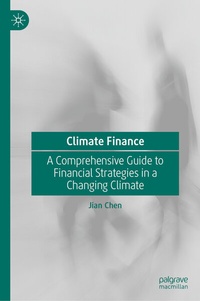
Climate Finance
Description

In a world confronting the urgent realities of climate change, Jian Chen's Climate Finance offers an indispensable guide for professionals tackling our greatest global challenge. This comprehensive textbook seamlessly connects environmental science with financial innovation, empowering students, investors, business leaders, and policymakers to address the dual crises of climate risk and economic disruption. Through a structured five-part framework, Chen demystifies the complexities of mobilizing capital for climate solutions-from renewable energy investments and risk modeling to disclosure frameworks and portfolio management. With clear insights into physical and transition risks, cutting-edge financing mechanisms, and emerging trends, this book transforms climate challenges into actionable financial opportunities. Whether you're managing assets, shaping policy, or studying sustainability, Climate Finance equips you with the knowledge to drive meaningful change in the transition to a resilient, low-carbon economy. Take the first step toward building a sustainable future-your journey begins here.
More details
Other editions
Additional editions
Person
Dr. Jian Chen is a professor of finance at Fudan University. His research spans climate finance, renewable energy, AI applications, and credit risk. He has advised Chelion Renewables Group on global energy storage projects. Previously, he held senior roles at MSCI, IFE Group, Freddie Mac, and Fannie Mae.
Content
Part I: Foundations of Climate Finance.- Chapter 1: The Imperative of Climate Finance: A Call to Action.- Chapter 2: Understanding Climate Risks.- Chapter 3: The Role of Financial Institutions.- Part II: Climate Risk Modeling and Assessment.- Chapter 4: Modeling the Climate: From Weather Forecasts to Financial Risks.- Chapter 5: Climate Scenarios: Navigating a Range of Possible Futures.- Chapter 6: Physical Risk Modeling: Quantifying the Impacts of a Changing Climate.- Chapter 7: Transition Risk Modeling: Navigating the Shift to a Low-Carbon Economy.- Chapter 8: The Challenge of Climate Risk Modeling: Navigating Complexity and Uncertainty.- Part III: Climate Finance Investments: Mobilizing Capital for a Sustainable Future.- Chapter 9: Renewable Energy: Powering a Sustainable Future.- Chapter 10: The Role of Energy Storage: Enabling the Renewable Energy Transition.- Chapter 11: Decarbonizing Hard-to-Abate Sectors: Innovations for a Net-Zero Future.- Chapter 12: Investing in Nature-Based Solutions and Climate Adaptation: Building Resilience for a Changing World.- Chapter 13: Innovative Financing Mechanisms for Climate Action: Unlocking Capital for a Sustainable Future.- Chapter 14: Navigating the Challenges: Greenwashing and Impact Measurement in Climate Finance.- Part IV: Climate Finance Tools and Applications: Navigating Risks, Driving Action.- Chapter 15: Climate Risk Assessment: Tools, Frameworks, and Applications.- Chapter 16: Climate-Related Disclosure: Standards, Best Practices, and Implementation.- Chapter 17: Climate-Aligned Portfolio Management: Strategies and Tools.- Chapter 18: Challenges of Integrating Climate Considerations: Overcoming Barriers to Action.- Part V: Moving Forward: Shaping the Future of Climate Finance.- Chapter 19: The Role of Governments and Policy: Creating an Enabling Environment for Climate Action.- Chapter 20: International Climate Finance: Flows, Challenges, and Innovations.- Chapter 21: A Roadmap for Climate Finance: Integrating Climate Considerations into Practice.- Chapter 22: The Future of Climate Finance: Trends, Opportunities, and a Call to Action.
