

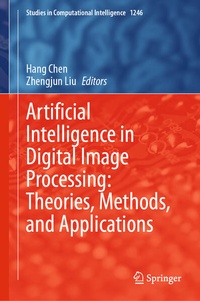
Artificial Intelligence in Digital Image Processing: Theories, Methods, and Applications
Description

This book is a focused, practice-driven resource organized around 10 key thematic sections, blending foundational AI knowledge with cutting-edge digital image processing applications-ideal for bridging theory and real-world use. It avoids generic coverage, instead diving into specialized, high-demand topics like deep learning fundamentals, deepfake technology, adversarial attacks in computer vision, adaptive cryptography, and generative AI-driven SAR-to-optical image translation. As a postgraduate handbook, it aligns perfectly with courses such as "AI Image Processing," "Advanced Signal Processing," and "Optical Information Security," helping students grasp core concepts (e.g., Q-learning for cancer detection-related image segmentation, deep learning-based remote sensing classification) and build practical skills.
Beyond academia, it caters to a broad range of users: researchers and faculty gain insights into novel directions like secure image processing via optical cryptography and automated dataset generation (SciData-Factory), while industry professionals in remote sensing (secure data handling with dynamic optical transforms), cybersecurity (adversarial defense), and medical imaging (AI-aided cancer detection) find actionable solutions for real-world challenges. Self-learners and career changers benefit from its foundational content and coverage of in-demand skills (aligned with certifications like IEEE Signal Processing), and educational institutions or corporate L&D programs (tech, aerospace, healthcare) can adopt it for upskilling. Supplementary online resources-including topic-specific code and lecture slides-add further value, making the book essential for anyone working in AI-driven image processing.
More details
Other editions
Additional editions
Persons
Content
Fundamentals of Deep Learning.- Deepfake in Image and Video Processing.- Adversarial Attacks and Defenses in Computer Vision.- Adaptive Cryptographic System Orchestration via Intelligent Agents.- Encryption/Decryption with Dynamic Algorithm-Based Optical Transform for Remote Sensing Images.- Classification of Typical Remote Sensing Images Based on Deep Learning.- Deep Learning Applications in Optical Cryptography.- SciData-Factory: An Automated Framework for Generating High-Quality Image-Text Datasets.- SAR-to-optical image translation based on generative artificial intelligence.- Q-learning Implementation for Decision Problems in Digital Image Processing: Application to Adaptive Image Segmentation in Histological Cancer Detection Corresponding author: Prof. Camel Tanougast.
