

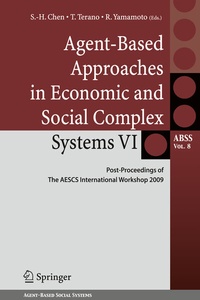
Agent-Based Approaches in Economic and Social Complex Systems VI
Post-Proceedings of The AESCS International Workshop 2009
1st Edition
Published on 12. January 2011
X, 202 pages
978-4-431-53907-0 (ISBN)
Description

Agent-based modeling/simulation is an emergent approach to the analysis of social and economic systems. It provides a bottom-up experimental method to be applied to social sciences such as economics, management, sociology, and politics as well as some engineering fields dealing with social activities. This book includes selected papers presented at the Sixth International Workshop on Agent-Based Approaches in Economic and Social Complex Systems held in Taipei in 2009. We have 39 presentations in the conference, and 14 papers are selected to be included in this volume. These 14 papers are then grouped into six parts: Agent-based financial markets; Financial forecasting and investment; Cognitive modeling of agents; Complexity and policy analysis; Agent-based modeling of good societies; and Miscellany. The research presented here shows the state of the art in this rapidly growing field.
More details
Other editions
Additional editions
Shu-Heng Chen | Takao Terano | Ryuichi Yamamoto
Agent-Based Approaches in Economic and Social Complex Systems VI
Post-Proceedings of The AESCS International Workshop 2009
Book
10/2014
Springer
€117.69
Shipment within 10-15 days

Shu-Heng Chen | Takao Terano | Ryuichi Yamamoto
Agent-Based Approaches in Economic and Social Complex Systems VI
Post-Proceedings of The AESCS International Workshop 2009
Book
01/2011
Springer
€160.49
Shipment within 10-15 days
Content
1 - Agent-Based Approaches in Economic and Social Complex Systems VI [Seite 1]
1.1 - Preface [Seite Preface]
- 5 [Seite 5]
1.2 - Committees and Chairs of AESCS'09 [Seite Committees and Chairs of AESCS'09]
- 7 [Seite 7]
1.3 - Contents [Seite Contents]
- 9 [Seite 9]
1.4 - Part I Agent-Based Financial Markets [Seite 11]
1.4.1 - Comprehensive Analysis of Information Transmission Among Agents: Similarity and Heterogeneity of Collective Behavior [Seite 12]
1.4.1.1 - 1 Introduction [Seite 12]
1.4.1.2 - 2 Literature Survey [Seite 14]
1.4.1.3 - 3 Model and Methods [Seite 15]
1.4.1.4 - 4 Empirical Analysis [Seite 18]
1.4.1.5 - 5 Conclusions [Seite 25]
1.4.1.6 - References [Seite 26]
1.4.2 - Examining the Effects of Traders' Overconfidence on Market Behavior [Seite 27]
1.4.2.1 - 1 Introduction [Seite 27]
1.4.2.2 - 2 The Model [Seite 29]
1.4.2.2.1 - 2.1 Market Structure [Seite 29]
1.4.2.2.2 - 2.2 Learning of Traders [Seite 30]
1.4.2.3 - 3 Simulations [Seite 32]
1.4.2.4 - 4 Conclusion [Seite 38]
1.4.2.5 - References [Seite 38]
1.5 - Part II Financial Forecasting and Investment [Seite 40]
1.5.1 - Short Time Correction to Mean Variance Analysis in an Optimized Two-Stock Portfolio [Seite 41]
1.5.1.1 - 1 Introduction [Seite 41]
1.5.1.2 - 2 Mean-Variance Analysis for the Long Time Scale [Seite 43]
1.5.1.3 - 3 Short Term Correction [Seite 44]
1.5.1.4 - 4 Decision Mechanism [Seite 45]
1.5.1.5 - 5 Simulation Result [Seite 46]
1.5.1.6 - 6 Conclusion [Seite 50]
1.5.1.7 - References [Seite 50]
1.5.2 - Exchange Rate Forecasting with Hybrid Genetic Algorithms [Seite 52]
1.5.2.1 - 1 Introduction [Seite 52]
1.5.2.2 - 2 Methodology and Data Description [Seite 54]
1.5.2.2.1 - 2.1 Genetic Algorithms [Seite 54]
1.5.2.2.2 - 2.2 Particle Swarm Optimization [Seite 55]
1.5.2.2.3 - 2.3 Back Propagation Network [Seite 56]
1.5.2.2.4 - 2.4 Variables and Data Normalization [Seite 57]
1.5.2.3 - 3 Experiment Design [Seite 57]
1.5.2.4 - 4 Experiment Results [Seite 59]
1.5.2.4.1 - 4.1 Comparing the Forecasting Results by Three Criteria [Seite 59]
1.5.2.4.2 - 4.2 Comparison of the Forecast Results by Monthly Exchange Rate [Seite 61]
1.5.2.5 - 5 Conclusion and Suggestions [Seite 62]
1.5.2.6 - References [Seite 62]
1.6 - Part III Cognitive Modeling of Agents [Seite 64]
1.6.1 - Learning Backward Induction: A Neural Network Agent Approach [Seite 65]
1.6.1.1 - 1 Introduction [Seite 65]
1.6.1.2 - 2 Methodology [Seite 66]
1.6.1.2.1 - 2.1 The Class of Games [Seite 66]
1.6.1.2.2 - 2.2 Introduction to Neural Networks [Seite 67]
1.6.1.2.3 - 2.3 Simulations, Models and Heuristics [Seite 69]
1.6.1.2.4 - 2.4 Performance Testing [Seite 70]
1.6.1.3 - 3 Results [Seite 71]
1.6.1.3.1 - 3.1 Comparison of NN Topologies [Seite 71]
1.6.1.3.2 - 3.2 Comparison of NNs to Standard Classification Algorithms and Heuristics [Seite 71]
1.6.1.3.3 - 3.3 Detailed Analysis of bold0mu mumu equation1 Agents' Performance [Seite 73]
1.6.1.3.4 - 3.4 Subgame and Truncation Consistency [Seite 73]
1.6.1.3.5 - 3.5 Agent Heterogeneity [Seite 74]
1.6.1.4 - 4 Conclusion [Seite 74]
1.6.1.5 - A Technical Presentation of the NN Backpropagation Algorithm [Seite 75]
1.6.1.6 - References [Seite 77]
1.6.2 - Cognitive-Costed Agent Model of the Microblogging Network [Seite 78]
1.6.2.1 - 1 Introduction [Seite 78]
1.6.2.2 - 2 Data Analysis [Seite 79]
1.6.2.3 - 3 Model [Seite 82]
1.6.2.3.1 - 3.1 Simple Reciprocal Model [Seite 82]
1.6.2.3.2 - 3.2 Reciprocal Model with Cognitive Cost [Seite 83]
1.6.2.4 - 4 Discussion and Conclusions [Seite 86]
1.6.2.5 - References [Seite 87]
1.7 - Part IV Complexity and Policy Analysis [Seite 88]
1.7.1 - Landscape Analysis of Possible Outcomes [Seite 89]
1.7.1.1 - 1 Introduction [Seite 89]
1.7.1.2 - 2 Landscape Analysis of Possible Outcomes [Seite 91]
1.7.1.3 - 3 Case Example [Seite 93]
1.7.1.3.1 - 3.1 Model [Seite 93]
1.7.1.3.1.1 - 3.1.1 Sales Division and Salespersons [Seite 93]
1.7.1.3.1.2 - 3.1.2 Organizational Behavior [Seite 94]
1.7.1.3.1.3 - 3.1.3 Evaluation System [Seite 94]
1.7.1.3.1.4 - 3.1.4 Organizational Learning [Seite 94]
1.7.1.3.2 - 3.2 Simulation [Seite 95]
1.7.1.3.2.1 - 3.2.1 Verification and Validation [Seite 95]
1.7.1.3.2.2 - 3.2.2 Experimental Design [Seite 95]
1.7.1.3.2.3 - 3.2.3 Result [Seite 96]
1.7.1.4 - 4 Discussion [Seite 97]
1.7.1.4.1 - 4.1 Analysis of Uncertainties [Seite 97]
1.7.1.4.2 - 4.2 Evaluation and Scope [Seite 98]
1.7.1.5 - 5 Summary and Future Study [Seite 99]
1.7.1.6 - References [Seite 99]
1.7.2 - The Flow of Information Through People's Network and Its Effect on Japanese Public Pension System [Seite 101]
1.7.2.1 - 1 Introduction [Seite 101]
1.7.2.2 - 2 Basics [Seite 102]
1.7.2.2.1 - 2.1 The Function for Agent to Agent Interactions [Seite 102]
1.7.2.2.2 - 2.2 Three Basic Network Models [Seite 105]
1.7.2.3 - 3 Choice of Network Model that Fit Well in Real People's Network [Seite 105]
1.7.2.4 - 4 Put the Information on the Agent-to-Agent Network [Seite 107]
1.7.2.5 - 5 The Effect of Releasing the Information and Its Expansion on Japanese Public Pension System [Seite 108]
1.7.2.5.1 - 5.1 The Execution of Simulation [Seite 108]
1.7.2.5.2 - 5.2 Simulation Results [Seite 109]
1.7.2.5.2.1 - 5.2.1 The Altered Distribution in Agent's Attitude Score [Seite 109]
1.7.2.5.2.2 - 5.2.2 Investigating the Reasons for the Differences from ``Agent's Links'' [Seite 109]
1.7.2.5.2.3 - 5.2.3 Investigating the Reasons for the Differences from Agent's ``Betweeness Centrality'' [Seite 114]
1.7.2.5.2.4 - 5.2.4 The Relationships Between Information Flow and Pension Premium Fund [Seite 115]
1.7.2.5.2.5 - 5.2.5 Additional Simulation [Seite 116]
1.7.2.6 - 6 Conclusion and Future Works [Seite 118]
1.7.2.7 - References [Seite 118]
1.7.3 - Identification of Voting with Individual's Feet Through Agent-Based Modeling [Seite 120]
1.7.3.1 - 1 Introduction [Seite 120]
1.7.3.2 - 2 Related Work [Seite 121]
1.7.3.2.1 - 2.1 Social Phenomenon of Migration [Seite 121]
1.7.3.2.2 - 2.2 Studies About VWF [Seite 122]
1.7.3.3 - 3 Model Description [Seite 123]
1.7.3.3.1 - 3.1 Government Agent Model [Seite 123]
1.7.3.3.1.1 - 3.1.1 Basic Concepts of the Model [Seite 123]
1.7.3.3.1.2 - 3.1.2 Budget Distribution Strategies [Seite 124]
1.7.3.3.2 - 3.2 Inhabitant Agent Model [Seite 124]
1.7.3.3.3 - 3.3 How the Agent-Simulator Works [Seite 125]
1.7.3.4 - 4 Experiments and Discussions [Seite 126]
1.7.3.4.1 - 4.1 Experimental Results [Seite 127]
1.7.3.4.1.1 - 4.1.1 Statistics of the Experiments [Seite 127]
1.7.3.5 - 5 Proposal of Multiple-Layer Modeling [Seite 131]
1.7.3.5.1 - 5.1 Issues of the Current VWIF Model [Seite 131]
1.7.3.5.2 - 5.2 Framework of MLM [Seite 131]
1.7.3.5.3 - 5.3 On Agents' Action Rules in the MLM Environment [Seite 132]
1.7.3.6 - 6 Concluding Remarks [Seite 132]
1.7.3.7 - References [Seite 133]
1.8 - Part V Agent-Based Modeling of Good Societies [Seite 134]
1.8.1 - Communities, Anti-Communities, Pan-Community as Social Order [Seite 135]
1.8.1.1 - 1 Introduction [Seite 135]
1.8.1.2 - 2 The Friend Selection Strategies based on Attribute and Reputation in Group (FSS-ARG) [Seite 136]
1.8.1.3 - 3 Evolutionary Simulation of Peace [Seite 138]
1.8.1.4 - 4 Emergence of Four Types of Social States [Seite 140]
1.8.1.5 - 5 Discussions [Seite 144]
1.8.1.6 - References [Seite 145]
1.8.2 - Bayesian Analysis Method of Time Series Data in Greenhouse Gas Emissions Trading Market [Seite 146]
1.8.2.1 - 1 Introduction [Seite 146]
1.8.2.2 - 2 Analytical Methods of Time Series Data [Seite 147]
1.8.2.2.1 - 2.1 Overview of DFT [Seite 147]
1.8.2.2.2 - 2.2 BAM [Seite 148]
1.8.2.2.3 - 2.3 Classification Method Using Distribution [Seite 149]
1.8.2.3 - 3 Model [Seite 150]
1.8.2.3.1 - 3.1 Model of Participant Nations in Emissions Trading [Seite 150]
1.8.2.3.2 - 3.2 Compliance Mechanism [Seite 152]
1.8.2.4 - 4 Experiments: Comparison of DFT and BAM [Seite 153]
1.8.2.4.1 - 4.1 Setting [Seite 153]
1.8.2.4.2 - 4.2 Experiment Results [Seite 154]
1.8.2.5 - 5 Discussion [Seite 156]
1.8.2.6 - 6 Conclusion [Seite 157]
1.8.2.7 - References [Seite 157]
1.8.3 - Large Scale Crowd Simulation of Terminal Station Area When Tokai Earthquake Advisory Information Is Announced Officially [Seite 159]
1.8.3.1 - 1 Introduction [Seite 159]
1.8.3.2 - 2 A Framework of the Simulation [Seite 160]
1.8.3.2.1 - 2.1 Characteristics of the Model Employed in the Research [Seite 160]
1.8.3.2.2 - 2.2 An Outline of the Model and Framework of the Simulation [Seite 161]
1.8.3.3 - 3 Production Design of LSCSver.1.0 [Seite 161]
1.8.3.3.1 - 3.1 Details of the Model [Seite 161]
1.8.3.3.2 - 3.2 Assessment of the Shortest Distance [Seite 163]
1.8.3.3.3 - 3.3 Rules Concerning Movement of Pedestrian Agents [Seite 163]
1.8.3.3.4 - 3.4 Rules for Route Selection by Pedestrian Agents [Seite 164]
1.8.3.4 - 4 Simulation Analysis [Seite 165]
1.8.3.4.1 - 4.1 Rules for Route Selection by Pedestrian Agents [Seite 165]
1.8.3.4.2 - 4.2 Results Analysis [Seite 165]
1.8.3.4.2.1 - 4.2.1 Measurement Data [Seite 167]
1.8.3.5 - 5 Conclusion [Seite 171]
1.8.3.6 - References [Seite 171]
1.9 - Part VI Miscellany [Seite 173]
1.9.1 - Boundary Organizations: An Evaluation of Their Impact Through a Multi-Agent System [Seite 174]
1.9.1.1 - 1 Introduction [Seite 174]
1.9.1.2 - 2 Boundary Organizations [Seite 175]
1.9.1.3 - 3 Methodology [Seite 177]
1.9.1.4 - 4 Results [Seite 180]
1.9.1.5 - 5 Conclusion [Seite 184]
1.9.1.6 - References [Seite 185]
1.9.2 - A Bibliometric Study of Agent-Based Modeling Literature on the SSCI Database [Seite 186]
1.9.2.1 - 1 Introduction [Seite 186]
1.9.2.2 - 2 Agent-Based Modeling Description [Seite 187]
1.9.2.3 - 3 Overall Analysis of ABM literature [Seite 187]
1.9.2.4 - 4 Bradford's Law and Journal Literature [Seite 191]
1.9.2.5 - 5 Lotka's Law and Author Productivity [Seite 193]
1.9.2.5.1 - 5.1 Distribution of Scientific Productivity of Authors with Equality of Chances of Participation [Seite 193]
1.9.2.5.2 - 5.2 Lotka's Law [Seite 193]
1.9.2.6 - 6 Conclusion [Seite 195]
1.9.2.7 - References [Seite 195]
1.10 - Author Index [Seite 196]
1.11 - Keyword Index [Seite 197]
1.1 - Preface [Seite Preface]
- 5 [Seite 5]
1.2 - Committees and Chairs of AESCS'09 [Seite Committees and Chairs of AESCS'09]
- 7 [Seite 7]
1.3 - Contents [Seite Contents]
- 9 [Seite 9]
1.4 - Part I Agent-Based Financial Markets [Seite 11]
1.4.1 - Comprehensive Analysis of Information Transmission Among Agents: Similarity and Heterogeneity of Collective Behavior [Seite 12]
1.4.1.1 - 1 Introduction [Seite 12]
1.4.1.2 - 2 Literature Survey [Seite 14]
1.4.1.3 - 3 Model and Methods [Seite 15]
1.4.1.4 - 4 Empirical Analysis [Seite 18]
1.4.1.5 - 5 Conclusions [Seite 25]
1.4.1.6 - References [Seite 26]
1.4.2 - Examining the Effects of Traders' Overconfidence on Market Behavior [Seite 27]
1.4.2.1 - 1 Introduction [Seite 27]
1.4.2.2 - 2 The Model [Seite 29]
1.4.2.2.1 - 2.1 Market Structure [Seite 29]
1.4.2.2.2 - 2.2 Learning of Traders [Seite 30]
1.4.2.3 - 3 Simulations [Seite 32]
1.4.2.4 - 4 Conclusion [Seite 38]
1.4.2.5 - References [Seite 38]
1.5 - Part II Financial Forecasting and Investment [Seite 40]
1.5.1 - Short Time Correction to Mean Variance Analysis in an Optimized Two-Stock Portfolio [Seite 41]
1.5.1.1 - 1 Introduction [Seite 41]
1.5.1.2 - 2 Mean-Variance Analysis for the Long Time Scale [Seite 43]
1.5.1.3 - 3 Short Term Correction [Seite 44]
1.5.1.4 - 4 Decision Mechanism [Seite 45]
1.5.1.5 - 5 Simulation Result [Seite 46]
1.5.1.6 - 6 Conclusion [Seite 50]
1.5.1.7 - References [Seite 50]
1.5.2 - Exchange Rate Forecasting with Hybrid Genetic Algorithms [Seite 52]
1.5.2.1 - 1 Introduction [Seite 52]
1.5.2.2 - 2 Methodology and Data Description [Seite 54]
1.5.2.2.1 - 2.1 Genetic Algorithms [Seite 54]
1.5.2.2.2 - 2.2 Particle Swarm Optimization [Seite 55]
1.5.2.2.3 - 2.3 Back Propagation Network [Seite 56]
1.5.2.2.4 - 2.4 Variables and Data Normalization [Seite 57]
1.5.2.3 - 3 Experiment Design [Seite 57]
1.5.2.4 - 4 Experiment Results [Seite 59]
1.5.2.4.1 - 4.1 Comparing the Forecasting Results by Three Criteria [Seite 59]
1.5.2.4.2 - 4.2 Comparison of the Forecast Results by Monthly Exchange Rate [Seite 61]
1.5.2.5 - 5 Conclusion and Suggestions [Seite 62]
1.5.2.6 - References [Seite 62]
1.6 - Part III Cognitive Modeling of Agents [Seite 64]
1.6.1 - Learning Backward Induction: A Neural Network Agent Approach [Seite 65]
1.6.1.1 - 1 Introduction [Seite 65]
1.6.1.2 - 2 Methodology [Seite 66]
1.6.1.2.1 - 2.1 The Class of Games [Seite 66]
1.6.1.2.2 - 2.2 Introduction to Neural Networks [Seite 67]
1.6.1.2.3 - 2.3 Simulations, Models and Heuristics [Seite 69]
1.6.1.2.4 - 2.4 Performance Testing [Seite 70]
1.6.1.3 - 3 Results [Seite 71]
1.6.1.3.1 - 3.1 Comparison of NN Topologies [Seite 71]
1.6.1.3.2 - 3.2 Comparison of NNs to Standard Classification Algorithms and Heuristics [Seite 71]
1.6.1.3.3 - 3.3 Detailed Analysis of bold0mu mumu equation1 Agents' Performance [Seite 73]
1.6.1.3.4 - 3.4 Subgame and Truncation Consistency [Seite 73]
1.6.1.3.5 - 3.5 Agent Heterogeneity [Seite 74]
1.6.1.4 - 4 Conclusion [Seite 74]
1.6.1.5 - A Technical Presentation of the NN Backpropagation Algorithm [Seite 75]
1.6.1.6 - References [Seite 77]
1.6.2 - Cognitive-Costed Agent Model of the Microblogging Network [Seite 78]
1.6.2.1 - 1 Introduction [Seite 78]
1.6.2.2 - 2 Data Analysis [Seite 79]
1.6.2.3 - 3 Model [Seite 82]
1.6.2.3.1 - 3.1 Simple Reciprocal Model [Seite 82]
1.6.2.3.2 - 3.2 Reciprocal Model with Cognitive Cost [Seite 83]
1.6.2.4 - 4 Discussion and Conclusions [Seite 86]
1.6.2.5 - References [Seite 87]
1.7 - Part IV Complexity and Policy Analysis [Seite 88]
1.7.1 - Landscape Analysis of Possible Outcomes [Seite 89]
1.7.1.1 - 1 Introduction [Seite 89]
1.7.1.2 - 2 Landscape Analysis of Possible Outcomes [Seite 91]
1.7.1.3 - 3 Case Example [Seite 93]
1.7.1.3.1 - 3.1 Model [Seite 93]
1.7.1.3.1.1 - 3.1.1 Sales Division and Salespersons [Seite 93]
1.7.1.3.1.2 - 3.1.2 Organizational Behavior [Seite 94]
1.7.1.3.1.3 - 3.1.3 Evaluation System [Seite 94]
1.7.1.3.1.4 - 3.1.4 Organizational Learning [Seite 94]
1.7.1.3.2 - 3.2 Simulation [Seite 95]
1.7.1.3.2.1 - 3.2.1 Verification and Validation [Seite 95]
1.7.1.3.2.2 - 3.2.2 Experimental Design [Seite 95]
1.7.1.3.2.3 - 3.2.3 Result [Seite 96]
1.7.1.4 - 4 Discussion [Seite 97]
1.7.1.4.1 - 4.1 Analysis of Uncertainties [Seite 97]
1.7.1.4.2 - 4.2 Evaluation and Scope [Seite 98]
1.7.1.5 - 5 Summary and Future Study [Seite 99]
1.7.1.6 - References [Seite 99]
1.7.2 - The Flow of Information Through People's Network and Its Effect on Japanese Public Pension System [Seite 101]
1.7.2.1 - 1 Introduction [Seite 101]
1.7.2.2 - 2 Basics [Seite 102]
1.7.2.2.1 - 2.1 The Function for Agent to Agent Interactions [Seite 102]
1.7.2.2.2 - 2.2 Three Basic Network Models [Seite 105]
1.7.2.3 - 3 Choice of Network Model that Fit Well in Real People's Network [Seite 105]
1.7.2.4 - 4 Put the Information on the Agent-to-Agent Network [Seite 107]
1.7.2.5 - 5 The Effect of Releasing the Information and Its Expansion on Japanese Public Pension System [Seite 108]
1.7.2.5.1 - 5.1 The Execution of Simulation [Seite 108]
1.7.2.5.2 - 5.2 Simulation Results [Seite 109]
1.7.2.5.2.1 - 5.2.1 The Altered Distribution in Agent's Attitude Score [Seite 109]
1.7.2.5.2.2 - 5.2.2 Investigating the Reasons for the Differences from ``Agent's Links'' [Seite 109]
1.7.2.5.2.3 - 5.2.3 Investigating the Reasons for the Differences from Agent's ``Betweeness Centrality'' [Seite 114]
1.7.2.5.2.4 - 5.2.4 The Relationships Between Information Flow and Pension Premium Fund [Seite 115]
1.7.2.5.2.5 - 5.2.5 Additional Simulation [Seite 116]
1.7.2.6 - 6 Conclusion and Future Works [Seite 118]
1.7.2.7 - References [Seite 118]
1.7.3 - Identification of Voting with Individual's Feet Through Agent-Based Modeling [Seite 120]
1.7.3.1 - 1 Introduction [Seite 120]
1.7.3.2 - 2 Related Work [Seite 121]
1.7.3.2.1 - 2.1 Social Phenomenon of Migration [Seite 121]
1.7.3.2.2 - 2.2 Studies About VWF [Seite 122]
1.7.3.3 - 3 Model Description [Seite 123]
1.7.3.3.1 - 3.1 Government Agent Model [Seite 123]
1.7.3.3.1.1 - 3.1.1 Basic Concepts of the Model [Seite 123]
1.7.3.3.1.2 - 3.1.2 Budget Distribution Strategies [Seite 124]
1.7.3.3.2 - 3.2 Inhabitant Agent Model [Seite 124]
1.7.3.3.3 - 3.3 How the Agent-Simulator Works [Seite 125]
1.7.3.4 - 4 Experiments and Discussions [Seite 126]
1.7.3.4.1 - 4.1 Experimental Results [Seite 127]
1.7.3.4.1.1 - 4.1.1 Statistics of the Experiments [Seite 127]
1.7.3.5 - 5 Proposal of Multiple-Layer Modeling [Seite 131]
1.7.3.5.1 - 5.1 Issues of the Current VWIF Model [Seite 131]
1.7.3.5.2 - 5.2 Framework of MLM [Seite 131]
1.7.3.5.3 - 5.3 On Agents' Action Rules in the MLM Environment [Seite 132]
1.7.3.6 - 6 Concluding Remarks [Seite 132]
1.7.3.7 - References [Seite 133]
1.8 - Part V Agent-Based Modeling of Good Societies [Seite 134]
1.8.1 - Communities, Anti-Communities, Pan-Community as Social Order [Seite 135]
1.8.1.1 - 1 Introduction [Seite 135]
1.8.1.2 - 2 The Friend Selection Strategies based on Attribute and Reputation in Group (FSS-ARG) [Seite 136]
1.8.1.3 - 3 Evolutionary Simulation of Peace [Seite 138]
1.8.1.4 - 4 Emergence of Four Types of Social States [Seite 140]
1.8.1.5 - 5 Discussions [Seite 144]
1.8.1.6 - References [Seite 145]
1.8.2 - Bayesian Analysis Method of Time Series Data in Greenhouse Gas Emissions Trading Market [Seite 146]
1.8.2.1 - 1 Introduction [Seite 146]
1.8.2.2 - 2 Analytical Methods of Time Series Data [Seite 147]
1.8.2.2.1 - 2.1 Overview of DFT [Seite 147]
1.8.2.2.2 - 2.2 BAM [Seite 148]
1.8.2.2.3 - 2.3 Classification Method Using Distribution [Seite 149]
1.8.2.3 - 3 Model [Seite 150]
1.8.2.3.1 - 3.1 Model of Participant Nations in Emissions Trading [Seite 150]
1.8.2.3.2 - 3.2 Compliance Mechanism [Seite 152]
1.8.2.4 - 4 Experiments: Comparison of DFT and BAM [Seite 153]
1.8.2.4.1 - 4.1 Setting [Seite 153]
1.8.2.4.2 - 4.2 Experiment Results [Seite 154]
1.8.2.5 - 5 Discussion [Seite 156]
1.8.2.6 - 6 Conclusion [Seite 157]
1.8.2.7 - References [Seite 157]
1.8.3 - Large Scale Crowd Simulation of Terminal Station Area When Tokai Earthquake Advisory Information Is Announced Officially [Seite 159]
1.8.3.1 - 1 Introduction [Seite 159]
1.8.3.2 - 2 A Framework of the Simulation [Seite 160]
1.8.3.2.1 - 2.1 Characteristics of the Model Employed in the Research [Seite 160]
1.8.3.2.2 - 2.2 An Outline of the Model and Framework of the Simulation [Seite 161]
1.8.3.3 - 3 Production Design of LSCSver.1.0 [Seite 161]
1.8.3.3.1 - 3.1 Details of the Model [Seite 161]
1.8.3.3.2 - 3.2 Assessment of the Shortest Distance [Seite 163]
1.8.3.3.3 - 3.3 Rules Concerning Movement of Pedestrian Agents [Seite 163]
1.8.3.3.4 - 3.4 Rules for Route Selection by Pedestrian Agents [Seite 164]
1.8.3.4 - 4 Simulation Analysis [Seite 165]
1.8.3.4.1 - 4.1 Rules for Route Selection by Pedestrian Agents [Seite 165]
1.8.3.4.2 - 4.2 Results Analysis [Seite 165]
1.8.3.4.2.1 - 4.2.1 Measurement Data [Seite 167]
1.8.3.5 - 5 Conclusion [Seite 171]
1.8.3.6 - References [Seite 171]
1.9 - Part VI Miscellany [Seite 173]
1.9.1 - Boundary Organizations: An Evaluation of Their Impact Through a Multi-Agent System [Seite 174]
1.9.1.1 - 1 Introduction [Seite 174]
1.9.1.2 - 2 Boundary Organizations [Seite 175]
1.9.1.3 - 3 Methodology [Seite 177]
1.9.1.4 - 4 Results [Seite 180]
1.9.1.5 - 5 Conclusion [Seite 184]
1.9.1.6 - References [Seite 185]
1.9.2 - A Bibliometric Study of Agent-Based Modeling Literature on the SSCI Database [Seite 186]
1.9.2.1 - 1 Introduction [Seite 186]
1.9.2.2 - 2 Agent-Based Modeling Description [Seite 187]
1.9.2.3 - 3 Overall Analysis of ABM literature [Seite 187]
1.9.2.4 - 4 Bradford's Law and Journal Literature [Seite 191]
1.9.2.5 - 5 Lotka's Law and Author Productivity [Seite 193]
1.9.2.5.1 - 5.1 Distribution of Scientific Productivity of Authors with Equality of Chances of Participation [Seite 193]
1.9.2.5.2 - 5.2 Lotka's Law [Seite 193]
1.9.2.6 - 6 Conclusion [Seite 195]
1.9.2.7 - References [Seite 195]
1.10 - Author Index [Seite 196]
1.11 - Keyword Index [Seite 197]
