

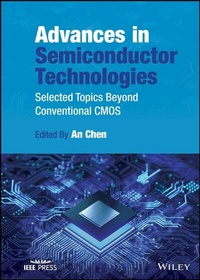
Advances in Semiconductor Technologies
Description

Discover the broad sweep of semiconductor technologies in this uniquely curated resource
Semiconductor technologies and innovations have been the backbone of numerous different fields: electronics, online commerce, the information and communication industry, and the defense industry. For over fifty years, silicon technology and CMOS scaling have been the central focus and primary driver of innovation in the semiconductor industry. Traditional CMOS scaling has approached some fundamental limits, and as a result, the pace of scientific research and discovery for novel semiconductor technologies is increasing with a focus on novel materials, devices, designs, architectures, and computer paradigms. In particular, new computing paradigms and systems--such as quantum computing, artificial intelligence, and Internet of Things--have the potential to unlock unprecedented power and application space.
Advances in Semiconductor Technologies provides a comprehensive overview of selected semiconductor technologies and the most up-to-date research topics, looking in particular at mainstream developments in current industry research and development, from emerging materials and devices, to new computing paradigms and applications. This full-coverage volume gives the reader valuable insights into state-of-the-art advances currently being fabricated, a wide range of novel applications currently under investigation, and a glance into the future with emerging technologies in development.
Advances in Semiconductor Technologies readers will also find:
* A comprehensive approach that ensures a thorough understanding of state-of-the-art technologies currently being fabricated
* Treatments on all aspects of semiconductor technologies, including materials, devices, manufacturing, modeling, design, architecture, and applications
* Articles written by an impressive team of international academics and industry insiders that provide unique insights into a wide range of topics
Advances in Semiconductor Technologies is a useful, time-saving reference for electrical engineers working in industry and research, who are looking to stay abreast of rapidly advancing developments in semiconductor electronics, as well as academics in the field and government policy advisors.
More details
Other editions
Additional editions
Person
An Chen, PhD, is with IBM Research - Almaden, CA, USA. He received his PhD in Electrical Engineering from Yale University in 2004. Prior to IBM, An worked at Spansion, AMD, and GLOBALFOUNDRIES, on emerging memory technologies and Beyond-CMOS research. He was the Chair of the Emerging Research Device (ERD) group of the International Technology Roadmap for Semiconductors (ITRS) and is currently the chair of the Beyond CMOS (BC) group of the International Roadmap of Devices and Systems (IRDS). An is a Senior Member of IEEE.
Content
Preface xi
List of Contributors xv
1 Heterogeneous Integration at Scale 1
Subramanian S. Iyer and Boris Vaisband
1.1 Introduction 1
1.2 Technology Aspects of Heterogeneous Integration 4
1.3 Design and Architecture of Heterogeneous Integration Platforms 9
1.4 Reliability of Heterogeneous Integration Systems 14
1.5 Application Space of Heterogeneous Integration 17
1.6 Future of Heterogeneous Integration 18
1.7 Summary 20
2 Hyperdimensional Computing: An Algebra for Computing with Vectors 25
Pentti Kanerva
2.1 Introduction 25
2.2 Overview: Three Examples 26
2.3 Operations on Vectors 28
2.4 Data Structures 30
2.5 Vector Sums Encode Probabilities 32
2.6 Decoding a Product 33
2.7 High-Dimensional Vectors at Large 34
2.8 Memory for High-Dimensional Vectors 35
2.9 Outline of Systems for Autonomous Learning 36
2.10 Energy-Efficiency 37
2.11 Discussion and Future Directions 37
3 CAD for Analog/Mixed-Signal Integrated Circuits 43
Ahmet F. Budak, David Z. Pan, Hao Chen, Keren Zhu, Mingjie Liu, Mohamed B. Alawieh, Shuhan Zhang, Wei Shi, and Xiyuan Tang
3.1 Introduction 43
3.2 Front-End CAD 45
3.3 Layout Automation 48
3.4 Post-Layout Extraction and Verification 52
3.5 Conclusion 53
4 Magnetoelectric Transistor Devices and Circuits with Steering Logic 61
Andrew Marshall and Peter A. Dowben
4.1 Introduction 61
4.2 Simple Logic Functions with the MEFET "Steering Logic" 62
4.3 Logic Functions - Majority Gate 64
4.4 The Full Adder and the Dual XOR (Sum) Gates 67
4.5 Latch and Memory 70
4.6 The JK Master-Slave Flip-Flop 72
4.7 Conclusion 75
5 Nonvolatile Memory Based Architectures Using Magnetoelectric FETs 79
Shaahin Angizi, Deliang Fan, Andrew Marshall, and Peter A. Dowben
5.1 Introduction 79
5.2 Magnetoelectric Field Effect Transistor (MEFET) 79
5.3 1T-1M Memory Design Based on the MEFET 81
5.4 2T-1M Memory Design Based on the MEFET 84
5.5 MEFET Steering Memory 87
5.6 Evaluation 90
5.7 Conclusion 91
6 Organic Electronics 93
Hagen Klauk
6.1 Introduction 93
6.2 Organic Light-Emitting Diodes 94
6.3 Organic Solar Cells 96
6.4 Organic Thin-Film Transistors 97
6.5 Outlook 101
7 Active-Matrix Electroluminescent Displays 109
Xiaojun Guo, Li'ang Deng, and Arokia Nathan
7.1 Introduction 109
7.2 Light-Emitting Diodes for Displays 110
7.3 TFT Backplanes 115
7.4 Driving Schemes and Pixel Circuits 116
7.5 Conclusion 124
8 Organic and Macromolecular Memory - Nanocomposite Bistable Memory Devices 133
Shashi Paul
8.1 Introduction 133
8.2 Organic Memory and Its Evolution 137
8.3 Summary 146
9 Next Generation of High-Performance Printed Flexible Electronics 153
Abhishek S. Dahiya, Yogeenth Kumaresan, and Ravinder Dahiya
9.1 Introduction 153
9.2 Printing Technologies 155
9.3 High-Performance Printed Devices and Circuits Using Nano-to-Chip Scale Structures 158
9.4 Challenges and Future Directions 168
9.5 Summary 171
10 Hybrid Systems-in-Foil 183
Mourad Elsobky
10.1 Introduction 183
10.2 Emerging Applications 185
10.3 Integration Technologies 191
10.4 State-of-the-Art Components 196
10.5 HySiF Testing 202
10.6 Conclusion and Future Directions 204
11 Optical Detectors 211
Lis Nanver and Tihomir Kne?evi¿c
11.1 Introduction 211
11.2 Si Photodiodes Designed in CMOS 213
11.3 Ultraviolet Photodetectors 217
11.4 Infrared Optical Detectors 219
11.5 Emerging Devices 225
11.6 Concluding Remarks 226
12 Environmental Sensing 231
Tarek Zaki
12.1 Motivation 231
12.2 Particulate Matter (PM) Sensing 238
13 Insulated Gate Bipolar Transistors (IGBTs) 255
homas Laska
13.1 Introduction 255
13.2 State-of-the-Art IGBT Technology 257
13.3 Future Prospect of IGBT 261
13.4 Outlook 268
14 III-V and Wide Bandgap 273
Mohammed Alomari
14.1 Introduction 273
14.2 Diamond Power Devices 276
14.3 SiC Power Devices 277
14.4 GaN Power Devices 279
14.5 Wide Bandgaps for High-Temperature Applications 285
14.6 Conclusion 286
15 SiC MOSFETs 295
Peter Friedrichs
15.1 Introduction to Silicon Carbide for Power Semiconductors 295
15.2 SiC Schottky Barrier Diodes 295
15.3 SiC Transistors 298
15.4 SiC Power MOSFETs 299
15.5 SiC MOSFETs in Power Applications - Selected Aspects and Prospects 316
16 Multiphase VRM and Power Stage Evolution 321
Danny Clavette
16.1 Evolution of the First Multiphase Controllers 321
16.2 Transition from VRMs to "Down" Solutions 324
16.3 Intel Xeon Generations Challenges Moore's Law 326
16.4 Increased System Digitization Enables Digital Control 327
16.5 DrMOS 1.0: Driver + MOSFETs 328
16.6 DrMOS 4.0 and International Rectifier's Power Stage Alternative 330
16.7 International Rectifier's "Smart" Power Stage 334
16.8 DrMOS 5 × 5 mm and 4 × 4 mm De-standardization 335
16.9 5 × 6 mm Smart Power Stage: Industry Driven Standardization 336
16.10 Latest SPS Activities 337
16.11 Trending Back to VRMs 338
16.12 Summary 339
References 340
Abbreviations 341
Index 343
Preface
Since the invention of the solid-state transistors, the semiconductor technologies have advanced at an exponential pace and become the foundation for numerous industries, e.g. computing, communication, consumer electronics, autonomous systems, and defense. Guided by Moore's law, the scaling of transistors has provided new generations of chips every one to two years, with ever-increasing density and better performance. Today, silicon transistors are approaching some fundamental limits of dimensional scaling. The semiconductor industry has also transformed through several phases and foundational technologies. The emergence of Internet of Things (IoT), big data, artificial intelligence (AI), and quantum computing has created new opportunities for advanced semiconductor technologies. The complementary metal-oxide-semiconductor (CMOS) technology dominates the semiconductor industry today, but there are numerous technologies and active research beyond conventional CMOS. Although semiconductors are often associated with high-performance computing chips such as central processing unit (CPU) and graphics processing unit (GPU), there is a wide range of applications beyond computing for semiconductor products, e.g. sensors, displays, and power electronics. Silicon (Si) is the most important semiconductor, but the semiconductor research also covers a variety of materials, e.g. germanium (Ge), III-V compounds, organic materials, carbon nanotube, 2D materials, magnetic materials, and topological materials.
This book is a collection of articles reviewing advanced semiconductor technologies beyond conventional Si CMOS for various applications. These articles written by the experts in the fields can be read independent of each other. The variety of topics reflects the breadth of the semiconductor R&D and applications today, but these articles only cover a very small fraction of semiconductor technologies.
With the transistor scaling approaching the fundamental limits, heterogeneous integration is a promising direction to sustain the improvement of performance and functionalities without relying on reducing transistor sizes. Chapter 1, "Heterogeneous Integration at Scale," provides a comprehensive review of technologies, design/architecture considerations, reliability issues, applications, and future directions of large-scale heterogeneous integration.
While technology innovation has been a primary driver for the semiconductor industry, the future of semiconductor systems will increasingly resort to novel computing paradigms. Chapter 2, "Hyperdimensional Computing: An Algebra for Computing with Vectors," presents an example of entirely new ways of computing inspired by the information processing in the brain. Instead of traditional model of computing with numbers, hyperdimensional (HD) computing encodes information in a holographic representation with wide vectors and unique operations. HD computing is extremely robust against noise, matches well with 3D circuits, and is uniquely suitable to process a variety of sensory signals without interference with each other.
The majority of semiconductor chips are digital circuits; however, analog and mixed-signal circuits are crucially important. The physical world is analog; therefore, analog circuits are always needed to connect digital chips with real world, e.g. sensory data, power management, and communication. Although digital circuit design is highly automated, analog circuit design still relies on manual effort. Chapter 3, "CAD for Analog/Mixed-Signal Integrated Circuits," reviews the progress toward automated computer-aided design (CAD) of analog and mixed-signal circuits.
Modern computers are built based on the von Neumann architecture with separate logic/computing units and memory/storage units. Emerging memory devices not only provide new technologies to improve memory systems but also enable novel computing architectures, e.g. in-memory computing. One of the most promising emerging memories is based on magnetic materials and properties. Chapters 4 and 5 focus on a so-called magnetoelectric field effect transistor (MEFET) based on the programming of the polarization in a 2D semiconductor channel with large spin-orbit coupling, via the proximity effect of a magnetoelectric gate. Chapter 4, "Magnetoelectric Transistor Devices and Circuits with Steering Logic," presents various logic gate designs based on a one-source two-drain MEFET configured with a steering function. Chapter 5, "Nonvolatile Memory Based Architectures Using Magnetoelectric FETs," describes MEFET memory designs with the performance and size suitable to fulfill the application space between static random-access-memory (SRAM) and dynamic random-access-memory (DRAM).
Novel materials beyond Si, Ge, and III-V compounds may enable new semiconductor products and applications. Among them, organic semiconductors are promising materials for low-cost, flexible, and bio-compatible electronics. Chapter 6, "Organic Electronics," discusses the opportunities of organic semiconductors for large-area flexible electronics, including organic light-emitting diode (OLED), organic displays, organic solar cells, and thin-film transistors. Chapter 7, "Active-Matrix Electroluminescent Displays," delves into the details of flat panel electroluminescent displays based on light-emitting diodes (LEDs) that have been utilized in a wide range of applications including smart phones, tablets, laptops, and TVs. Various underlying LED technologies, associated circuits, and design considerations are reviewed. Another interesting application of organic materials is memory. Chapter 8, "Organic and Macromolecular Memory - Nanocomposite Bistable Memory Devices," discusses the mechanisms, characteristics, and current status of organic memories. One of the advantages of organic materials is their low-cost processing and the potential to stack up multiple layers. Chapter 9, "Next Generation of High-Performance Printed Flexible Electronics," summarizes different printing technologies for flexible electronics, showcases the state-of-the-art printed flexible electronic circuits, and discusses the challenges and future directions of large-scale cost-effective printed electronics. The vision of integrating electronic components onto polymer foils leads to the flexible electronics version of systems-on-chip (SoC), known as systems-in-foil (SiF). A wide range of applications can benefit from SiF, e.g. smart labels, intelligent electronic skin, and implanted devices. Chapter 10 "Hybrid Systems-in-Foil" reviews the opportunities of SiF and challenges in materials, integration, and testing.
The electronic systems need an interface with the physical world. Semiconductor chips rely on sensors to "see," "hear," and "smell." Optical sensing is utilized in a wide range of applications, e.g. camera, fiber optics and communication, light source and laser, data storage, medical monitoring and diagnostics, and manufacturing. Chapter 11, "Optical Detectors," reviews the photodiodes based on Si, III-V, and emerging materials as the essential components for highly sensitive detectors for a broad spectrum of wavelengths. Chapter 12, "Environmental Sensing," covers comprehensively different air pollution sources, air quality metrics, and various sensing approaches for particulate matters and volatile organic compounds. The advancement of semiconductor technologies contributes to the miniaturization of the sensing equipment and the improvement of their performance.
Unlike computer chips operating with very low voltage and current, power electronics handle very high voltage (e.g. thousands of volt or higher) and current required to operate machinery, vehicles, appliances, etc. Special device designs and unique material properties are required to sustain such high voltage and current in semiconductor chips. Chapter 13, "Insulated Gate Bipolar Transistors (IGBTs)," reviews an important high-power device known as Si insulated gate bipolar transistors (IGBTs). IGBT not only dominates power electronics today but also continues to be innovated for further gains in power density and efficiency. At the same time, significant progress has been made on wide bandgap semiconductors. Chapter 14, "III-V and Wide Bandgap," reviews promising materials (e.g. diamond, GaN) and their applications in high-frequency power conversion and high-temperature electronics. While wide bandgap power modules may be combined with Si-based control circuits in near-term solutions, considerable effort is made to advance integrated circuits based on wide bandgap semiconductors. Chapter 15, "SiC MOSFETs," reviews SiC-based power semiconductor devices including diodes and transistors. SiC is well positioned to fulfill the requirements of power...
