

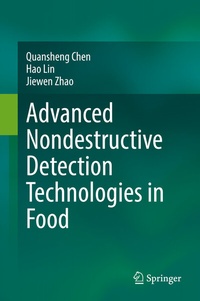
Advanced Nondestructive Detection Technologies in Food
Description

In the noninvasive measurement of food quality, this book has a systematic introduction of the detection principle, data processing, and rapid detection system, in-field detection case studies. This book is novel and practical and can be used as a professional textbook for undergraduates majoring in food science and engineering. It can also be used as a reference book for scientific research and technical personnel engaged in the field of food quality and safety detection.
More details
Other editions
Additional editions
Persons
Dr. Quansheng Chen is a professor in the School of Food and Biological Engineering of Jiangsu University. He has been engaged in the research of non-destructive detection of food quality and safety for nearly twenty 20 years. His main research interest includes using NIR, computer vision, spectral imaging, and multi-sensors fusion technologies food quality and safety non-destructive detection, and real-time monitoring for food quality using non-destructive methods.
Hao Lin Dr. Hao Lin is an associate professor in the School of Food and Biological Engineering of Jiangsu University. He has been engaged in the research of non-destructive detection of food quality and safety for fifteen years. His main research interest includes using NIR, bionic sensors, colorimetric sensors, acoustic sensor technologies for food quality and safety non-destructive detection, and the development of intelligent equipment.Jiewen Zhao
Dr. Jiewen Zhao is a professor in the School of Food and Biological Engineering of Jiangsu University. He has been engaged in the research of non-destructive detection of food quality and safety for more than thirty years. His main research interest includes using NIR, computer vision, bionic sensors, spectral imaging and multi-sensors fusion technologies food quality and safety non-destructive detection, and online grading for food quality using non-destructive methods.
Content
Chapter 1 Introduction. -Chapter 2 Computer Vision Technologies in Food.- Chapter 3 Near Infrared Spectroscopy Analysis in Food.- Chapter 4 Spectral Imaging Technologies in Food.- Chapter 5 CSAs Array Technologies in Food.- Chapter 6 Acoustic and Vibrating Signal Analysis Technologies in Food.- Chapter 7 Bionic Sensors Technologies in Food.- Chapter 8 Multi-Sensors data fusion Technologies in Food External and Internal Quality Comprehensive Evaluation.- Chapter 9 Intelligent and Portable Equipments of Nondestructve Detection Technologies in Food.- Chapter 10 Nondestructive Deatection Technologies for Real-time Monitoring Food Processing.
