

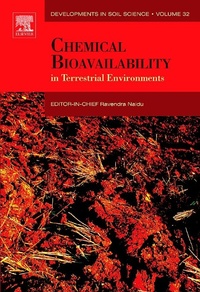
Chemical Bioavailability in Terrestrial Environments
Elsevier (Publisher)
Published on 31. August 2011
828 pages
978-0-08-055775-5 (ISBN)
Description

This book begins with an overview of current thinking on bioavailability, its definition, cutting-edge research in speciation and advancement in tools for assessing chemical bioavailability in the terrestrial environment. The second section of the book focuses on the role of chemical speciation in bioavailability. Section three addresses bioavailability and ecotoxicity of contaminants and leads into the next section on bioavailability of nutrients and agrichemicals. Subsequent sections provide an overview of tools currently being used and new cutting-edge techniques to assess contaminant bioavailability. The last section of the book builds on previous sections in relating bioavailability to risk assessment and how this could be used for managing risks associated with contaminated land.
- Provides the latest information on developing concepts and definitions of bioavailability
- Includes a discussion of bioavailability and ecotoxicity of contaminants and bioavailability of nutrients and agrichemicals for applications in agriculture
- Analyzes tools for assessing bioavailability and the role of bioavailability in risk assessment and remediation
More details
Other editions
Additional editions
Book
03/2008
Elsevier
€109.50
Shipment within 15-20 days
Person
Content
- Cover
- Contents
- List of contributors
- Preface
- Chapter 1. Chemical bioavailability in terrestrial environments
- 1.1 Introduction
- 1.2 Conclusion
- References
- A: Bioavailability - new concepts and definitions
- Chapter 2. Contaminant chemistry in soils: key concepts and bioavailability
- 2.1 Introduction
- 2.2 Nature and sources of contaminants
- 2.3 Contaminant interactions in soil
- 2.4 Key soil properties influencing chemical bioavailability in soils
- 2.5 Accessibility to contaminants bound to soil determines biodegradation of contaminants
- 2.6 Concluding remarks
- References
- Chapter 3. Bioavailability: definition, assessment and implications for risk assessment
- 3.1 Introduction
- 3.2 Definition of bioavailability
- 3.3 Methods for the assessment of contaminant bioavailability
- 3.4 Bioavailability implications to risk assessment
- References
- Chapter 4. Bioavailability: the underlying basis for risk-based land management
- 4.1 Introduction
- 4.2 Risk-based land management
- 4.3 Bioavailability and risk management
- 4.4 Risk management - policy
- 4.5 Sources and definition of contamination
- 4.6 Contaminant interaction
- 4.7 Key contaminants
- 4.8 Contaminant interaction varies with soil type
- 4.9 Historical approach to remediation
- 4.10 Risk assessment
- 4.11 Case study: As contaminated soil - application of risk-based land management
- 4.12 Conclusion
- References
- Chapter 5. Bioavailability of sorbed pesticides to bacteria: an overview
- 5.1 Introduction
- 5.2 Sorption influences bioavailability
- 5.3 Desorption-limited degradation
- 5.4 Role of surfactant molecules
- 5.5 Species-specific interactions and bioavailability
- 5.6 Conclusion
- References
- Chapter 6. Mechanistic Approach for Bioavailability of Chemicals in Soil
- 6.1 Introduction
- 6.2 Soil and rhizosphere system
- 6.3 Rhizosphere, a competitive environment
- 6.4 Food web complications
- 6.5 Spatiotemporal variability of exposure
- 6.6 Conceptual simplifications
- Acknowledgement
- References
- B: The role of chemical speciation in bioavailability
- Chapter 7. Frontiers in assessing the role of chemical speciation and natural attenuation on the Bioavailability of Contaminants in the Terrestrial Environment
- 7.1 Introduction
- 7.2 Isotopic dilution techniques
- 7.3 Microbeam synchrotron X-ray fluorescence of human teeth
- 7.4 XANES and XRF studies of Cr speciation in particulate matter
- 7.5 XANES and EXAFS analyses of As in soils
- 7.6 Complementary spectroscopic analyses of lacustrine sediments
- 7.7 Summary
- Acknowledgements
- References
- Chapter 8. Process-based approach in the study of bioavailability of ions in soils
- 8.1 Introduction
- 8.2 Donnan membrane technique
- 8.3 Multisurface models
- 8.4 Competition between ions for uptake
- 8.5 Ion transport and bioavailability
- 8.6 Outlook for future research
- Acknowledgement
- Reference
- Chapter 9. DGT measurements to predict metal bioavailability in soils
- 9.1 Introduction
- 9.2 Theoretical background
- 9.3 Experimental procedures
- 9.4 Example case studies of DGT application
- 9.5 Conclusion
- References
- Chapter 10. Organic contaminant speciation and bioavailability in the terrestrial environment
- 10.1 Introduction
- 10.2 Speciation, toxicity and abundance in soils
- 10.3 Bioavailability of organic compounds in soil - definitions and measurement
- 10.4 Factors influencing compound bioavailability
- 10.5 Bioavailability and uptake in organisms
- 10.6 Implications for risk based corrective action
- References
- C: Bioavailability and ecotoxicity of contaminants
- Chapter 11. Bioavailability and toxicity of contaminant mixtures to soil biota
- 11.1 Introduction
- 11.2 Impact on microbiological processes
- 11.3 Pollutant tolerance and adaptation of microorganisms
- 11.4 Degradation products may be more toxic than parent chemicals
- 11.5 Toxicity at long-term total petroleum hydrocarbon contaminated site - No single bioassay is adequate to assess the impact of several contaminants
- 11.6 Toxicity of organic (atrazine) and inorganic (copper) combination to soil biota
- 11.7 Approaches for bioremediation of co-contaminated soils
- 11.8 Conclusion
- Acknowledgement
- References
- Chapter 12. Bioavailability in soil: the role of invertebrate behaviour
- 12.1 Introduction
- 12.2 Invertebrates as active players in the context of soil contamination
- 12.3 Practical use of soil invertebrate behaviour: the earthworm avoidance test
- 12.4 Avoidance tests in environmental risk assessment
- 12.5 Outlook
- References
- Chapter 13. Relationship between biochemical activity and metal concentration in soil amended with sewage sludge
- 13.1 Introduction
- 13.2 Acute effects of sewage sludge on soil biochemical properties
- 13.3 Chronic effects of sewage sludge on soil biochemical properties
- 13.4 What is the relationship between metal concentration and soil biochemical activity?
- References
- D: Bioavailability of nutrients and agrichemicals
- Chapter 14. Techniques for assessing nutrient bioavailability in soils: Current and future issues
- 14.1 Introduction
- 14.2 Conceptual models of nutrient availability in soil
- 14.3 Applied tools for assessing and removing soil mineral constraints to crop production
- 14.4 Applied tools for assessing soil management threats to water quality
- 14.5 Research tools for building a fundamental understanding of the quantity, form and dynamics of plant-available nutrients in soils
- 14.6 Future directions
- References
- Chapter 15. The role of inhibitors in the bioavailability and mitigation of nitrogen losses in grassland ecosystems
- 15.1 Introduction
- 15.2 Issues
- 15.3 Sources of nitrogen input in grazed pastures
- 15.4 Nitrogen dynamics in pasture soils
- 15.5 Environmental impact of N losses
- 15.6 Inhibitors in nitrogen cycle
- 15.7 Bioavailability of N with inhibitors
- 15.8 Effect of inhibitors on N losses
- 15.9 Conclusions
- References
- Chapter 16. Assessment of phosphorus bioavailability from organic wastes in soil
- 16.1 Introduction
- 16.2 Phosphorus compounds in soil environment
- 16.3 Soil factors influencing phosphorus bioavailability
- 16.4 Fractionation of soil phosphorus
- 16.5 Phosphorus in organic residues
- 16.6 Phosphorus compounds recovered from sludges
- 16.7 Conclusions
- Acknowledgement
- References
- Chapter 17. Biological transformation and bioavailability of nutrient elements in acid soils as affected by liming
- 17.1 Introduction
- 17.2 Processes of acid generation in soils
- 17.3 Biological transformation of nutrients in soils
- 17.4 Soil acidity and bioavailability of nutrients
- 17.5 Liming and bioavailability of nutrients
- 17.6 Conclusions and future research needs
- References
- E: Tools to assess bioavailability
- Chapter 18. Contaminant concentrations in organisms as indicators of bioavailability: a review of kinetic theory and the use of target species in biomonitoring
- 18.1 Introduction
- 18.2 Toxicokinetic interpretation of residues
- 18.3 Target species for residue analysis
- 18.4 Confounding factors
- 18.5 Contaminants in food-webs
- 18.6 Conclusions
- References
- Chapter 19. Biological tools to assess contaminant bioavailability in soils
- 19.1 Introduction
- 19.2 Bioavailability
- 19.3 Factors affecting bioavailability of contaminants in soil
- 19.4 Assessment of contaminant bioavailability in soil
- 19.5 Biological tools for assessment of contaminant bioavailability
- 19.6 Conclusion
- References
- Chapter 20 Chemical Methods for Assessing Contaminant Bioavailability in Soils
- 20.1 Introduction
- 20.2 Solid-phase chemical fractionation
- 20.3 Concluding remarks
- References
- Chapter 21. Microbial activities, monitoring and application as part of a management strategy for heavy metal-contaminated soil and ground water
- 21.1 Introduction
- 21.2 Heavy metal resistance in bacteria
- 21.3 Methods for studying microbial community composition and activity
- 21.4 Bioremediation processes based on microbial heavy metal detoxification mechanisms
- 21.5 Conclusions
- References
- Chapter 22. DNA adduct analysis of environmental DNA: a potential method to assess the in situ bioavailability of polycyclic aromatic hydrocarbons
- 22.1 Introduction
- 22.2 Materials and methods
- 22.3 Results and discussion
- 22.4 Conclusions and future work
- Acknowledgements
- References
- Chapter 23. Can bioavailability assays predict the efficacy of PAH bioremediation?
- 23.1 Introduction
- 23.2 PAH sequestration and ageing
- 23.3 Determination of contaminant bioavailability
- 23.4 Non-exhaustive extractants
- 23.5 Predicting PAH biodegradation using bioavailability assays
- 23.6 Conclusion
- Acknowledgement
- References
- Chapter 24. The application of fibre optic chemical sensors for heavy metal monitoring in contaminated environments
- 24.1 Introduction
- 24.2 Fibre optic chemical sensors: general characteristics
- 24.3 Development of heavy metal sensors
- 24.4 Challenges for application to real-life monitoring
- 24.5 Conclusions
- References
- F: The role of bioavailability in risk assessment and remediation
- Chapter 25. Concept for risk assessment of soil contaminants based on total and bioavailable concentration - implementation in Switzerland
- 25.1 Introduction
- 25.2 Soil, soil fertility and soil quality
- 25.3 Characterisation of soil contamination
- 25.4 Concept for setting up three levels of standard values
- 25.5 Methodological foundations
- 25.6 Accuracy and limitations in the derivation of standard values
- 25.7 Conclusions
- References
- Chapter 26. Contaminants in the rootzone: bioavailability, uptake and transport, and their implications for remediation
- 26.1 Introduction
- 26.2 Clonal variation in the bioavailability of cadmium
- 26.3 Boron uptake from contaminated sawdust by a poplar
- 26.4 Consequences of chelation for enhancing copper extraction by plants
- 26.5 Distributed uptake across the root system
- 26.6 Modelling and parameterising biophysical transport mechanisms
- 26.7 Prognosis
- Acknowledgement
- References
- Chapter 27. Manipulating bioavailability to manage remediation of metal-contaminated soils
- 27.1 Introduction
- 27.2 Sources of heavy metals
- 27.3 Dynamics of heavy metals in soils
- 27.4 Definition and indicators of bioavailability
- 27.5 Indicators of bioavailability
- 27.6 Soil amendments for metal (im)mobilization
- 27.7 Conclusions
- References
- Chapter 28. The value of nitrilotriacetate in chelate-assisted phytoremediation
- 28.1 Introduction
- 28.2 Effect of NTA on metal solubility in clay suspension solutions and in soils
- 28.3 Influence of NTA on metal uptake by tobacco in hydroponic culture
- 28.4 Influence of NTA on metal uptake from nutrient solution with montmorillonite
- 28.5 Pot and field Experiments
- 28.6 Conclusion
- Acknowledgements
- References
- Chapter 29. EDTA-assisted phytostabilization by barley roots contaminated with heavy metals
- 29.1 Introduction
- 29.2 Materials and methods
- 29.3 Results and discussion
- 29.4 Future research dealing with chelate-assisted phytoremediation
- 29.5 Conclusion
- Acknowledgement
- References
- Chapter 30. Land reclamation using earthworms in metal contaminated soils
- 30.1 Introduction
- 30.2 The use of earthworms for land reclamation
- 30.3 The role of earthworms in reclaiming heavy metal contaminated soils
- 30.4 Trials of earthworm inoculation for the reclamation of Pb/Zn mine tailings from Lechang (China)
- 30.5 Conclusion
- Acknowledgements
- References
