

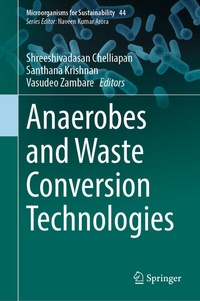
Anaerobes and Waste Conversion Technologies
Description

This book covers all aspects of anaerobic waste conversion technologies using anaerobes, particularly in anaerobic digestion and fermentation processes. It provides the latest advances in waste-to-energy techniques for converting solid and liquid wastes to valuable fuel and energy. It goes beyond traditional municipal waste, including energy recovery from various industrial wastewater and biomass. Topics include biomass pretreatment, metabolic pathways, anaerobic reactor design, product recovery, and conversion technology applications. Essential information is provided, and individual chapters are dedicated to each topic. The book assists academicians, postgraduate students, biochemical engineers, environmental engineers, analysts, chemical engineers, and industrial entrepreneurs in acquiring the skills needed for real-time implementation of anaerobic digestion technologies.
More details
Other editions
Additional editions
Persons
Dr. Shreeshivadasan Chelliapan Phd (Editor)
Professor, Department of Smart Engineering and Advanced Technology,
Faculty of Artificial Intelligence, Universiti Teknologi Malaysia,
54100 Kuala Lumpur, Malaysia.
Dr. Santhana Krishnan, Phd (Editor)
Postdoctoral Research Associate, Department Of Civil and Environmental Engineering,
Faculty Of Engineering, Prince of Songkla University,
Hat Yai, 90110, Thailand.
Dr. Vasudeo Zambare, PhD (Editor)
R&D Head, R&D Department, Balaji Enzyme and Chemical Pvt Ltd,
Mumbai 400059, Maharashtra, India.
Content
Chapter 1. Metabolic and biochemical pathways for anaerobic digestion.- Chapter 2. Impact of Anaerobic Bioreactors Configurations for Wastewater Treatment.- Chapter 3. Agricultural Waste Degradation: A Sustainable Solution Powered by Anaerobic Microbes.- Chapter 4. Anaerobic digestion and the characterization of variability of agricultural and municipal waste for its efficient valorization potential.- Chapter 5. Recycling of organic wastes by anaerobic microbial community.- Chapter 6. Microbial Ways for Pretreatment of Lignocellulosic Waste.- Chapter 7. Enhancement of Methane Production from Food waste using Multi-Objective Centralized Control Schemes.- Chapter 8. Advancements in Anaerobic Degradation Technology: A Sustainable Solution for Textile Azo Dye Wastewater Effluents Treatment in Anaerobic Reactor.- Chapter 9. Start-up of a High-solid Pilot-digester Treating Low Quality Mechanically-separated Small Particle Fraction of OFMSW.- Chapter 10. Methane Potential and Kinetic Analysis from A Pilot-Scale Anaerobic Digester Fed by Food Waste.- Chapter 11. Current progress in biogas and biochemicals production with effluent treatment.- Chapter 12. Possibilities of sustainable bioenergy generation from palm oil mill effluent using anaerobic technology.- Chapter 13. Saccharomyces cerevisiae: A Facultative Anaerobe for Ethanol Fermentation using Organic Waste.
