

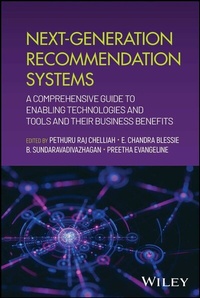
Next-Generation Recommendation Systems
Description

A detailed guide to building cutting-edge recommendation systems
In Next-Generation Recommendation Systems: A Comprehensive Guide to Enabling Technologies and Tools and their Business Benefits, a team of experienced technologists and educators, each with a proven track record in the field, delivers an expert guide to building robust recommendation systems that can interface with complex databases. The authors' deep understanding of the subject matter is evident as they explain how to use the latest AI technologies, including LLMs, graph neural networks, diffusion models, and generative adversarial networks, to create recommendation engines that users enjoy and that drive business revenue.
The book does not just delve into theoretical concepts, but also connects them to advanced implementation techniques. It demonstrates the application of practical and adaptable techniques, such as graph embeddings and Bayesian networks, to solve real-world problems faced by platform users and businesses. Readers will find the knowledge and tools to tackle these challenges head-on.
- Comprehensive coverage of practical generative AI techniques, including large language models and diffusion models
- Detailed exploration of graph neural networks and knowledge graph embeddings to solve common recommendation engine problems
- Practical guidance on implementing generative adversarial networks and variational autoencoders to address mode collapse and information bottleneck challenges
- In-depth analysis of hybrid recommendation architectures that combine content-based, collaborative, and knowledge-based filtering
Real-world deployment strategies using cloud-native computing environments are not just theoretical concepts in this book. They are actionable strategies that have been tested and proven effective. This emphasis on real-world applicability will reassure readers about the book's relevance to their professional or academic pursuits.
Perfect for data scientists, AI specialists, software engineers, architects, and graduate students, Next-Generation Recommendation Systems is an essential, up-to-date resource for everyone involved in the design, deployment, and optimization of recommendation systems that connect to large, complex datasets.
More details
Other editions
Additional editions
Persons
PETHURU RAJ CHELLIAH, PhD, is Principal AI Architect in Infocion Inc., Bangalore
E. CHANDRA BLESSIE, PhD, is an Associate Professor in the Department of Computing (Artificial et al.) at the Coimbatore Institute of Technology.
B. SUNDARAVADIVAZHAGAN, PhD, is an information and communications engineering researcher and educator.
PREETHA EVANGELINE, PhD, is an experienced educator and expert in data structures, operating systems, and high-performance computing.
Content
About the Editors xxxii
List of Contributors xxxiv
1 Describing Decisive Digital Transformation Technologies and Tools 1
Mamta
2 Delineating the Big Data Era and the Information Overload Problem 21
Sreekumar Vobugari and Shaurya Jauhari
3 Expounding Collaborative Filtering-Based Recommendation System 47
B. Sri Bhavan Prakath, B. Senthilkumar, and M. Sujithra
4 Illuminating Knowledge Graph-Based Recommendation Solutions 69
B. Rajalingam, A. Ruba, and N. Balasubramanian
5 Next Level Recommendation Systems: Harnessing the Power of GANs 97
Gnanasankaran Natarajan, Susai Rathinam Raja, Devika Govindhan, and Rakesh Gnanasekaran
6 Graph Neural Networks in Recommendation Systems for Superior User Experiences 121
Priyansha Upadhyay and P.K. Nizar Banu
7 Generative AI for Next Generation Recommendation System 151
Sunil Sharma, Sandip Das, Yashwant Singh Rawal, and Prashant Sharma
8 MindGraphFusion Method to Enhance Multi-Behavior Recommendation System for Cognitive Decision 175
D. Mythili and S. Rajasekaran
9 Generative AI for Next-Generation Recommender Systems: Architectures, Applications, and Future Directions 201
Shaik Valli Haseena and Neha Jaswani
10 Bayesian Networks (BNs) for Recommendation Systems 225
Ketan Sarvakar, Kaushik Rana, and Chandrakant Patel
11 Diffusion Models-Based Recommendation Systems 253
Elakkiya Elango, Sundaravadivazhagan Balasubaramanian, Shreenidhi Krishnamurthy Subramaniyan, and Harishchander Anandaram
12 Deep Learning for Personalized Recommendations: Overcoming Traditional Challenges 271
Beena Suresh Gaikwad, Jitha Janardhanan, and Arghya Das Dev
13 Dual-Stream Context-Aware GANs for Next-Generation Recommendation Systems 303
Vankayala Chethan Prakash, Raveendranadh Bokka, Aruchamy Prasanth, and Mariya Ouaissa
14 Revolutionizing Recommendations with LLMs: Intelligent, Adaptive, and Context-Aware Systems 337
M.K. Vidhyalakshmi, A.V. Allin Geo, Aswathy K. Cherian, and Sundaravadivazhagan Balasubaramanian
15 Evaluating Recommendation Algorithms: A Case Study on Online News Platforms 363
Alvin Nishant, J Alamelu Mangai, Mohammadi Akheela Khanum, and B Meenu
16 Recommendation Systems: Applications, Challenges, Ethics, and Future Directions 385
Elakkiya Elango, Gnanasankaran Natarajan, Harishchander Anandaram, and Shreenidhi Krishnamurthy Subramaniyan
17 Beyond Prediction: Generative AI as the Engine of Future Recommender Systems 407
Balan Senthilkumaran, Karthikeyan Sowndarya, N. Mahendran, and Pham Chien Thang
18 Enhanced Heart Disease Prediction using GANLSTM and GANSWOT - Augmented Data and Machine Learning 427
Ritu Aggarwal and Eshaan Aggarwal
19 AI-Powered Recommendation System for Intelligent Lesson Planning 447
Kanagaraj Karuppiah
20 Graph Neural Networks for Enhanced Customer Segmentation in Next-Generation Recommendation Systems 465
Nandhini Citibabu and Ayyanathan Natarajan
21 Intelligent Recommendation Systems: Bridging Next-Gen AI, Knowledge Engineering, and User-Centric Innovation 487
Gaganpreet Kaur, Amandeep Kaur, Ramandeep Sandhu, Astha jain, Indu Rani, and Deepika Ghai
22 Navigating Big Data: From Volume to Value in Next-Gen Recommendation Systems 509
N. Balasubramanian, A. Ruba, B. Rajalingam, and A. Manjula
23 Architectures, Advancements, and Real-World Implementations of Deep Learning-Based Recommendation Systems 543
S. Janani, Rajendran Bhojan, and R. Kumuthaveni
24 Deep Learning for Recommender Systems: A Comparative Analysis of RNN, LSTM, and GRU on MovieLens and Educational Data 571
Hasna Mahmoud, Es-said Boulmane, Mohamed Badouch, Omar Zaioudi, Mohamed Ouhssini, and Mehdi Boutaounte
References 587
Index 591
List of Contributors
Eshaan Aggarwal
Department of Computer Science and Engineering, Maharishi Markandeshwar Engineering College (Deemed To Be University)
(MM(DU)), Mullana, Haryana, India
Ritu Aggarwal
Department of Computer Science and Engineering, Maharishi Markandeshwar Engineering College (Deemed To Be University)
(MM(DU)), Mullana, Haryana, India
Harishchander Anandaram
Department of Artificial Intelligence
Amrita Vishwa Vidyapeetham College
Coimbatore, Tamilnadu, India
Mohamed Badouch
LabSIV, Department of Computer Science, Faculty of Science, Ibnou Zohr University, Agadir, Morocco
Sundaravadivazhagan Balasubaramanian
Department of Information Technology, University of Technology and Applied Sciences, Al Mussanah
Oman
N. Balasubramanian
Department of MCA, Mohamed Sathak Engineering College, Kilakarai
Tamilnadu, India
P.K. Nizar Banu
Department of Computer Science
Christ University, Bangalore, India
Rajendran Bhojan
Computer Science section, School of Mathematics and Computer Science
The Papua New Guinea University of Technology, Lae City, Morobe Province, Papua New Guinea
Raveendranadh Bokka
Department of Computer Science and Engineering, MLR Institute of Technology, Hyderabad, Telangana
India
Es-said Boulmane
LabSIV, Department of Computer Science, Faculty of Science, Ibnou Zohr University, Agadir, Morocco
Mehdi Boutaounte
National School of Commerce and Management, Ibnou Zohr University
Dakhla, Morocco
Aswathy K. Cherian
Department of Computing Technologies, SRM Institute of Science and Technology, Chengalpattu
Tamilnadu, India
Nandhini Citibabu
Department of Computer Applications, Hindustan Institute of Technology & Science, Chennai, India
Sandip Das
Department of CSE, Brainware University, West Bengal, India
Arghya Das Dev
Department of Computer Application
Presidency College, Bangalore, India
Elakkiya Elango
Department of Computer Science
Government Arts College for Women
Sivagangai, Tamilnadu, India
Beena Suresh Gaikwad
Department of Computer Application
Presidency College, Bangalore, India
A.V. Allin Geo
Department of Artificial Intelligence and Data Science, St. Joseph's Institute of Technology, Chennai
Tamilnadu
India
Deepika Ghai
School of Electronics and Electrical Engineering, Lovely Professional University, Phagwara, India
Rakesh Gnanasekaran
Department of Computer Science
Thiagarajar College, Madurai, India
Devika Govindhan
Department of Computer Science
Mannar Thirumalai Naicker College
Madurai, India
Shaik Valli Haseena
Presidency College, Christ University
Bengaluru, India
Astha Jain
Department of Computer Applications, Chandigarh Group of Colleges, Mohali, India
S. Janani
Department of Artificial Intelligence and Machine Learning, KPR College of Arts, Science and Research
Coimbatore, India
Jitha Janardhanan
Department of Computer Application
Presidency College, Bangalore, India
Neha Jaswani
Presidency College, Christ University
Bengaluru, India
Shaurya Jauhari
Responsible AI Office, Infosys Limited, Mysore, India
Kanagaraj Karuppiah
School of Computer Science and Engineering, Vellore Institute of Technology, Vellore, India
Amandeep Kaur
Advanced Centre of Research and Innovation (ACRI), School of Management Studies, CGC University
Mohali, India
Gaganpreet Kaur
Advanced Centre of Research and Innovation (ACRI), School of Management Studies, CGC University
Mohali, India
Mohammadi Akheela Khanum
School of Computer Science and Engineering, Presidency University
Bengaluru, India
Rathinasamy Kumuthaveni
Department of Artificial Intelligence and Machine Learning, KPR College of Arts, Science and Research
Coimbatore, India
N. Mahendran
Department of Electronics and Communication Engineering
M. Kumarasamy College of Engineering (Autonomous)
Karur, India
Hasna Mahmoud
LabSIV, Department of Computer Science, Faculty of Science, Ibnou Zohr University, Agadir, Morocco
Mamta
Department of CSE, Chandigarh University, Mohali, India
J. Alamelu Mangai
School of Computer Science and Engineering, Presidency University
Bangalore, India
A. Manjula
Department of EEE, Mohamed Sathak Engineering College, Keelakarai
Tamilnadu, India
B Meenu
School of Computer Science and Engineering, Presidency University
Bengaluru, India
D. Mythili
Department of Computer Science
Hindusthan College of Arts & Science (Autonomous), Bharathiar University
Coimbatore, India
Ayyanathan Natarajan
Department of Computer Applications, Hindustan Institute of Technology & Science, Chennai, India
Gnanasankaran Natarajan
Department of Computer Science
Thiagarajar College, Madurai
Tamilnadu, India
Alvin Nishant
School of Computer Science and Engineering, Presidency University
Bengaluru, India
Mariya Ouaissa
Cadi Ayyad University, Marrakech
Morocco
Mohamed Ouhssini
LabSIV, Department of Computer Science, Faculty of Science, Ibnou Zohr University, Agadir, Morocco
Chandrakant Patel
Acharya Motibhai Patel Institute of Computer Studies, Ganpat University
India
Vankayala Chethan Prakash
Department of Electronics and Communication Engineering, Sri Manakula Vinayagar Engineering College, Puducherry, India
Aruchamy Prasanth
Department of Computer Science and Engineering, Vel Tech Rangarajan Dr. Sagunthala Institute of Science and Technology, Chennai, Tamil Nadu
India
Susai Rathinam Raja
Department of Computer Applications, Hindustan Institute of Technology and Science, Chennai
India
B. Rajalingam
Department of Information Technology, Mohamed Sathak Engineering College, Kilakarai
Tamilnadu, India
S. Rajasekaran
College of Computing and Information Sciences, University of Technology and Applied Science, Ibri, Oman
Kaushik Rana
Computer Engineering, Lalbhai Dalpatbhai College of Engineering (LDCE), Gujarat Technological University, Ahmedabad, India
Indu Rani
Advanced Centre of Research and Innovation (ACRI), School of Management Studies, CGC University
Mohali, India
Yashwant Singh Rawal
Department of HM, Amity School of Hospitality, Amity University Rajasthan, Jaipur, India
A. Ruba
Department of Artificial Intelligence & Data Science, Mohamed Sathak Engineering College, Kilakarai
Tamilnadu, India
Ramandeep Sandhu
School of Computer Science & Engineering, Lovely Professional University, Phagwara, India
Ketan Sarvakar
Information Technology, U. V. Patel College of Engineering (GUNI-UVPCE), Ganpat University
Gujarat, India
B. Senthilkumar
Department of Mechanical Engineering, Kumaraguru College of Technology, Coimbatore, India
Balan Senthilkumaran
Department of Computer Science and Engineering, Vel Tech Rangarajan Dr. Sagunthala R&D Institute of Science and Technology, Chennai, India
Prashant Sharma
Department of CSE, Vivekananda Global University, Rajasthan
India
Sunil Sharma
Department of ECE, Techno NJR Institute of Technology, Rajasthan
India
Karthikeyan Sowndarya
Department of Electronics and Communication Engineering, DMI College of Engineering, Chennai
Tamilnadu, India
B. Sri Bhavan Prakath
Department of...
