

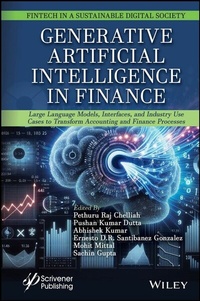
Generative Artificial Intelligence in Finance
Description

This comprehensive volume delves deep into the diverse applications and implications of generative AI across accounting, finance, economics, business, and management, providing readers with a holistic understanding of this rapidly evolving landscape.
Generative Artificial Intelligence in Finance: Large Language Models, Interfaces, and Industry Use Cases to Transform Accounting and Finance Processes provides a comprehensive guide to ethically harnessing generative AI systems to reshape financial management. Generative AI is a key theme across the accounting and finance sectors to drive significant optimizations leading to sustainability. Across 22 chapters, leading researchers supply innovative applications of large language models across the economic realm. Through detailed frameworks, real-world case studies, and governance recommendations, this book highlights applied research for generative AI in finance functions. Several chapters demonstrate how data-driven insights from AI systems can optimize complex financial processes to reduce resource usage, lower costs, and drive positive environmental impact over the long term. In addition, chapters on AI-enabled risk assessment, fraud analytics, and regulatory technology highlight applied research for generative AI in finance. The book also explores emerging applications like leveraging blockchain and metaverse interfaces to create generative AI models that can revolutionize areas from carbon credit trading to virtual audits. Overall, with in-depth applied research at the nexus of sustainability and optimization enabled by data science and generative AI, the book offers a compilation of best practices in leveraging AI for optimal, ethical, and future-oriented financial management.
Audience
The audience for this book is quite diverse, ranging from financial and accounting experts across banking, insurance, consultancies, regulatory agencies, and corporations seeking to enhance productivity and efficiency; business leaders want to implement ethical and compliant AI practices; researchers exploring the domain of AI and finance.
More details
Other editions
Additional editions
Persons
Pethuru Raj Chelliah, PhD, is a chief architect at Reliance Jio Platforms Ltd. (JPL), Bangalore, India. He has also worked at the IBM global cloud center and Robert Bosch Corporate Research.
Pushan Kumar Dutta, PhD, is an assistant professor in the Electronics and Communication Engineering Department at ASETKL, Amity University Kolkata, West Bengal, India. He has edited multiple books, published about 50 articles, and completed 10 book editorials. He was honored with the Young Faculty in Engineering Award in 2018.
Abhishek Kumar, PhD, is the assistant director and an associate professor in the Computer Science & Engineering Department, Chandigarh University, Punjab, India. He has more than 100 publications in reputed peer-reviewed national and international journals, books, and conferences.
Ernesto D.R. Santibanez Gonzalez, PhD, is a professor at the University of Talca, Chile, and a professor at Paulista University, Brazil. He has published more than 60 research articles and has developed numerous projects.
Mohit Mittal, PhD, is a data scientist at Knowtion GmbH in Karlsruhe, Germany. He completed a post-doctorate at Kyoto Sangyo University in Japan. He has authored numerous papers published in prestigious journals and at top-tier conferences.
Sachin Gupta, PhD, is an assistant professor in the Department of Business Administration, Mohanlal Sukhadia University, Udaipur, Rajasthan, India. His core subjects are finance, entrepreneurship & innovation, business & corporate law, etc.
Content
Preface xxi
Part I: Foundations and Applications of AI in Finance 1
1 Artificial Intelligence Application and Research in Accounting, Finance, Economics, Business, and Management 3
Peterson K. Ozili
2 Automating Data Entry in the Indian Banking Industry Through Generative 5
AI Srividya Prathiba, Rahul Pandey, Yashwant Patel and Manjinder Singh
3 Future Approach Generative AI, Stylized Architecture, and its Potential in Finance 33
Abhinna Baxi Bhatnagar, Abhaya Nanad, Anshul Kumar and Rakesh Kumar
4 Generative Artificial Intelligence (GAI) for Accurate Financial Forecasting 57
Tajinder Kumar, Sachin Lalar, Vishal Garg, Pooja Sharma and Ravi Dutt Mishra
5 The Far-Reaching Impacts of Emerging Technologies in Accounting and Finance 77
Sudhansu Sekhar Nanda
Part II: Generative AI in Risk Management and Fraud Detection 99
6 Deep Diving into Financial Frauds via Ad Click, Credit Card Management and Document Dispensation in E-Commerce Transactions 101
Bhupinder Singh, Pushan Kumar Dutta and Christian Kaunert
7 Generative AI: A Transformative Tool for Mitigating Risks for Financial Frauds 125
Rahul Joshi, Krishna Pandey and Suman Kumari
8 Innovation Unleashed Charting a New Course in Risk Evaluation with Generative AI 149
Shabeena Shah W., Khadeeja Bilquees A. and M. Jamal Mohamed Zubair
9 The Significance of Generative AI in Enhancing Fraud Detection and Prevention Within the Banking Industry 159
Roshni Rawal, Priya Sachdeva and Aabha S. Singhvi
10 Role of Generative AI for Fraud Detection and Prevention 175
Prasanna Kulkarni, Pankaj Pathak, Samaya Pillai and Vishal Tigga
Part III: Ethical, Legal, and Regulatory Considerations 199
11 Ethical and Regulatory Compliance Challenges of Generative 201
AI in Human Resources Leena Singh, Ankur Randhelia, Ashish Jain and Akash Kumar Choudhary
12 Navigating the Frontier of Finance: A Scoping Review of Generative AI Applications and Implications 215
Ahmad Haidar and Ahmad Abbass
13 Ensuring Compliance and Ethical Standards with Generative AI in Fintech: A Multi-Dimensional Approach 253
Vishal Jain and Archan Mitra
14 Privacy Laws and Leak of Financial Data in the Era of Generative AI 265
Nitish Kumar Ojha and Sanjeev Thakur
15 Ethics and Laws: Governing Generative AI's Role in Financial Systems 283
Prakriti Dixit Porwal
Part IV: Industry-Specific Applications and Innovations 299
16 Generative AI Tools for Product Design and Engineering 301
Manoj Singh Adhikari, Yogesh Kumar Verma, Manoj Sindhwani and Shippu Sachdeva
17 AI-Driven Generative Design Redefines the Engineering Process 327
Harpreet Kaur Channi, Amritjot Kaur and Surinder Kaur
18 Insurance Disruption: Analytics on Blockchain Transforming Indian Insurance Industry 361
Swati Gupta and Ruchika Rastogi
19 Application of Explainable Artificial Intelligence in Fintech 383
Raunak Kumar, Priya Gupta and Bhawna
20 Empowering Financial Efficiency in India: Harnessing Artificial Intelligence (AI) for Streamlining Accounting and Finance 407
Bhawna and Priya Gupta
21 Framework and Interface: The Backbone of AI Systems in Banking in India 429
Priya Sachdeva, Priti Goswami, Sumona Bhattacharya and Mohd. Ashfaq Siddiqui
22 Harnessing Generative AI for Engineering and Product Design: Conceptualization, Techniques, Advancements and Challenges 443
Sakshi, Chetan Sharma, Gunjan Verma and Nisha Chanana
References 463
Index 467
Preface
The financial industry is on the precipice of a transformative revolution, driven by rapid advancements in artificial intelligence (AI) and, more specifically, the emergence of generative AI. This comprehensive volume explores deep into the diverse applications and implications of generative AI across accounting, finance, economics, business, and management, providing readers with a holistic understanding of this rapidly evolving landscape.
The primary purpose of this book is to equip a wide range of stake-holders-from industry practitioners and policymakers to academics and students-with the knowledge and insights necessary to navigate the transformative potential of generative AI in the financial sector. Through contributions from leading experts and researchers, this volume shows the myriad ways this innovative technology is driving efficiency, enhancing decision-making, and mitigating risks across various financial domains.
The chapters herein cover a diverse range of topics. Each highlights the unique challenges, opportunities, and best practices associated with the deployment of generative AI in the financial ecosystem. The book begins by exploring the current applications of AI in accounting, finance, economics, and business management, setting the stage for a deeper dive into the specific use cases.
Whether you are a finance professional seeking to enhance productivity and efficiency using generative AI for competitive advantage, a business leader aiming to implement ethical and compliant AI practices, or a researcher exploring the frontiers of this domain, this book promises to be an invaluable resource in navigating the exciting future where artificial intelligence and the world of finance converge.
Part I: Foundations and Applications of AI in Finance
The opening chapter of this book provides a comprehensive overview of Artificial Intelligence applications across various business disciplines. It begins with an introduction to AI in business and finance, followed by a literature review examining existing research. The chapter then explores into specific AI applications in accounting, finance, economics, and business management, before discussing the potential risks associated with AI implementation. This broad exploration sets the stage for the more focused discussions that follow. The second and third chapters narrow the focus to specific applications and technical aspects of Generative AI in finance. Chapter 2 examines the automation of data entry in the Indian banking industry through Generative AI, providing a practical case study of AI implementation. It covers the methodology used, the specifics of data entry automation, and an analysis of the results. Chapter 3 then explores the future approach of Generative AI, its stylized architecture, and its potential in finance. This chapter bridges the gap between technical understanding and practical applications, discussing risk considerations such as data privacy and embedded bias, as well as significant challenges like explainability and cybersecurity. The final two chapters of this section examine specific applications and broader impacts of AI and related technologies in finance. Chapter 4 focuses on the use of Generative Artificial Intelligence (GAI) for accurate financial forecasting, detailing the methodology, model selection, and performance metrics used in this application. It provides insights into how GAI can improve forecasting accuracy compared to traditional methods. Chapter 5 broadens the scope once again, exploring the far-reaching impacts of emerging technologies in accounting and finance. This chapter covers not only AI but also blockchain, robotic process automation, and big data analytics, examining how these technologies work together to reshape the financial landscape. It concludes by discussing ethical considerations and potential future trends, providing a holistic view of the technological transformation in finance.
Part II: Generative AI in Risk Management and Fraud Detection
The exploration of Generative AI in financial fraud detection begins with a deep dive into various types of financial frauds, including ad-click fraud, credit card management fraud, and document dispensation fraud in e-commerce transactions. This comprehensive overview sets the stage for understanding the complex landscape of financial fraud and the challenges faced by the industry. Building on this foundation, the next chapter introduces Generative AI as a transformative tool for mitigating risks in financial fraud. It discusses the characteristics of Generative AI, its applications in financial assets, and the associated risks and mitigation strategies. This chapter bridges the gap between traditional fraud detection methods and cutting-edge AI technologies, paving the way for innovative approaches to risk evaluation. As the narrative progresses, the focus shifts to charting a new course in risk evaluation with Generative AI. This chapter explores novel applications and emerging roles in the field, showcasing how Generative AI is reshaping the financial industry's approach to risk assessment. The discussion then narrows to the specific context of the banking industry, examining the significance of Generative AI in enhancing fraud detection and prevention within this sector. By presenting case studies and addressing ethical considerations, this chapter provides a practical perspective on the implementation of Generative AI in real-world banking scenarios. The next chapter ties together the preceding discussions by examining the overarching role of Generative AI in fraud detection and prevention across various financial sectors. It offers a comparative analysis of Generative AI with other fraud detection methods and outlines best practices for implementation. By exploring future trends and potential developments, this chapter not only concludes the current state of Generative AI in financial fraud detection but also opens up avenues for future research and innovation. Throughout these interconnected chapters, readers gain a comprehensive understanding of how Generative AI is revolutionizing the fight against financial fraud, from theoretical concepts to practical applications and future possibilities.
Part III: Ethical, Legal, and Regulatory Considerations
The next set of chapters in this exploration of Generative AI in finance begins with an in-depth examination of ethical and regulatory compliance challenges in human resources. Chapter 11 explores into the complexities of using AI in HR processes, addressing critical issues such as bias in hiring, privacy concerns, and the impact on diversity and inclusion. It also provides practical guidance on compliance with laws like General Data Protection Regulation and Equal Employment Opportunity, emphasizing best practices for responsible AI implementation in HR. This discussion sets the stage for broader considerations of AI's role in finance, which is further explored in Chapter 12. This chapter offers a scoping review of Generative AI applications and implications in the financial sector, examining its evolution, potential risks, and diverse applications in financial analysis and strategy. By exploring regulatory, ethical, and user-centric perspectives, it provides a comprehensive overview of the current state and future potential of AI-driven finance. The subsequent chapters build upon this foundation, addressing specific aspects of Generative AI in finance. Chapter 13 focuses on ensuring compliance and ethical standards in fintech, likely proposing a multi-dimensional approach that encompasses legal, ethical, operational, and technological considerations. This is followed by Chapter 14, which tackles the critical issue of privacy laws and data protection in the era of Generative AI, exploring the challenges of safeguarding sensitive financial information in an increasingly AI-driven landscape. The final chapter in this set, Chapter 15, brings together these threads by examining the overarching theme of ethics and laws governing Generative AI's role in financial systems. This chapter likely discusses the need for new regulatory frameworks and ethical guidelines to ensure responsible AI use in finance.
Throughout these chapters, a common thread emerges: the need to balance the transformative potential of Generative AI in finance with robust ethical considerations and regulatory compliance. From HR practices to broader financial systems, the chapters collectively address the multifaceted challenges and opportunities presented by AI technology. They provide a comprehensive view of how the financial sector can navigate the complex landscape of AI implementation, ensuring that innovation is tempered with responsibility and ethical considerations. This set of chapters not only offers valuable insights for practitioners and policymakers but also sets the stage for future research and development in the field of AI-driven finance.
Part IV: Industry-Specific Applications and Innovations
The final section of the book explores into the broader implications and future directions of generative AI in the financial industry. The next set of three chapters (16-18) focus on the application of generative AI in product design and engineering. They explore how AI is revolutionizing these fields by enhancing creativity, streamlining workflows, and driving innovation. The chapters cover various applications such as concept generation, topology optimization, and rapid prototyping, while also delving into the fundamentals of generative AI in engineering, including machine learning and neural networks. Chapter...
