

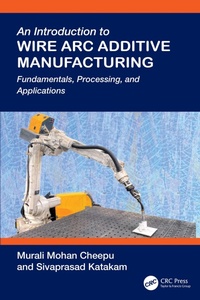
An Introduction to Wire Arc Additive Manufacturing
Fundamentals, Processing, and Applications
1st Edition
Published on 28. November 2025
302 pages
978-1-040-44995-0 (ISBN)
Description

This book covers the fundamentals of wire arc additive manufacturing processes including principles and processing procedures for developing near-net shape components and their applications. It further addresses wire arc additive manufacturing of titanium, aluminium, nickel-based alloys, stainless steel, copper, bronze, and iron-based alloys backed by case studies and illustrations. It explains the metallurgical and mechanical features of the wire arc additively manufactured components.
Overviews directed energy deposition processes and fundamentals of wire arc additive manufacturing process.
Deals with most successful additive manufacturing process to create large-scale components.
Provides the comparison of productivity between wire arc additive manufacturing and other additive manufacturing processes for various materials.
Discusses solidification process, thermal gradient, and microstructural features.
Includes real-time case studies and numerous illustrations.
This book is aimed at researchers and graduate students in manufacturing and materials science engineering, welding, and additive manufacturing.
Overviews directed energy deposition processes and fundamentals of wire arc additive manufacturing process.
Deals with most successful additive manufacturing process to create large-scale components.
Provides the comparison of productivity between wire arc additive manufacturing and other additive manufacturing processes for various materials.
Discusses solidification process, thermal gradient, and microstructural features.
Includes real-time case studies and numerous illustrations.
This book is aimed at researchers and graduate students in manufacturing and materials science engineering, welding, and additive manufacturing.
More details
Edition
1. Auflage
Language
English
Place of publication
London
United Kingdom
Publishing group
Taylor & Francis Ltd
Target group
College/higher education
Illustrations
2 Tables, black and white; 31 Line drawings, black and white; 49 Halftones, black and white; 80 Illustrations, black and white
File size
18,56 MB
ISBN-13
978-1-040-44995-0 (9781040449950)
Copyright in bibliographic data and cover images is held by Nielsen Book Services Limited or by the publishers or by their respective licensors: all rights reserved.
Schweitzer Classification
Other editions
Additional editions
Murali Mohan Cheepu | Sivaprasad Katakam
An Introduction to Wire Arc Additive Manufacturing
Fundamentals, Processing, and Applications
Book
approx. 12/2025
1st Edition
CRC Press
€146.00
Not yet published
Persons
Dr. Murali Mohan Cheepu, born in 1988, received his Bachelor's degree in Mechanical and Production Engineering from Andhra University (GITAM College) in Visakhapatnam, India. He earned his Master's degree in Welding Engineering from the National Institute of Technology Tiruchirappalli (NITT) in India. In 2018, he was awarded his Doctoral degree from Kyungsung University in Republic of Korea. He also carried out his Post-octoral research at Pukyong National University, Korea in 2019. In 2011, Dr. Murali was appointed as a Junior Manager at JSW Steel Ltd., where he oversaw the fabrication and maintenance of structural welding, overlay welding, and WAAM (Wire Arc Additive Manufacturing) components. Dr. Murali is currently serving as the Deputy General Manager of the Research and Technical Division at JIN HEUNG TECH CO., LTD. Republic of Korea. Prior to this, he worked as a Research and Project Manager at VITZRONEXTECH Co., Ltd., Republic of Korea and Research Manager at STARWELDS Inc. Republic of Korea. He has several years of industry experience, most notably at JSW STEEL Ltd. and STARWELDS, Inc. as a Research Manager specializing in the development of WAAM processes for large-cale components, welding process design, automation, digitalization, and artificial intelligence. Dr. Murali has extensive research experience in additive manufacturing, welding and joining technologies, development of welding filler materials, mechanical behavior materials, and machine learning and AI of the WAAM process. Most recently, he started working for the development of welding methods for the construction of "Artificial Sun: Future Energy: Fusion & Plasma". He has published research articles, edited books, and patents on Advances in Additive Manufacturing Processes and Automation in Welding Technologies, Green Technology, and Smart Materials for Engineering Applications, and continues to serve as the editorial board member of several journals. In 2023, Dr. Murali was honored with several prestigious awards, including the Outstanding Young Manufacturing Engineer from Society of Manufacturing Engineers (SME), USA, and the Young Fellow Award from the Korean Welding and Joining Society (KWJS), Republic of Korea. In addition, he received the Best Researcher Award from the KWJS in 2020. Additionally, Dr. Murali received the Outstanding Contributor Award from the Korean Society for Precision Engineering (KSPE), Korea, and the Outstanding Citations Award from KWJS. This recognition was further elevated in 2024 with the "A. F. Davis Silver Medal Award" from the American Welding Society, USA, and in 2025 with the "IAAM Scientist Award" from the International Association of Advanced Materials, Sweden, highlighting Dr. Murali's significant contributions and achievements in the field. Dr. Murali is an IEEE senior member and a member of Korean Welding and Joining Society (KWJS), Hong Kong Society of Mechanical Engineers (HKSME), American Welding Society (AWS), Korean Society of Mechanical Engineers (KSME), and Society of Manufacturing Engineers (SME).
Dr. Katakam Sivaprasad was born in 1977. He completed his Diploma in Metallurgical Engineering at Government Polytechnic, Visakhapatnam, Andhra Pradesh, India. Later, he completed his AMIIM (Under Graduation) and moved to the Indian Institute of Technology Madras, Chennai, India to complete his M.Tech. (2002) and Ph.D. (2007) in Metallurgical Engineering. He took his professional career in 2007 at the National Institute of Technology (NIT), Tiruchirappalli, Tamil Nadu, India as an Assistant Professor in the Department of Metallurgical and Materials Engineering. He served in administrative roles like Associate Dean (Research & Consultancy) at NIT. Presently, he is working there only as a Professor (Full). His major activities at NIT are teaching and research related to mechanical behavior of materials, structure-property-process correlations, additive manufacturing, and materials characterization. His major research activities are on cryo-deformation of materials, metal-intermetallic laminates for defense applications, deformation of nanocrystalline materials, and additive manufacturing. He has published more than 110 research articles in refereed international journals and presented his work in more than 50 conferences. He edited few special issues in SCOPUS and SCIE journals. He has contributed to few book chapters in refereed edited books. He has guided 13 doctoral candidates and more than 50 Master's candidates at NIT. He completed many sponsored and consultancy research activities with various funding agencies such as Department of Science and Technology (India) (DST), Ministry of Higher Education (MoHE), Defence Research and Development Organisation (India) (DRDO), Naval Research Board (under DRDO, India) (NRB), Indian Space Research Organisation (ISRO), and Tata Steel. He organized several international and national conferences related to advanced materials and additive manufacturing. He has a very strong international collaboration from various countries such as USA, UK, Japan, Estonia, and Singapore, and he was a visiting scientist to the USA and Japan. He is the first recipient of Sir Dorabji Tata and T R Anantharaman faculty fellowship in 2014 and received many best paper awards in many conferences. He is on many international research review panels across the globe. He is a senior member of Society of Manufacturing Engineers -Hong Kong (SMEHK) and also a life member of Indian Institute of Metals (IIM), Indian Welding Society (IWS), Materials Research Society of India (MRSI), Indian Society for Technical Education (ISTE), Powder Metallurgy Association of India (PMAI), and Indian Science Congress Association (ISCA).
Dr. Katakam Sivaprasad was born in 1977. He completed his Diploma in Metallurgical Engineering at Government Polytechnic, Visakhapatnam, Andhra Pradesh, India. Later, he completed his AMIIM (Under Graduation) and moved to the Indian Institute of Technology Madras, Chennai, India to complete his M.Tech. (2002) and Ph.D. (2007) in Metallurgical Engineering. He took his professional career in 2007 at the National Institute of Technology (NIT), Tiruchirappalli, Tamil Nadu, India as an Assistant Professor in the Department of Metallurgical and Materials Engineering. He served in administrative roles like Associate Dean (Research & Consultancy) at NIT. Presently, he is working there only as a Professor (Full). His major activities at NIT are teaching and research related to mechanical behavior of materials, structure-property-process correlations, additive manufacturing, and materials characterization. His major research activities are on cryo-deformation of materials, metal-intermetallic laminates for defense applications, deformation of nanocrystalline materials, and additive manufacturing. He has published more than 110 research articles in refereed international journals and presented his work in more than 50 conferences. He edited few special issues in SCOPUS and SCIE journals. He has contributed to few book chapters in refereed edited books. He has guided 13 doctoral candidates and more than 50 Master's candidates at NIT. He completed many sponsored and consultancy research activities with various funding agencies such as Department of Science and Technology (India) (DST), Ministry of Higher Education (MoHE), Defence Research and Development Organisation (India) (DRDO), Naval Research Board (under DRDO, India) (NRB), Indian Space Research Organisation (ISRO), and Tata Steel. He organized several international and national conferences related to advanced materials and additive manufacturing. He has a very strong international collaboration from various countries such as USA, UK, Japan, Estonia, and Singapore, and he was a visiting scientist to the USA and Japan. He is the first recipient of Sir Dorabji Tata and T R Anantharaman faculty fellowship in 2014 and received many best paper awards in many conferences. He is on many international research review panels across the globe. He is a senior member of Society of Manufacturing Engineers -Hong Kong (SMEHK) and also a life member of Indian Institute of Metals (IIM), Indian Welding Society (IWS), Materials Research Society of India (MRSI), Indian Society for Technical Education (ISTE), Powder Metallurgy Association of India (PMAI), and Indian Science Congress Association (ISCA).
Content
1. Introduction and Basic Principles
2. Types of WAAM Processes
3. Equipment and Automation
4. Guidelines for Materials and Process Selection
5. Metallurgical Aspects of WAAM Process
6. Defects Analysis and Quality Assurance
7. Finite Element Modeling of WAAM
8. Machine Learning in WAAM
9. Challenges in WAAM
10 Applications and Future Scope of WAAM
2. Types of WAAM Processes
3. Equipment and Automation
4. Guidelines for Materials and Process Selection
5. Metallurgical Aspects of WAAM Process
6. Defects Analysis and Quality Assurance
7. Finite Element Modeling of WAAM
8. Machine Learning in WAAM
9. Challenges in WAAM
10 Applications and Future Scope of WAAM
