

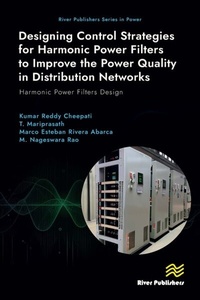
Designing Control Strategies for Harmonic Power Filters to Improve the Power Quality in Distribution Networks
Harmonic Power Filters Design
1st Edition
Published on 17. June 2025
258 pages
978-1-040-39721-3 (ISBN)
Description

In today's complex and interconnected electrical power systems, maintaining high power quality is crucial for efficient operation and reliability. This book delves into the intricacies of power quality issues, with a special focus on harmonics and their mitigation through advanced filter design and control strategies. It is tailored for both professionals and students in electrical engineering, power systems, and power electronics. It offers a detailed exploration of the following key topics:
Fundamentals of power quality: Understand the basic concepts of power quality, its importance, and the common issues encountered in modern distribution networks
Harmonic analysis: Learn about the sources of harmonics, their effects on electrical systems, and the methodologies for their analysis
Filter design techniques: Discover various types of harmonic filters, including passive, active, and hybrid filters, and the principles behind their design
Control strategies: Gain insights into advanced control techniques for harmonic filters, focusing on improving system stability, efficiency, and performance
Future trends and innovations: Stay ahead with the latest developments and future trends in harmonic filtering and power quality improvement
Written by leading experts in the field, this book combines theoretical foundations with practical insights, making it an essential resource for anyone looking to deepen their understanding of power quality and harmonic filtering. Whether you are an academic, a practicing engineer, or a researcher, this book provides the knowledge and tools needed to tackle the challenges of modern power distribution networks and ensure high-quality power delivery.
Fundamentals of power quality: Understand the basic concepts of power quality, its importance, and the common issues encountered in modern distribution networks
Harmonic analysis: Learn about the sources of harmonics, their effects on electrical systems, and the methodologies for their analysis
Filter design techniques: Discover various types of harmonic filters, including passive, active, and hybrid filters, and the principles behind their design
Control strategies: Gain insights into advanced control techniques for harmonic filters, focusing on improving system stability, efficiency, and performance
Future trends and innovations: Stay ahead with the latest developments and future trends in harmonic filtering and power quality improvement
Written by leading experts in the field, this book combines theoretical foundations with practical insights, making it an essential resource for anyone looking to deepen their understanding of power quality and harmonic filtering. Whether you are an academic, a practicing engineer, or a researcher, this book provides the knowledge and tools needed to tackle the challenges of modern power distribution networks and ensure high-quality power delivery.
More details
Series
Language
English
Place of publication
London
United Kingdom
Target group
College/higher education
Professional and scholarly
Illustrations
62 Tables, black and white; 132 Line drawings, color; 50 Line drawings, black and white; 132 Illustrations, color; 50 Illustrations, black and white
File size
43,97 MB
ISBN-13
978-1-040-39721-3 (9781040397213)
Copyright in bibliographic data and cover images is held by Nielsen Book Services Limited or by the publishers or by their respective licensors: all rights reserved.
Schweitzer Classification
Other editions
Additional editions
Kumar Reddy Cheepati | T. Mariprasath | Marco Esteban Rivera Abarca
Designing Control Strategies for Harmonic Power Filters to Improve the Power Quality in Distribution Networks
Harmonic Power Filters Design
Book
06/2025
1st Edition
River Publishers
€169.10
Article not available for order
Persons
Dr. Kumar Reddy Cheepati obtained his Ph.D. degree from JNTUK, Kakinada in 2021. Currently he is working as an Associate Professor in the department of Electrical and Electronics Engineering at KSRM College of Engineering (Autonomous), Kadapa, Andhra Pradesh. He has published research papers in various international journals of high repute which include Scopus, SCI and ESCI indexed journals. He attended and presented papers in prestigious international conferences which include IEEE. Dr. Reddy is mainly working on predictive control techniques for shunt active filters to mitigate the harmonics in distribution networks as per IEEE-519-2022 standards. He is an active reviewer of the Electrical Power System Research (EPSR) journal, Journal of Circuits, Systems and Computers (JCSC), Journal of Engineering Research (JER) and Circuit World journal. He has been invited to several research meetings, conferences and guest lectures.
Dr. T. Mariprasath received a Ph.D. degree from the Rural Energy Centre at The Gandhigram Rural Institute (deemed to be a university) in January 2017. Since June 2018, he has been working as an Associate Professor in the Department of EEE at KSRM College of Engineering (Autonomous), Andhra Pradesh, India. He is also a member of the R&D Cell. He has published eleven journal articles in the Science Citation Index and fifteen articles in Scopus. He received a grant from the Ministry of Micro, Small, and Medium Enterprises to develop a self-powered GPS tracker. Springer Discover Electronics recently selected him as an editorial board member. He serves as a reviewer for reputed publishers like IEEE, Elsevier, Wiley, Springer, Taylor & Francis, and IET. His research interests include electric vehicles, solar PV, IoT, machine learning, and green materials.
Prof.-Dr. Marco Rivera received an Electronic Civil Engineering degree and M.Sc. degree in Engineering, with specialization in Electrical Engineering, from the Universidad de Concepcion. Later he obtained a Ph.D. degree in Electronic Engineering from the Universidad Tecnica Federico Santa Maria, and was awarded the "Premio Tesis de Doctorado Academia Chilena de Ciencias 2012", for the best Ph.D. Thesis developed in 2011 for national and foreign students in any exact or natural sciences program, and is a member of the Academia Chilena de Ciencias, Chile. In the past few years, he has been a visiting professor at several international universities. He has directed and participated in several projects financed by the National Fund for Scientific and Technological Development (Fondo Nacional de Desarrollo Cientifico y Tecnologico, FONDECYT), the Chilean National Agency for Research and Development (Agencia Nacional de Investigacion y Desarrollo, ANID), and the Paraguayan Program for the Development of Science and Technology (Proyecto Paraguayo para el Desarrollo de la Ciencia y Tecnologia, PROCIENCIA), among others. He has been the responsible researcher of basal financed projects whose objective is to enhance, through substantial and long-term financing, Chile's economic development through excellence and applied research. He is the Director of the Laboratory of Energy Conversion and Power Electronics (Laboratorio de Conversion de Energias y Electronica de Potencia, LCEEP) at Universidad de Talca, Chile. He was a full professor at the Department of Electrical Engineering at the Universidad de Talca. In April 2023 he joined the Power Electronics, Machines and Control (PEMC) research group of the University of Nottingham as a Professor. His main research areas are power electronics, renewable energies, advanced control of power converters, and microgrids, among others. He has published more than 520 academic publications in leading international conferences and journals.
Dr. Maddala Nageswara Rao is a distinguished Professor of Electrical and Electronics Engineering (EEE) at UCEK, JNTUK, Kakinada. He holds a B.Tech from JNTUH Hyderabad, an M.Tech from NIT Calicut, and a Ph.D. from JNTUK Kakinada. His doctoral thesis, supervised by Dr. R. Srinivas Rao, focused on ""Distributed Power Generation Planning and Evaluation in Rural Distribution System under Indian Conditions-A Cost/Benefit Analysis"" and was awarded in 2017. With 20 years of professional experience and 17 years of research experience, Dr. Rao has held several administrative positions including NSS Programme Officer, NSS Coordinator, Officer Incharge of Examinations, Additional Controller of Examinations, Departmental IQAC Coordinator, and Project Engineer at UCEK and JNTUK. He has guided 72 PG students and 1 Ph.D. scholar, with 9 Ph.D. scholars currently under his supervision. His publications include 16 international journals, 15 international conferences, and 15 faculty development programs. He also has a patent on a smart ring main distribution system and authored a book chapter on energy storage systems in microgrid operations. His research interests lie in power and control systems. Dr. Rao teaches various subjects, including electrical measurements, AI techniques, electrical circuits, and neural networks and fuzzy logic, and is a member of the Institution of Engineers (India). He has co-organized a workshop on AI and machine learning applications to power systems, sponsored by SERB, DST, Govt. of India.
Dr. T. Mariprasath received a Ph.D. degree from the Rural Energy Centre at The Gandhigram Rural Institute (deemed to be a university) in January 2017. Since June 2018, he has been working as an Associate Professor in the Department of EEE at KSRM College of Engineering (Autonomous), Andhra Pradesh, India. He is also a member of the R&D Cell. He has published eleven journal articles in the Science Citation Index and fifteen articles in Scopus. He received a grant from the Ministry of Micro, Small, and Medium Enterprises to develop a self-powered GPS tracker. Springer Discover Electronics recently selected him as an editorial board member. He serves as a reviewer for reputed publishers like IEEE, Elsevier, Wiley, Springer, Taylor & Francis, and IET. His research interests include electric vehicles, solar PV, IoT, machine learning, and green materials.
Prof.-Dr. Marco Rivera received an Electronic Civil Engineering degree and M.Sc. degree in Engineering, with specialization in Electrical Engineering, from the Universidad de Concepcion. Later he obtained a Ph.D. degree in Electronic Engineering from the Universidad Tecnica Federico Santa Maria, and was awarded the "Premio Tesis de Doctorado Academia Chilena de Ciencias 2012", for the best Ph.D. Thesis developed in 2011 for national and foreign students in any exact or natural sciences program, and is a member of the Academia Chilena de Ciencias, Chile. In the past few years, he has been a visiting professor at several international universities. He has directed and participated in several projects financed by the National Fund for Scientific and Technological Development (Fondo Nacional de Desarrollo Cientifico y Tecnologico, FONDECYT), the Chilean National Agency for Research and Development (Agencia Nacional de Investigacion y Desarrollo, ANID), and the Paraguayan Program for the Development of Science and Technology (Proyecto Paraguayo para el Desarrollo de la Ciencia y Tecnologia, PROCIENCIA), among others. He has been the responsible researcher of basal financed projects whose objective is to enhance, through substantial and long-term financing, Chile's economic development through excellence and applied research. He is the Director of the Laboratory of Energy Conversion and Power Electronics (Laboratorio de Conversion de Energias y Electronica de Potencia, LCEEP) at Universidad de Talca, Chile. He was a full professor at the Department of Electrical Engineering at the Universidad de Talca. In April 2023 he joined the Power Electronics, Machines and Control (PEMC) research group of the University of Nottingham as a Professor. His main research areas are power electronics, renewable energies, advanced control of power converters, and microgrids, among others. He has published more than 520 academic publications in leading international conferences and journals.
Dr. Maddala Nageswara Rao is a distinguished Professor of Electrical and Electronics Engineering (EEE) at UCEK, JNTUK, Kakinada. He holds a B.Tech from JNTUH Hyderabad, an M.Tech from NIT Calicut, and a Ph.D. from JNTUK Kakinada. His doctoral thesis, supervised by Dr. R. Srinivas Rao, focused on ""Distributed Power Generation Planning and Evaluation in Rural Distribution System under Indian Conditions-A Cost/Benefit Analysis"" and was awarded in 2017. With 20 years of professional experience and 17 years of research experience, Dr. Rao has held several administrative positions including NSS Programme Officer, NSS Coordinator, Officer Incharge of Examinations, Additional Controller of Examinations, Departmental IQAC Coordinator, and Project Engineer at UCEK and JNTUK. He has guided 72 PG students and 1 Ph.D. scholar, with 9 Ph.D. scholars currently under his supervision. His publications include 16 international journals, 15 international conferences, and 15 faculty development programs. He also has a patent on a smart ring main distribution system and authored a book chapter on energy storage systems in microgrid operations. His research interests lie in power and control systems. Dr. Rao teaches various subjects, including electrical measurements, AI techniques, electrical circuits, and neural networks and fuzzy logic, and is a member of the Institution of Engineers (India). He has co-organized a workshop on AI and machine learning applications to power systems, sponsored by SERB, DST, Govt. of India.
Content
1. Introduction to the Power Quality and Harmonic Power Filters 2. Tuned Passive Harmonic Power Filter Design 3. Shunt Active Harmonic Power Filters Design 4. Comparative Analysis 5. Conclusions and Future Scope
