

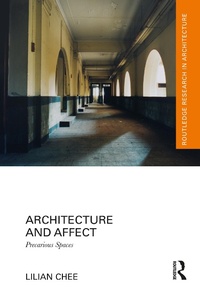
Architecture and Affect
Precarious Spaces
1st Edition
Published on 17. May 2023
388 pages
978-1-317-06865-5 (ISBN)
Description

Architecture and Affect is motivated by two questions: Why does dismissed affective evidence trouble us? What would it mean for architecture to assemble such discrepant evidence into its discourse?
Arguing that the persistent refrains of lived affect dwell in architecture, this book traces such refrains to a concept of architecture wedged in the middle ground-jammed amidst life, things and events. Rather than being aloof from its surrounds, architecture-in-the-midst challenges an autonomous epistemology. Beyond accounting for the vivid but excluded, this book develops a frame and a disposition for thinking critically about, speculatively through, and being grounded by, encounter. Examining affect through a constellation of spaces in contemporary Singapore, it details architecture's uneasy but inextricable relationship with key subjects relegated to the incommensurate, the peripheral, the scenic and the decorative. The outcome is a politicized architectural discourse simultaneously grounded and speculative; bridging depth and intuition, thinking and feeling.
Arguing that the persistent refrains of lived affect dwell in architecture, this book traces such refrains to a concept of architecture wedged in the middle ground-jammed amidst life, things and events. Rather than being aloof from its surrounds, architecture-in-the-midst challenges an autonomous epistemology. Beyond accounting for the vivid but excluded, this book develops a frame and a disposition for thinking critically about, speculatively through, and being grounded by, encounter. Examining affect through a constellation of spaces in contemporary Singapore, it details architecture's uneasy but inextricable relationship with key subjects relegated to the incommensurate, the peripheral, the scenic and the decorative. The outcome is a politicized architectural discourse simultaneously grounded and speculative; bridging depth and intuition, thinking and feeling.
Reviews / Votes
'Chee takes us on an encounter-as-detour, tracking spatial stories imbued with affect and haunted by precarious power relations. Undoing the discipline's instrumental ambitions and revealing the fallacy of its purported autonomy, she asks: If we become better attuned to the micro-politics of radically open-ended affective encounters, can our knowledge practices in architecture be transformed?'----- Helene Frichot, Professor of Architecture and Philosophy, University of Melbourne
'Lilian Chee's Architecture and Affect is an exceptionally important contribution to the architectural field. It asks a simple but most profound question: how can we account for affective responses to architecture, so often dismissed as incidental yet so vital to lived experience? Chee draws on a series of encounters with spaces in Singapore in order to build a frame through which to incorporate affect into architectural histories, theories, and practices. These encounters immerse readers in residual spaces where scholars still-too-rarely go, from mass housing to cemeteries, and dwell on everyday practices of inhabitation and care, from feeding stray cats to exhuming tombs. A noted filmmaker, architectural designer and feminist theorist, Chee's original and rooted portrait of architectural affect reflects years of intimate engagement with her sites across many registers. The result is itself a beautiful 'monument' - to squinting from blindspots, being captivated by subjects, and never ignoring the tiger under the billiard table.'
----- Barbara Penner, Professor in Architectural Humanities, Bartlett School of Architecture, UCL
'With delight and wit, Lilian Chee opens the door of architecture to anecdotes, stories, film, and photography of lives within, on, and around the structures that architects install. She takes on the ideology of social democratic mass housing and its implications for muted subjectivities enmeshed in the discipline of mortgages and home ownership, while at the same time stirring up spectralities of pasts and futures that are ambiguous and compelling. With this book, Chee re-opens a new chapter in Singaporean critical theory.'
----- Michael M.J. Fischer, Andrew W. Mellon Professor in the Humanities, Professor of Anthropology and Science and Technology Studies, MIT
'A dialectical ingenuity, Chee's Architecture and Affect provocatively recasts the role of architectural history and theory as being three things at once: intellectual, affectively lived, and speculative. Giving alternative and intimate insights into Singapore's spatial politics, this beautifully illustrated and eccentric fly-on-the-wall work is a critical and imaginative profundity of lasting memory.'
----- CJ Lim, Professor of Architecture and Urbanism, The Bartlett School of Architecture, UCL
More details
Series
Edition
1. Auflage
Language
English
Place of publication
London
United Kingdom
Publishing group
Taylor & Francis Ltd
Target group
College/higher education
Professional and scholarly
Illustrations
99 Halftones, black and white; 99 Illustrations, black and white
ISBN-13
978-1-317-06865-5 (9781317068655)
Copyright in bibliographic data and cover images is held by Nielsen Book Services Limited or by the publishers or by their respective licensors: all rights reserved.
Schweitzer Classification
Other editions
Additional editions
Book
11/2024
1st Edition
Routledge
€54.50
Shipment within 10-20 days
Book
05/2023
1st Edition
Routledge
€200.56
Shipment within 10-20 days
Person
Lilian Chee is Associate Professor of Architectural Theory and Design at the National University of Singapore, where she co-leads the Research by Design Cluster. Her research revolves around architectural representation, affect theory, feminist politics, and creative practice methods. Her works include the award-winning essay film 03-FLATS (2014), the documentary Objects for Thriving (2022), and a co-edited book Remote Practices (2022). She leads a Social Sciences Research Council funded project about home-based labour. She writes on affect, architectural representation and domesticity.
Content
List of Illustrations
List of Abbreviations
Preface: Squinting from a Blindspot
Acknowledgements
Introduction- Knowing Otherwise: Architecture after affect
PART I: MONUMENT
Chapter 1: The Ruled and the Unruly: Animality, anecdotes and storytelling
Chapter 2: Tracing the Last Tiger | The Third Archive
Chapter 3: After the Last Train: Remainders at the Tanjong Pagar Station
PART II: BLOCK
Chapter 4: Keeping Cats, Hoarding Things: Situations in the housing block
Chapter 5: Anarchiving Public Housing | The Third Archive
Chapter 6: 03-FLATS: Architecture filmmaking, disciplinary questions
PART III: LANDSCAPE
Chapter 7: In the Midst of: Field notes at a cemetery
Chapter 8: Holes in the Ground | The Third Archive
Chapter 9: The Sea, and the Sea: Infrastructure and the dialectical image
Index
List of Abbreviations
Preface: Squinting from a Blindspot
Acknowledgements
Introduction- Knowing Otherwise: Architecture after affect
PART I: MONUMENT
Chapter 1: The Ruled and the Unruly: Animality, anecdotes and storytelling
Chapter 2: Tracing the Last Tiger | The Third Archive
Chapter 3: After the Last Train: Remainders at the Tanjong Pagar Station
PART II: BLOCK
Chapter 4: Keeping Cats, Hoarding Things: Situations in the housing block
Chapter 5: Anarchiving Public Housing | The Third Archive
Chapter 6: 03-FLATS: Architecture filmmaking, disciplinary questions
PART III: LANDSCAPE
Chapter 7: In the Midst of: Field notes at a cemetery
Chapter 8: Holes in the Ground | The Third Archive
Chapter 9: The Sea, and the Sea: Infrastructure and the dialectical image
Index
