

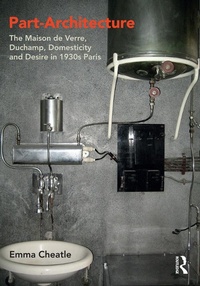
Part-Architecture
The Maison de Verre, Duchamp, Domesticity and Desire in 1930s Paris
Published on 20. July 2017
256 pages
978-1-317-08403-7 (ISBN)
Description

Part-Architecture presents a detailed and original study of Pierre Chareau's Maison de Verre through another seminal modernist artwork, Marcel Duchamp's Large Glass. Aligning the two works materially, historically and conceptually, the book challenges the accepted architectural descriptions of the Maison de Verre, makes original spatial and social accounts of its inhabitation in 1930s Paris, and presents new architectural readings of the Large Glass. Through a rich analysis, which incorporates creative projects into history and theory research, the book establishes new ways of writing about architecture.
Designed for politically progressive gynaecologist Dr Jean Dalsace and his avant-garde wife, Annie Dalsace, the Maison de Verre combines a family home with a gynaecology clinic into a 'free-plan' layout. Screened only by glass walls, the presence of the clinic in the home suggests an untold dialogue on 1930s sexuality. The text explores the Maison de Verre through another radical glass construction, the Large Glass, where Duchamp's complex depiction of unconsummated sexual relations across the glass planes reveals his resistance to the marital conventions of 1920s Paris. This and other analyses of the Large Glass are used as a framework to examine the Maison de Verre as a register of the changing history of women's domestic and maternal choices, reclaiming the building as a piece of female social architectural history.
The process used to uncover and write the accounts in the book is termed 'part-architecture'. Derived from psychoanalytic theory, part-architecture fuses analytical, descriptive and creative processes, to produce a unique social and architectural critique. Identifying three essential materials to the Large Glass, the book has three main chapters: 'Glass', 'Dust' and 'Air'. Combining theory text, creative writing and drawing, each traces the history and meaning of the material and its contribution to the spaces and sexuality of the Large Glass and the Maison de Verre. As a whole, the book contributes important and unique spatial readings to existing scholarship and expands definitions of architectural design and history.
Designed for politically progressive gynaecologist Dr Jean Dalsace and his avant-garde wife, Annie Dalsace, the Maison de Verre combines a family home with a gynaecology clinic into a 'free-plan' layout. Screened only by glass walls, the presence of the clinic in the home suggests an untold dialogue on 1930s sexuality. The text explores the Maison de Verre through another radical glass construction, the Large Glass, where Duchamp's complex depiction of unconsummated sexual relations across the glass planes reveals his resistance to the marital conventions of 1920s Paris. This and other analyses of the Large Glass are used as a framework to examine the Maison de Verre as a register of the changing history of women's domestic and maternal choices, reclaiming the building as a piece of female social architectural history.
The process used to uncover and write the accounts in the book is termed 'part-architecture'. Derived from psychoanalytic theory, part-architecture fuses analytical, descriptive and creative processes, to produce a unique social and architectural critique. Identifying three essential materials to the Large Glass, the book has three main chapters: 'Glass', 'Dust' and 'Air'. Combining theory text, creative writing and drawing, each traces the history and meaning of the material and its contribution to the spaces and sexuality of the Large Glass and the Maison de Verre. As a whole, the book contributes important and unique spatial readings to existing scholarship and expands definitions of architectural design and history.
Reviews / Votes
Emma Cheatle's inspiring book is a must-read for any historian of twentieth-century modernism. Drawing on a vast range of materials, Cheatle argues that Marcel Duchamp's Large Glass (1923) and Pierre Chareau's Maison de Verre (1932) are two key representations of early twentieth century sexual culture that can productively be read against each other. The insistence that Maison de Verre be understood within the context of contemporary struggles over sexual and reproductive rights for women is a ground-breaking one. More broadly, Cheatle's concept of 'part-architecture' itself sets out a mode of working that can go beyond the limits of the textual record, using the building's materiality and creative sited practices to offer new interpretations and speculative insights for architectural history and design thinking.Barbara Penner, Bartlett School of Architecture, UCL
More details
Language
English
Place of publication
London
United Kingdom
Publishing group
Taylor & Francis Ltd
Target group
College/higher education
Product notice
Reflowable
Illustrations
8 Halftones, color; 88 Halftones, black and white
File size
23,03 MB
ISBN-13
978-1-317-08403-7 (9781317084037)
Copyright in bibliographic data and cover images is held by Nielsen Book Services Limited or by the publishers or by their respective licensors: all rights reserved.
Schweitzer Classification
Other editions
Additional editions
Book
02/2018
1st Edition
Routledge
€81.89
Shipment within 10-20 days
Book
08/2016
1st Edition
Routledge
€237.70
Shipment within 10-20 days
Person
Emma Cheatle is Postdoctoral Research Fellow at Newcastle University Humanities Research Institute and dissertation tutor at Bartlett School of Architecture, UCL.
Content
Prologue, 1. Introduction, Part I, 2. Histories: the Maison de Verre through the Large Glass, 3. Theories: part-object, part-architecture, Part II, 4. Glass, 5. Dust, 6. Air, Coda
