

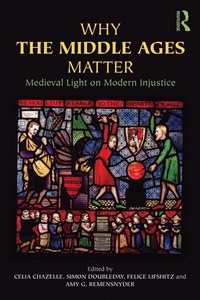
Why the Middle Ages Matter
Medieval Light on Modern Injustice
1st Edition
Published on 20. February 2012
224 pages
978-1-136-63647-9 (ISBN)
Description

The word "medieval" is often used in a negative way when talking about contemporary issues. Why the Middle Ages Matter refreshes our thinking about this historical era, and our own, by looking at some pressing concerns from today's world, asking how these issues were really handled in the medieval period, and showing why the past matters now. The contributors here cover topics such as torture, marriage, sexuality, imprisonment, refugees, poverty, work, the status of women, disability, race, political leadership and end of life care. They focus on a variety of regions, from North Africa and the Middle East, through Western and Central Europe, to the British Isles.
This collection challenges many negative stereotypes of medieval people, revealing a world from which, for instance, much could be learned about looking after the spiritual needs of the dying, and about integrating prisoners into the wider community through an emphasis on reconciliation between victim and criminal. It represents a new level of engagement with issues of social justice by medievalists and provides a highly engaging way into studying the middle ages. All the essays are written so as to be accessible to students, and each is accompanied by a list of further readings.
This collection challenges many negative stereotypes of medieval people, revealing a world from which, for instance, much could be learned about looking after the spiritual needs of the dying, and about integrating prisoners into the wider community through an emphasis on reconciliation between victim and criminal. It represents a new level of engagement with issues of social justice by medievalists and provides a highly engaging way into studying the middle ages. All the essays are written so as to be accessible to students, and each is accompanied by a list of further readings.
Reviews / Votes
The "lessons of history" cannot be reduced to some specious argument that knowledge of the past provides a privileged insight into the present. Nevertheless these essays show that a deep understanding of the otherness of the medieval past and of the myriad possibilities of belief, thought, and behavior of this distant and yet creative period, can help us to understand both how the medieval past has shaped our present as well as how this same past offers models for thinking and acting differently. One need not agree with all of the authors represented in this volume either in their reading of the Middle Ages or in their recommendations for the present in order to applaud them for being what everyone should be: a thoughtful, engaged and critical participant in the great adventure of life. These learned and committed essays challenge the notion that the deep past is somehow irrelevant to the present and compel contemporary society to recognize that the human condition is essentially historical and that dialogue with the past is a necessity to build a different and better future. Patrick J. Geary Distinguished Professor of History UCLA"Recommended. All levels/libraries." - CHOICE, K. F. Drew, Rice University, USA
"...Why the Middle Ages...show[s] how even the distant medieval past can be made relevant to the present through a sensitive integration of modern concerns with considered historical analysis. It offers a provocative starting point for those medieval historians who wish to engage in self-reflection or who are considering begging an ethical turn of their own." -Yvonne Seale, Hortulus Journal
More details
Language
English
Place of publication
London
United Kingdom
Publishing group
Taylor & Francis Ltd
Target group
College/higher education
Product notice
Reflowable
File size
1,94 MB
ISBN-13
978-1-136-63647-9 (9781136636479)
Copyright in bibliographic data and cover images is held by Nielsen Book Services Limited or by the publishers or by their respective licensors: all rights reserved.
Schweitzer Classification
Other editions
Additional editions
Celia Chazelle | Simon Doubleday | Felice Lifshitz
Why the Middle Ages Matter
Medieval Light on Modern Injustice
Book
09/2011
1st Edition
Routledge
€206.30
Shipment within 15-20 days
Celia Chazelle | Simon Doubleday | Felice Lifshitz
Why the Middle Ages Matter
Medieval Light on Modern Injustice
Book
09/2011
1st Edition
Routledge
€69.20
Shipment within 15-20 days
Persons
Chazelle, Celia; Doubleday, Simon; Lifshitz, Felice; Remensnyder, Amy G.
Content
Introduction. 1. Crime and Punishment: Penalizing Without Prisons Celia Chazelle 2. Social Deviancy: a Medieval Approach Guy Geltner 3. End of Life: Listening to the Monks of Cluny Fred Paxton 4. Marriage: Medieval Couples and the Uses of Tradition Ruth Mazo Karras 5. Women: The Da Vinci Code and the Fabrication of Tradition Felice Lifshitz 6. Homosexuality: Augustine and the Christian Closet Mathew Kuefler 7. Sexual Scandal and the Clergy: a Medieval Blueprint for Disaster Dyan Elliott 8. Labor: Insights from a Medieval Monastery Martha Newman 9. Disability?: Perspectives on Bodily Difference from the Middle East Kristina Richardson 10. Race: What the Bookstore Hid Maghan Keita 11. Refugees: Views from Thirteenth-Century France Megan Cassidy-Welch 12. Torture and Truth: Torquemada's Ghost Amy Remensnyder 13. Class Justice: Why we need a Wat Tyler Day Peter Linebaugh 14. Leadership: Why we have Mirrors for Princes but none for Presidents Geoff Koziol
