

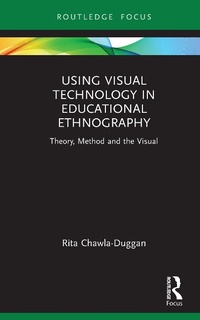
Using Visual Technology in Educational Ethnography
Theory, Method and the Visual
1st Edition
Published on 19. June 2024
160 pages
978-1-040-00071-7 (ISBN)
Description

Introducing readers to debates underpinning the uses of visual technology in educational ethnography, this book takes actual research projects across different country contexts to discuss how research designs can use visual technology in educational ethnography; to show connections between theory, method and research problems.
The book begins by introducing readers to three epistemological positions underpinning the use of visual technology in social science and educational research: the scientific realist, reflexive, and dialectic. It illustrates the uses of visual technology in the form of digital film and photographs, and how as a source of data, it has potential in developing ethnographic knowledge and representation in a range of educational contexts. The ideas are illustrated through three research projects in the context of classrooms, home environments and intervention work with practitioners. With clear practical applications, this resource considers the part theory plays in research designs, which use visual technology to investigate educational problems.
Using Visual Technology in Educational Ethnography is ideal reading for anyone seeking to learn more about the benefits and practicalities of using visual technology within their ethnographic practice.
The book begins by introducing readers to three epistemological positions underpinning the use of visual technology in social science and educational research: the scientific realist, reflexive, and dialectic. It illustrates the uses of visual technology in the form of digital film and photographs, and how as a source of data, it has potential in developing ethnographic knowledge and representation in a range of educational contexts. The ideas are illustrated through three research projects in the context of classrooms, home environments and intervention work with practitioners. With clear practical applications, this resource considers the part theory plays in research designs, which use visual technology to investigate educational problems.
Using Visual Technology in Educational Ethnography is ideal reading for anyone seeking to learn more about the benefits and practicalities of using visual technology within their ethnographic practice.
More details
Series
Edition
1. Auflage
Language
English
Place of publication
London
United Kingdom
Publishing group
Taylor & Francis Ltd
Target group
College/higher education
Illustrations
3 Tables, black and white; 3 Line drawings, black and white; 60 Halftones, black and white; 63 Illustrations, black and white
ISBN-13
978-1-040-00071-7 (9781040000717)
Copyright in bibliographic data and cover images is held by Nielsen Book Services Limited or by the publishers or by their respective licensors: all rights reserved.
Schweitzer Classification
Other editions
Additional editions
Book
10/2025
1st Edition
Routledge
€31.60
Shipment within 10-20 days
Book
06/2024
1st Edition
Routledge
€74.90
Shipment within 15-20 days
Person
Rita Chawla-Duggan is an Associate Professor in Education at the University of Bath, UK.
Content
1. Introduction
2. Visual Technology for Educational Ethnography: Possibilities, positions, and potential
3. Visual Technology and Invisible Pedagogy: Using film and photography to analyse Pedagogic Culture
4. Video, Post Developmental Methodologies and Agency
5. Visual Representations in Interventionist Methodology: Seeing is thinking in the Change Laboratory
6. Conclusion
7. Appendix I
2. Visual Technology for Educational Ethnography: Possibilities, positions, and potential
3. Visual Technology and Invisible Pedagogy: Using film and photography to analyse Pedagogic Culture
4. Video, Post Developmental Methodologies and Agency
5. Visual Representations in Interventionist Methodology: Seeing is thinking in the Change Laboratory
6. Conclusion
7. Appendix I
