

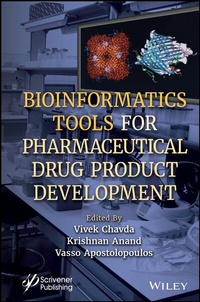
Bioinformatics Tools for Pharmaceutical Drug Product Development
Description

A timely book that details bioinformatics tools, artificial intelligence, machine learning, computational methods, protein interactions, peptide-based drug design, and omics technologies, for drug development in the pharmaceutical and medical sciences industries.
The book contains 17 chapters categorized into 3 sections. The first section presents the latest information on bioinformatics tools, artificial intelligence, machine learning, computational methods, protein interactions, peptide-based drug design, and omics technologies. The following 2 sections include bioinformatics tools for the pharmaceutical sector and the healthcare sector. Bioinformatics brings a new era in research to accelerate drug target and vaccine design development, improving validation approaches as well as facilitating and identifying side effects and predicting drug resistance. As such, this will aid in more successful drug candidates from discovery to clinical trials to the market, and most importantly make it a more cost-effective process overall.
Readers will find in this book:
* Applications of bioinformatics tools for pharmaceutical drug product development like process development, pre-clinical development, clinical development, commercialization of the product, etc.;
* The ever-expanding application of this novel technology and discusses some of the unique challenges associated with such an approach;
* The broad and deep background, as well as updates, on recent advances in both medicine and AI/ML that enable the application of these cutting-edge bioinformatics tools.
Audience
The book will be used by researchers and scientists in academia and industry including drug developers, computational biochemists, bioinformaticians, immunologists, pharmaceutical and medical sciences, as well as those in artificial intelligence and machine learning.
More details
Other editions
Additional editions
Persons
Vivek Chavda, M. Pharm, is an assistant professor in the Department of Pharmaceutics and Pharmaceutical Technology, L. M. College of Pharmacy, Ahmedabad, India. He has more than 40 research articles in international journals.
Krishnan Anand, PhD, is a research scientist in the Department of Chemical Pathology, University of the Free State, Bloemfontein, South Africa. He has more than 40 research articles in international journals and his research interests are in organic chemistry, medicinal chemistry, chemical pathology, bioinformatics, and nanotechnology.
Vasso Apostolopoulos, PhD, is at the Institute for Health and Sport, Immunology and Translational Research Group, Victoria University, Melbourne, Australia. She received her PhD in immunology in 1995 from the University of Melbourne, and the Advanced Certificate in Protein Crystallography from Birkbeck College, University of London. Professor Vasso Apostolopoulos is a world-renowned researcher who has been recognized with over 100 awards for the outstanding results of her research and she was named one of the most successful Greeks abroad by the prestigious Times magazine. Vasso was the first in the world to develop the concept of immunotherapy for cancer in the early 1990s, which today is used by hundreds of labs around the world. Immunotherapy aims to boost specific immune cells and program them to kill cancer cells; it was used by Vasso to develop the world's first breast cancer vaccine with phase I, II, and III clinical trials completed. Of note, one of the studies now has long-term follow-up data showing that 20 years later those injected with the vaccine remain cancer free.
Content
Preface xv
Part I: Bioinformatics Tools 1
1 Introduction to Bioinformatics, AI, and ml for Pharmaceuticals 3
Vivek P. Chavda, Disha Vihol, Aayushi Patel, Elrashdy M. Redwan and Vladimir N. Uversky
1.1 Introduction 4
1.2 Bioinformatics 4
1.2.1 Limitations of Bioinformatics 8
1.2.2 Artificial Intelligence (AI) 8
1.3 Machine Learning (ML) 11
1.3.1 Applications of ml 12
1.3.2 Limitations of ml 14
1.4 Conclusion and Future Prospects 14
References 15
2 Artificial Intelligence and Machine Learning-Based New Drug Discovery Process with Molecular Modelling 19
Isha Rani, Kavita Munjal, Rajeev K. Singla and Rupesh K. Gautam
2.1 Introduction 20
2.2 Artificial Intelligence in Drug Discovery 21
2.2.1 Training Dataset Used in Medicinal Chemistry 22
2.2.2 Availability and Quality of Initial Data 23
2.3 AI in Virtual Screening 24
2.4 AI for De Novo Design 25
2.5 AI for Synthesis Planning 26
2.6 AI in Quality Control and Quality Assurance 27
2.7 AI-Based Advanced Applications 28
2.7.1 Micro/Nanorobot Targeted Drug Delivery System 28
2.7.2 AI in Nanomedicine 29
2.7.3 Role of AI in Market Prediction 29
2.8 Discussion and Future Perspectives 30
2.9 Conclusion 31
References 31
3 Role of Bioinformatics in Peptide-Based Drug Design and Its Serum Stability 37
Vivek Chavda, Prashant Kshirsagar and Nildip Chauhan
3.1 Introduction 37
3.2 Points to be considered for Peptide-Based Delivery 38
3.3 Overview of Peptide-Based Drug Delivery System 40
3.4 Tools for Screening of Peptide Drug Candidate 41
3.5 Various Strategies to Increase Serum Stability of Peptide 42
3.5.1 Cyclization of Peptide 42
3.5.2 Incorporation of D Form of Amino Acid 44
3.5.3 Terminal Modification 44
3.5.4 Substitution of Amino Acid Which is Not Natural 46
3.5.5 Stapled Peptides 46
3.5.6 Synthesis of Stapled Peptides 47
3.6 Method/Tools for Serum Stability Evaluation 47
3.7 Conclusion 48
3.8 Future Prospects 49
References 49
4 Data Analytics and Data Visualization for the Pharmaceutical Industry 55
Shalin Parikh, Ravi Patel, Dignesh Khunt, Vivek P. Chavda and Lalitkumar Vora
4.1 Introduction 56
4.2 Data Analytics 57
4.3 Data Visualization 58
4.4 Data Analytics and Data Visualization for Formulation Development 60
4.5 Data Analytics and Data Visualization for Drug Product Development 65
4.6 Data Analytics and Data Visualization for Drug Product Life Cycle Management 69
4.7 Conclusion and Future Prospects 71
References 72
5 Mass Spectrometry, Protein Interaction and Amalgamation of Bioinformatics 77
Vivek Chavda, Kaustubh Dange and Madhav Joglekar
5.1 Introduction 77
5.2 Mass Spectrometry - Protein Interaction 79
5.2.1 The Prerequisites 80
5.2.2 Finding Affinity Partner (The Bait) 80
5.2.3 Antibody-Based Affinity Tags 80
5.2.4 Small Molecule Ligands 80
5.2.5 Fusion Protein-Based Affinity Tags 81
5.3 MS Analysis 81
5.4 Validating Specific Interactions 82
5.5 Mass Spectrometry - Qualitative and Quantitative Analysis 83
5.6 Challenges Associated with Mass Analysis 83
5.7 Relative vs. Absolute Quantification 85
5.8 Mass Spectrometry - Lipidomics and Metabolomics 86
5.9 Mass Spectrometry - Drug Discovery 87
5.10 Conclusion and Future Scope 88
5.11 Resources and Software 89
Acknowledgement 89
References 89
6 Applications of Bioinformatics Tools in Medicinal Biology and Biotechnology 95
Harshil Shah, Vivek Chavda and Moinuddin M. Soniwala
6.1 Introduction 96
6.2 Bioinformatics Tools 97
6.3 The Genetic Basis of Diseases 97
6.4 Proteomics 98
6.5 Transcriptomic 100
6.6 Cancer 101
6.7 Diagnosis 102
6.8 Drug Discovery and Testing 103
6.9 Molecular Medicines 105
6.10 Personalized (Precision) Medicines 106
6.11 Vaccine Development and Drug Discovery in Infectious Diseases and COVID-19 Pandemic 108
6.12 Prognosis of Ailments 109
6.13 Concluding Remarks and Future Prospects 110
Acknowledgement 111
References 111
7 Clinical Applications of "Omics" Technology as a Bioinformatic Tool 117
Vivek Chavda, Rajashri Bezbaruah, Disha Valu, Sanjay Desai, Nildip Chauhan, Swati Marwadi, Gitima Deka and Zhiyong Ding
Abbreviations 118
7.1 Introduction 118
7.2 Execution Method 119
7.3 Overview of Omics Technology 121
7.4 Genomics 124
7.5 Nutrigenomics 127
7.6 Transcriptomics 128
7.7 Proteomics 129
7.8 Metabolomics 130
7.9 Lipomics or Lipidomics 133
7.10 Ayurgenomics 134
7.11 Pharmacogenomics 134
7.12 Toxicogenomic 135
7.13 Conclusion and Future Prospects 139
Acknowledgement 139
References 139
Part II: Bioinformatics Tools for Pharmaceutical Sector 147
8 Bioinformatics and Cheminformatics Tools in Early Drug Discovery 149
Palak K. Parikh, Jignasa K. Savjani, Anuradha K. Gajjar and Mahesh T. Chhabria
Abbreviations 150
8.1 Introduction 151
8.2 Informatics and Drug Discovery 152
8.3 Computational Methods in Drug Discovery 153
8.3.1 Homology Modeling 153
8.3.2 Docking Studies 155
8.3.3 Molecular Dynamics Simulations 158
8.3.4 De Novo Drug Design 159
8.3.5 Quantitative Structure Activity Relationships 160
8.3.6 Pharmacophore Modeling 161
8.3.7 Absorption, Distribution, Metabolism, Excretion and Toxicity Profiling 165
8.4 Conclusion 168
References 169
9 Artificial Intelligence and Machine Learning-Based Formulation and Process Development for Drug Products 183
Vivek P. Chavda
9.1 Introduction 184
9.2 Current Scenario in Pharma Industry and Quality by Design (QbD) 185
9.3 AI- and ML-Based Formulation Development 187
9.4 AI- and ML-Based Process Development and Process Characterization 189
9.5 Concluding Remarks and Future Prospects 192
References 193
10 Artificial Intelligence and Machine Learning-Based Manufacturing and Drug Product Marketing 197
Kajal Baviskar, Anjali Bedse, Shilpa Raut and Narayana Darapaneni
Abbreviations 198
10.1 Introduction to Artificial Intelligence and Machine Learning 199
10.1.1 AI and ML in Pharmaceutical Manufacturing 200
10.1.2 AI and ML in Drug Product Marketing 201
10.2 Different Applications of AI and ML in the Pharma Field 202
10.2.1 Drug Discovery 202
10.2.2 Pharmaceutical Product Development 202
10.2.3 Clinical Trial Design 203
10.2.4 Manufacturing of Drugs 203
10.2.5 Quality Control and Quality Assurance 203
10.2.6 Product Management 203
10.2.7 Drug Prescription 204
10.2.8 Medical Diagnosis 204
10.2.9 Monitoring of Patients 204
10.2.10 Drug Synergism and Antagonism Prediction 204
10.2.11 Precision Medicine 205
10.3 AI and ML-Based Manufacturing 205
10.3.1 Continuous Manufacturing 205
10.3.2 Process Improvement and Fault Detection 209
10.3.3 Predictive Maintenance (PdM) 210
10.3.4 Quality Control and Yield 211
10.3.5 Troubleshooting 211
10.3.6 Supply Chain Management 212
10.3.7 Warehouse Management 213
10.3.8 Predicting Remaining Useful Life 214
10.3.9 Challenges 215
10.4 AI and ML-Based Drug Product Marketing 217
10.4.1 Product Launch 217
10.4.2 Real-Time Personalization and Consumer Behavior 218
10.4.3 Better Customer Relationships 219
10.4.4 Enhanced Marketing Measurement 220
10.4.5 Predictive Marketing Analytics 220
10.4.6 Price Dynamics 221
10.4.7 Market Segmentation 222
10.4.8 Challenges 223
10.5 Future Prospects and Way Forward 223
10.6 Conclusion 224
References 225
11 Artificial Intelligence and Machine Learning Applications in Vaccine Development 233
Ali Sarmadi, Majid Hassanzadeganroudsari and M. Soltani
11.1 Introduction 234
11.2 Prioritizing Proteins as Vaccine Candidates 237
11.3 Predicting Binding Scores of Candidate Proteins 238
11.4 Predicting Potential Epitopes 243
11.5 Design of Multi-Epitope Vaccine 244
11.6 Tracking the RNA Mutations of a Virus 245
Conclusion 248
References 249
12 AI, ML and Other Bioinformatics Tools for Preclinical and Clinical Development of Drug Products 255
Avinash Khadela, Sagar Popat, Jinal Ajabiya, Disha Valu, Shrinivas Savale and Vivek P. Chavda
Abbreviations 256
12.1 Introduction 257
12.2 AI and ML for Pandemic 258
12.3 Advanced Analytical Tools Used in Preclinical and Clinical Development 259
12.3.1 Spectroscopic Techniques 260
12.3.2 Chromatographic Techniques 263
12.3.3 Electrochemical Techniques 263
12.3.4 Electrophoretic Techniques 264
12.3.5 Hyphenated Techniques 264
12.4 AI, ML, and Other Bioinformatics Tools for Preclinical Development of Drug Products 265
12.4.1 Various Computational Tools Used in Pre-Clinical Drug Development 266
12.5 AI, ML, and Other Bioinformatics Tools for Clinical Development of Drug Products 268
12.5.1 Role of AI, ML, and Bioinformatics in Clinical Research 270
12.5.2 Role of AI and ML in Clinical Study Protocol Optimization 272
12.5.3 Role of AI and ML in the Management of Clinical Trial Participants 272
12.5.4 Role of AI and ML in Clinical Trial Data Collection and Management 272
12.6 Way Forward 275
12.7 Conclusion 276
References 277
Part III: Bioinformatics Tools for Healthcare Sector 285
13 Artificial Intelligence and Machine Learning in Healthcare Sector 287
Vivek P. Chavda, Kaushika Patel, Sachin Patel and Vasso Apostolopoulos
Abbreviations 288
13.1 Introduction 288
13.2 The Exponential Rise of AI/ML Solutions in Healthcare 289
13.3 AI/ML Healthcare Solutions for Doctors 291
13.4 AI/ML Solution for Patients 293
13.5 AI Solutions for Administrators 295
13.6 Factors Affecting the AI/ML Implementation in the Healthcare Sector 297
13.6.1 High Cost 297
13.6.2 Lack of Creativity 298
13.6.3 Errors Potentially Harming Patients 298
13.6.4 Privacy Issues 298
13.6.5 Increase in Unemployment 299
13.6.6 Lack of Ethics 299
13.6.7 Promotes a Less-Effort Culture Among Human Workers 299
13.7 AI/ML Based Healthcare Start-Ups 299
13.8 Opportunities and Risks for Future 304
13.8.1 Patient Mobility Monitoring 305
13.8.2 Clinical Trials for Drug Development 305
13.8.3 Quality of Electronic Health Records (EHR) 305
13.8.4 Robot-Assisted Surgery 305
13.9 Conclusion and Perspectives 306
References 307
14 Role of Artificial Intelligence in Machine Learning for Diagnosis and Radiotherapy 315
Sanket Chintawar, Vaishnavi Gattani, Shivanee Vyas and Shilpa Dawre
Abbreviations 316
14.1 Introduction 317
14.2 Machine Learning Algorithm Models 318
14.2.1 Supervised Learning 318
14.2.2 Unsupervised Learning 319
14.2.3 Semi-Supervised Learning 319
14.2.4 Reinforcement Learning (RL) 320
14.3 Artificial Learning in Radiology 321
14.3.1 Types of Radiation Therapy 321
14.3.1.1 External Radiation Therapy 322
14.3.1.2 Internal Radiation Therapy 323
14.3.1.3 Systemic Radiation Therapy 323
14.3.2 Mechanism of Action 323
14.4 Application of Artificial Intelligence and Machine Learning in Radiotherapy 324
14.4.1 Delineation of the Target 324
14.4.2 Radiotherapy Delivery 325
14.4.3 Image Guided Radiotherapy 327
14.5 Implementation of Machine Learning Algorithms in Radiotherapy 328
14.5.1 Image Segmentation 328
14.5.2 Medical Image Registration 329
14.5.3 Computer-Aided Detection (CAD) and Diagnosis System 329
14.6 Deep Learning Models 331
14.6.1 Deep Neural Networks 331
14.6.2 Convolutional Neural Networks 332
14.7 Clinical Implementation of AI in Radiotherapy 332
14.8 Current Challenges and Future Directions 339
References 339
15 Role of AI and ML in Epidemics and Pandemics 345
Rajashri Bezbaruah, Mainak Ghosh, Shuby Kumari, Lawandashisha Nongrang, Sheikh Rezzak Ali, Monali Lahiri, Hasmi Waris and Bibhuti Bhushan Kakoti
15.1 Introduction 346
15.2 History of Artificial Intelligence (AI) in Medicine 347
15.3 AI and MI Usage in Pandemic and Epidemic (COVID-19) 348
15.3.1 SARS-CoV-2 Detection and Therapy Using Machine Learning and Artificial Intelligence 349
15.3.2 SARS-Cov-2 Contact Tracing Using Machine Learning and Artificial Intelligence 350
15.3.3 SARS-CoV-2 Prediction and Forecasting Using Machine Learning and Artificial Intelligence 350
15.3.4 SARS-CoV-2 Medicines and Vaccine Using Machine Learning and Artificial Intelligence 350
15.4 Cost Optimization for Research and Development Using Al and ml 351
15.5 AI and ML in COVID 19 Vaccine Development 352
15.6 Efficacy of AI and ML in Vaccine Development 357
15.7 Artificial Intelligence and Machine Learning in Vaccine Development: Clinical Trials During an Epidemic and Pandemic 358
15.8 Clinical Trials During an Epidemic 360
15.8.1 Ebola Virus 360
15.8.2 SARS-CoV- 2 361
15.9 Conclusion 361
References 362
16 AI and ML for Development of Cell and Gene Therapy for Personalized Treatment 371
Susmit Mhatre, Somanshi Shukla, Vivek P. Chavda, Lakshmikanth Gandikota and Vandana Patravale
16.1 Fundamentals of Cell Therapy 372
16.1.1 Stem Cell Therapies 374
16.1.1.1 Mesenchymal Stem Cells (MSCs) 375
16.1.1.2 Hematopoietic Stem Cells (HSCs) 375
16.1.1.3 Mononuclear Cells (MNCs) 375
16.1.1.4 Endothelial Progenitor Cells (EPCs) 375
16.1.1.5 Neural Stem Cells (NSCs) or Neural Progenitor Cells (NPCs) 376
16.1.2 Adoptive Cell Therapy 376
16.1.2.1 Tumor-Infiltrating Lymphocyte (TIL) Therapy 376
16.1.2.2 Engineered T-Cell Receptor (TCR) Therapy 377
16.1.2.3 Chimeric Antigen Receptor (CAR) T Cell Therapy 377
16.1.2.4 Natural Killer (NK) Cell Therapy 377
16.2 Fundamentals of Gene Therapy 378
16.2.1 Identification 378
16.2.2 Treatment 379
16.3 Personalized Cell Therapy 381
16.4 Manufacturing of Cell and Gene-Based Therapies 382
16.5 Development of an Omics Profile 385
16.6 ml in Stem Cell Identification, Differentiation, and Characterization 387
16.7 Machine Learning in Gene Expression Imaging 389
16.8 AI in Gene Therapy Target and Potency Prediction 390
16.9 Conclusion and Future Prospective 391
References 392
17 Future Prospects and Challenges in the Implementation of AI and ML in Pharma Sector 401
Prashant Pokhriyal, Vivek P. Chavda and Mili Pathak
17.1 Current Scenario 402
17.2 Way Forward 406
References 407
Index 417
1
Introduction to Bioinformatics, AI, and ML for Pharmaceuticals
Vivek P. Chavda1*, Disha Vihol2, Aayushi Patel3, Elrashdy M. Redwan4,5 and Vladimir N. Uversky6┼
1Department of Pharmaceutics and Pharmaceutical Technology, L. M. College of Pharmacy, Ahmedabad, Gujarat, India
2Department of Phytopharmacy and Phytomedicine, School of Pharmacy, Gujarat Technological University, Ahmedabad, Gujarat, India
3Pharmacy Section, L. M. College of Pharmacy, Ahmedabad, Gujarat, India
4Department of Biological Sciences, Faculty of Sciences, King Abdulaziz University, Jeddah, Saudi Arabia
5Therapeutic and Protective Proteins Laboratory, Protein Research Department, Genetic Engineering and Biotechnology Research Institute, City of Scientific Research and Technological Applications, New Borg EL-Arab, Alexandria, Egypt
6Department of Molecular Medicine and Byrd Alzheimer's Research Institute, Morsani College of Medicine, University of South Florida, Tampa, FL, USA
Abstract
Bioinformatics is a growing field that has emerged in recent years. The use of computational applications for protein sequence analysis in the early 1960s created the groundwork for bioinformatics. Alongside, developments in molecular biology techs evolved DNA analysis, leading to simpler manipulation of DNA, its sequencing, and computer science, suggesting the development of compatible and more powerful computers with innovative software for performing bioinformatics tasks. Biological Big Data collection when analyzed with bioinformatics tools leads to powerful predictive results with repeatability. Due to advancements in the merging of computer science and biology, even subdisciplines like synthetic biology, systems biology, and whole-cell modeling are emerging rapidly.
Keywords: Bioinformatics, artificial intelligence, machine learning, AI/ML, pharmaceuticals, drug product development
1.1 Introduction
In the context of Artificial Intelligence (AI), Machine Learning (ML), and Big Data, the healthcare industry explores the medication research process, evaluating how emerging technologies can enhance efficacy [1]. Artificial intelligence and machine learning are seen as the way of the future in a variety of fields and sectors, including pharmaceuticals. In a world, where a single authorized medicine costs millions of dollars and requires years of rigorous testing before being licensed, saving money and time is a priority.
Producing new pharmacological compounds to combat any disease is an expensive and time-consuming procedure, yet it goes unchecked. The most important aspect of drug design is to take advantage of the collected data and seek fresh and unique leads. Once the medication target has been determined, numerous multidisciplinary domains collaborate to develop enhanced pharmaceuticals using AI and ML technologies [2]. These technologies are utilized at every phase of the computer-aided drug discovery process, and combining them results in a proven track record of success in finding hit molecules. Furthermore, the fusion of AI and ML with high-dimension data enhanced the capabilities of computer-aided drug discovery and design [3]. Clinical trial output prediction using AI/ML integrated models might decrease the costs of the clinical trial, while simultaneously increasing their success rates. In this study, we will be covering the potential of AI and ML technologies in enabling computer-aided drug creation, along with challenges and opportunities for the pharmaceutical sector.
1.2 Bioinformatics
When biological data along with genetic information is analyzed using computer technology for calculating and obtaining mathematically and statistically approved results, is called Bioinformatics. The computational means are utilized for addressing data-intensive, large-scale biological challenges [4]. It includes the development and application of databases, algorithms, computational and statistical tools, and theory to tackle formal and practical issues emerging from biological data administration and analysis [5, 6].
Bioinformatics allows rapid molecular modeling of biological processes from the collected big data for obtaining meaningful conclusions through various stages such as compilation of the statistical information from biological data, creation of a computational model, the resolution of computational modeling issues, and the assessment of the resulting computational algorithm [7]. Genomics and proteomics are the branches of bioinformatics that aim at understanding the organizing principles encoded inside the nucleic acid and protein sequences, respectively. Image and signal processing enables usable conclusions to be extracted from vast volumes of raw data [5]. It helps in decoding genetics by facilitating text mining of biological literature, comparing, analyzing, and interpreting genetic, genomic, and proteomic data, assessing gene and protein expression, detecting mutations, sequencing and annotating genomes, and interpreting evolutionary aspects with disease pathways [8, 9]. Moreover, it helps to simulate and model DNA, RNA, proteins, and biomolecular interactions in structural biology. All of these can be achieved by correlating the biological data for understanding the effect of the diseased condition on the body's normal cellular functions [10]. Hence, bioinformatics has progressed now to the point, where analysis and interpretation of diverse forms of data is the most important challenge.
Omics technologies offer a chance to investigate changes in DNA, RNA, proteins, and other biological components across intraspecies and interspecies. The analysis of these components is interesting from a toxicity assessment view as they can alter in response to chemical or drug exposure in cells or tissues. Genomic research, which generates enormous amounts of data, is one area, where bioinformatics is very valuable. Bioinformatics aids in the interpretation of data, which may then be used to provide a diagnosis for a patient suffering from a rare ailment, track and monitor infectious organisms as they spread across a community, or determine the best therapy for a cancer patient [11]. Genomics sequences assemble and analyze the structure and function of genomes using recombinant DNA, DNA sequencing technologies, and bioinformatics. Various software used in bioinformatics includes accessibility of protein surface and secondary structure predictions using NetSurfP, prediction of beta-turn sites in protein sequences using NetTurnP, and AutoDock for Automated Docking Tool Suite [4].
Rapid advances in genomics and other molecular research tools, along with advances in information technology, have resulted in a massive volume of molecular biology knowledge during the last few decades [12]. Bioinformatics will continue to advance as a result of the integration of many technologies and techniques that bring together professionals from other domains to build cutting-edge computational and informational tools tailored to the biomedical research business [4, 9]. Table 1.1. represents various bioinformatics and AI-driven tools, which can be applied in the pharmacy department and industry.
Table 1.1 Various bioinformatics and AI-driven tools applied in the pharmacy department and industry.
Computational tools Application Reference BLAST The Basic Local Alignment Search Tool (BLAST) is used for searching local similarity regions between sequences and compares to the available database for calculating the statistical significance of matches. The matching infers functional and evolutionary relationships between sequences and identifies genetically related families. [15] ChEMBL ChEMBL is designed manually to maintain a database of bioactive molecules. It correlates genomic data with chemical structure and bioactivity for the development of new drugs. [16] geWorkbench The genomics Workbench (geWorkbench) comprises the tools for performing management, analysis, visualization, and annotation of biomedical data. It supports data for microarray gene expression, DNA and Protein Sequences, pathways, Molecular structure - prediction, Sequence Patterns, Gene Ontology, and Regulatory Networks [11] GROMACS It is software for high-performance molecular dynamics and output analysis, especially for proteins and lipids. [7] IGV Integrative Genomics Viewer (IGV) is a high-performance, user-friendly, interactive tool for the visualization and exploration of genomic data. [17] MODELLER A protein three-dimensional structural homology or comparative modeling tool. [18] SwissDrugDesign SwissDrugDesign provides a collection of tools required for Computer-Aided Drug Design (CADD). [19] UCSF Chimera UCSF Chimera is an interactive tool for the visualization and analysis of molecular structures. [20] AlphaFold It is an AI system developed to computationally predict protein structures with unprecedented accuracy and...